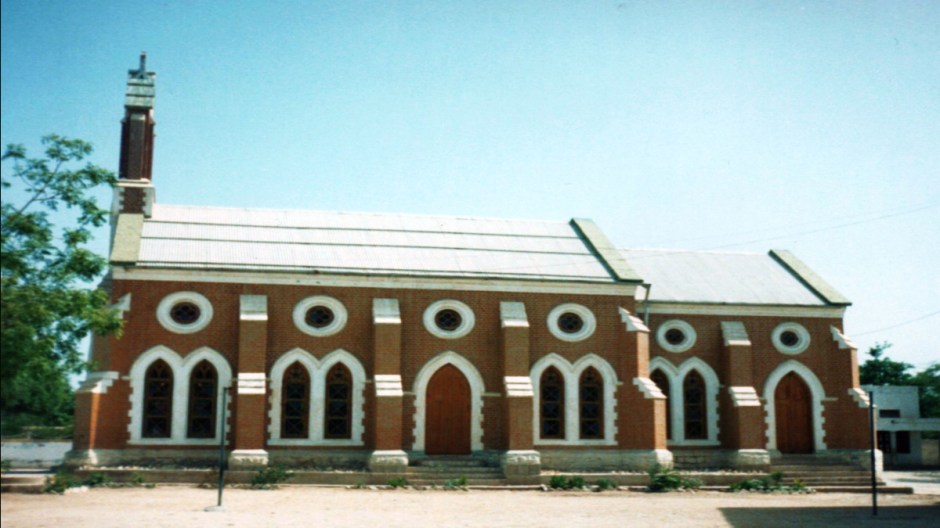
Christians in Pakistan: A Crisis of Persecution and Protection

(Photo credit: Francis Hannaway/ St. Mary’s Catholic Church, Sukkur, Pakistan, July 31, 1992. Creative Commons.)

WILLIAM DESJARDINS

Pakistan’s 4.5 million Christians and other religious minorities face an unprecedented crisis of persecution, systemic discrimination, and legal vulnerability that has reached alarming new heights in recent years. Ranked eighth on the Open Doors World Watch List, Pakistan represents one of the most dangerous places in the world to be a Christian, with minorities comprising less than 4% of the population yet bearing a disproportionate burden of violence and injustice.
At the heart of the persecution lies Pakistan’s controversial blasphemy laws, which carry the death penalty and have become weaponized tools of exploitation and intimidation. A groundbreaking confidential police report titled “The Blasphemy Business” has exposed the dark reality behind many blasphemy accusations: criminal networks systematically targeting young people for financial gain.

These sophisticated scams involve fake social media accounts that lure young men into conversations containing blasphemous content, creating elaborate traps that have ensnared over 450 victims since 2021, according to Pakistan’s Human Rights Commission. Once trapped, families face devastating choices—pay substantial bribes to police to drop charges or watch their loved ones face potential death sentences. Lawyers representing affected families have documented not only arrests and disappearances but also evidence of torture in police custody.

The blasphemy laws serve purposes far beyond their stated religious protection mandate. They have become instruments for land grabs, targeting business rivals, and criminal extortion. Though death sentences are rarely carried out, accusations frequently trigger mob violence and extrajudicial killings that claim lives with disturbing regularity.

A rare glimmer of hope emerged when Justice Ishaq Khan of Islamabad’s High Court ordered the government to investigate the abuse of blasphemy laws, prompted by the revealing police report. However, this hope was swiftly crushed by intense backlash from religious extremist groups. Members of the Tehreek-e-Labbaik Pakistan party publicly attacked the court ruling, while lawyers from the Jamiat Ulema-e-Islam party challenged the order in court. By July 24, Justice Khan’s order was suspended amid fears that hostility could turn violent.

This pattern reflects Pakistan’s troubled history with blasphemy law reform. Historically, any attempt to modify or investigate these laws has been quickly shut down by violent protests from radical Islamic groups, creating a climate where even judicial review becomes impossible.
The situation deteriorated dramatically in 2024, with the Centre for Social Justice reporting a record 344 new blasphemy cases—the highest number in Pakistan’s history. At least 10 individuals accused of blasphemy were extrajudicially killed by individuals or violent mobs during the same year, highlighting the deadly consequences of these accusations.

Christians bear a particularly heavy burden under this system. Despite comprising only 1.8% of Pakistan’s population, roughly a quarter of all blasphemy accusations target Christians. This disproportionate targeting reflects deeper systemic discrimination that permeates Pakistani society and institutions.

The human cost of this persecution becomes clear through individual cases. In June 2024, an elderly man was killed by mob violence after being accused of desecrating the Quran, demonstrating how quickly accusations can turn fatal. The case of Anwar Kenneth illustrates the system’s cruel inefficiency: the 72-year-old Christian spent 23 years on death row after being sentenced to death in 2002 for sending allegedly blasphemous letters. Only in June 2025 did Pakistan’s Supreme Court finally acquit him, ruling that “a person of unsound mind could not be held liable for such a crime.”

The Jaranwala incident in August 2023 exemplifies how blasphemy accusations can trigger community-wide violence. When Pervaiz Masih was accused of writing blasphemous content, violent riots erupted that destroyed at least 20 churches and forcibly displaced hundreds of Christians. On April 18, 2025, Masih was sentenced to death, but the damage to the Christian community had already been done.

Perhaps most troubling is the impact on minority children, as documented in a new report by Pakistan’s National Commission on the Rights of the Child (NCRC). The report, titled “Situation Analysis of Children from Minority Religions in Pakistan,” reveals severe challenges including forced conversion, child marriages, and child labor affecting minority children, particularly from Christian and Hindu communities.

Between April 2023 and December 2024, the NCRC received 27 complaints related to the oppression of minority children, including abduction, murder, forced conversion, and underage marriages. Punjab province, Pakistan’s most populous region, reported the highest number of violence cases against minority children (40%) from January 2022 to September 2024, with 547 Christian victims, 32 Hindus, two Ahmadis, two Sikhs, and 99 others.

The discrimination extends into Pakistan’s educational system, where minority children face multiple forms of marginalization. The Single National Curriculum mandates Islamic religious education with no alternatives for minority students to study their own faiths, effectively infringing on religious freedom and hindering academic progress. Minority students report feeling uncomfortable sharing their religious identities, viewing them as inferior markers that lead to mockery from majority-religion classmates and even encouragement to convert.

Economic exploitation compounds these educational challenges. Many minority households remain trapped in cycles of bonded labor, particularly in brick kilns and agriculture, where entire families, including children, work under cruel conditions. This economic vulnerability makes families more susceptible to various forms of exploitation and abuse.

Forced religious conversions and marriages of Christian and Hindu girls to older Muslim men persist as major human rights violations. Despite legal protections on paper, institutional biases, public pressure, and inadequate law enforcement allow these practices to continue unchecked. These forced conversions often serve to legitimize what would otherwise be recognized as kidnapping and sexual assault.

The persecution occurs within a constitutional framework that explicitly limits religious freedom. Pakistan’s constitution restricts the right to free speech to maintain “the glory of Islam,” creating a legal environment where minority rights are subordinated to religious considerations from the outset.

NCRC Chairperson Ayesha Raza Farooq, working in collaboration with UNICEF, emphasizes that millions of children continue to fall through protection gaps due to fragmented efforts, lack of coordination, and limited political will. The NCRC has urged the government to strengthen legal protections, expand social safety nets, create inclusive education policies, and adopt specific measures to counter child and bonded labor, as well as forced religious conversions.

NCRC Minorities Member Pirbhu Lal Satyani states bluntly that children from religious minorities are among the most marginalized in Pakistani society, facing stigma, stereotyping, and structural exclusion that begins in childhood and continues throughout their lives.

The police report exposing “The Blasphemy Business” has opened new territory in Pakistan’s debate over blasphemy laws, revealing uncomfortable truths for the political establishment about the country’s human rights crisis and the extreme vulnerability of its minorities. However, the swift suspension of judicial review attempts demonstrates the powerful forces aligned against reform.

For Pakistan’s minorities, particularly its 4.5 million Christians, each day brings fresh uncertainty. The combination of weaponized blasphemy laws, systematic discrimination, economic exploitation, and social marginalization creates an environment where basic human dignity remains elusive. Without significant political will to confront extremist groups and implement meaningful reforms, Pakistan’s minorities will continue to live under the shadow of persecution, their children growing up in a society that treats their very existence as somehow lesser and their faith as inherently suspect.
The international community watches as Pakistan struggles with this fundamental test of its commitment to human rights and religious freedom. The outcome will determine not only the fate of millions of vulnerable citizens but also Pakistan’s standing as a nation capable of protecting all its people, regardless of their faith.

True Worship: Freedom from Religious Rules

JEFF TURNER

Have you ever felt pressured to follow certain religious practices, like fasting or observing special days, as if they were required to be truly faithful? The Apostle Paul addressed this issue in his letter to the Colossians. He warned believers not to let anyone control their worship by enforcing rules about festivals, specific diets, or Sabbath observance.

In the Old Testament, only one fast was commanded, and the New Testament does not require fasting for the church. Jewish traditions, such as dietary laws and the observance of Sabbaths, were part of the ceremonial system given to Israel. However, these rituals were set aside after Christ’s resurrection. From that point, believers began gathering on the first day of the week rather than observing the Jewish Sabbath. Additionally, dietary restrictions were lifted—God’s instruction to Peter in Acts was clear: “Rise, kill, and eat.”

Christian worship is not about following external rituals but about the condition of the heart. Jesus emphasized this in John 4:23-24, where He explained that true worshippers honour God in spirit and truth. What matters most is sincere devotion to God, not adherence to man-made religious expectations

More from Bibleref.com

Misuse of Noble Pursuits

DAVID INGRAM

Throughout history, leaders have committed atrocities in the name of religion. However, this doesn’t necessarily mean that all religion is inherently evil. A parallel can be drawn with science, where unethical experiments like the Tuskegee syphilis study have been conducted in the pursuit of knowledge.

The issue lies not with religion or science themselves, but with flawed individuals who use these noble pursuits to justify their immoral actions. Often, it’s a lack of morality and an overwhelming desire for success that drives such wrongdoing.

It’s interesting that these individuals may not always be consciously deceiving others; they might be blind to their own malevolent actions.

Consider what is written in Proverbs 21:2, “Every way of a man is right in his own eyes, but the Lord weighs the heart.”

Pakistan Court Sentences Two for Blasphemy on WhatsApp

TEXAS GOSPEL STAFF

A court in Gujranwala, Pakistan, has issued severe punishments in a blasphemy case involving social media messages. A 22-year-old student received a death sentence, while a 17-year-old was given life imprisonment for sharing content deemed blasphemous through WhatsApp. The sentences were announced this week.

The case began when the Federal Investigation Agency (FIA) filed charges in Lahore based on a complaint. The plaintiff stated that he had received offensive videos and photos from three different mobile numbers. After examining the plaintiff’s phone, the FIA concluded that “obscene material” had been sent.

Initially handled by the Lahore High Court, the case was later transferred to a local court in Gujranwala for trial. An additional district and sessions judge delivered the verdicts. Defence lawyers contend that the accused students were “trapped in a false case”. However, details about the specific nature of the shared content or the defence’s evidence were not provided in the available information.

Pakistan’s blasphemy laws are among the strictest globally. They mandate capital punishment or life imprisonment for individuals found guilty of insulting Islam or the Prophet Mohammad. This applies to offences committed through spoken or written words, visual representations, or indirect insinuations.

It is worth noting that many blasphemy convictions in Pakistan are overturned on appeal in higher courts. However, the accused often face significant dangers even before their cases go to trial. There have been numerous instances of mob violence against individuals accused of blasphemy, with some being lynched before formal legal proceedings could take place.

The case highlights ongoing concerns about the application of blasphemy laws in Pakistan, particularly in relation to social media content. Human rights organizations have expressed worry about the potential for these laws to be misused or to infringe on freedom of expression. As this case progresses, it is likely to draw attention from both domestic and international observers, given the severity of the sentences and the young age of the accused.

Do Christians today heal the sick and raise the dead

Floyd Rogers – Texas Gospel Volunteer, Christian writer

Miracles of Healing Matthew 9:18-36 (NASB)

18 While He was saying these things to them, behold, a synagogue official came and bowed down before Him, and said, “My daughter has just died; but come and lay Your hand on her, and she will become alive again.” 19 Jesus got up from the table and began to accompany him, along with His disciples.

20 And behold, a woman who had been suffering from a hemorrhage for twelve years came up behind Him, and touched the border of His cloak; 21 for she was saying to herself, “If I only touch His cloak, I will get well.” 22 But Jesus, turning and seeing her, said, â€śDaughter, take courage; your faith has made you well.” And at once the woman was made well.

23 When Jesus came into the official’s house and saw the flute players and the crowd in noisy disorder, 24 He said, â€śLeave; for the girl has not died, but is asleep.” And they began laughing at Him. 25 But when the crowd had been sent out, He entered and took her by the hand, and the girl got up. 26 And this news spread throughout that land.

27 As Jesus went on from there, two men who were blind followed Him, crying out, “Have mercy on us, Son of David!” 28 And after He entered the house, the men who were blind came up to Him, and Jesus *said to them, â€śDo you believe that I am able to do this?” They *said to Him, “Yes, Lord.” 29 Then He touched their eyes, saying, â€śIt shall be done for you according to your faith.” 30 And their eyes were opened. And Jesus sternly warned them, saying, â€śSee that no one knows about this!” 31 But they went out and spread the news about Him throughout that land.

32 And as they were going out, behold, a demon-possessed man who was unable to speak was brought to Him. 33 And after the demon was cast out, the man who was previously unable to speak talked; and the crowds were amazed, and were saying, “Nothing like this has ever been seen in Israel.” 34 But the Pharisees were saying, “He casts out the demons by the ruler of the demons.”

35 Jesus was going through all the cities and villages, teaching in their synagogues and proclaiming the gospel of the kingdom, and healing every disease and every sickness.

36 Seeing the crowds, He felt compassion for them, because they were distressed and downcast, like sheep without a shepherd. 37 Then He said to His disciples, â€śThe harvest is plentiful, but the workers are few. 38 Therefore, plead with the Lord of the harvest to send out workers into His harvest.”

If someone were to ask me about the purpose of the Book of Matthew, I would tell them one of the important themes of the book is to show that Jesus is the Jewish Messiah.  Matthew 9:18-36 continues this theme as it records healings and other signs Jesus did that fulfill prophecy. So, let’s ask a few questions.  Do the apostles of Jesus, or anyone else heal, give sight to the blind or perform miracles? Are these things upon which a doctrine should be made? Perhaps we should ask if some preachers today present inferences about what Matthew and others had to say as if their inferences are scripture itself?  Let’s delve into my inference (which I do not claim are as important as scripture) along with the questions I’ve posed.

I believe Matthew’s theme is made clear by his repeated use of the phrase, “…to fulfill that which was spoken through the prophet.”  Matthew 9:18-36 records Jesus healing the sick and blind. This is in harmony with the theme of demonstrating Jesus as the Messiah because prophecy says a time will come when the blind will see and tongue of those who cannot speak will shout for joy. His acts of healing serve a purpose. They fulfill prophecy. I think scripture shows us these acts are for something beyond improving an individual’s health (not to make light of someone’s wellbeing.)  Matthew records healings to reveal the nature of Jesus.  This idea brings up a few questions. Did anyone other than Jesus and his apostles have the power to heal? Are healings, raising the dead and other miracles something we see today?

The first question is easy to answer.  Matthew tells us Jesus instructed his disciples to heal the sick. The Bible also tells us the Holy Spirit gave others the ability to do signs and wonders as well.  This is Biblical evidence that some use as they argue that such things happen today; that is, the idea that of someone other than Jesus healed then we must be able to do these things.  Many use the same line of logic as they point to Luke  where Jesus gave 70 others power to do miracles as evidence that all Christians have the power to heal. One could also point to Acts 6:8 where the Holy Spirit gave power to perform, “great wonders and signs.”  I do not contradict what is written in the scripture when I ask if these scriptures mean God is obligated to give this power to all Christians; meaning, each and every Christian and not just those to whom he is speaking to or speaking about. Some say yes and point to Mark’s account which tells us, “…these signs will accompany those who have believed…” This is perhaps the strongest evidence some people use to say any believer can do miracles.  So, that’s a summary of one side.  Let’s look at Biblical evidence that some say show this is a wrong inference. We’ll begin with three observations of these scriptures.

Jesus’ instructions to his disciples are limited to the number of disciples. I say this because Matthew 10:1-9 stipulates a specific number. Acts 6:8 stipulates a specific person performed wonders and signs. And Mark was speaking to the disciples about the people they would lead to Christ, and he also stipulated a purpose for the healings. Mark says it was so they could identify who believed? Let’s look at this in context starting with Mark 16:16.

The one who has believed and has been baptized will be saved; but the one who has not believed will be condemned. 17 These signs will accompany those who have believed: in My name they will cast out demons, they will speak with new tongues; 18 they will pick up serpents, and if they drink any deadly poison, it will not harm them; they will lay hands on the sick, and they will recover.”

My point here is Mark tells us the miracles are done. He stipulated by whom: those who are saved as the apostles witnessed to them.  He also stipulated for what purpose: So the apostles would know who was saved. It does not say anyone else presenting the Gospel would see these miracles. That is an inference made by those who say miracles are for all people at all time. I am not denying God can heal anyone at any time. I am not denying that God can raise people from the dead.  I am not denying that God can give any individual whom he chooses the power to do miracles.  God DOES have the power to heal and could give anyone such power to serve his purpose.  This does not contradict my observation that Jesus and the Holy Spirit in these verses gave specific people power to heal to individuals so that they could do His will.  Nowhere in these verses does it say all Christians will heal or raise the dead. This conclusion could be reached through inference, but inferences bring the possibility of error.  It is also important to point out these scriptures do not contradict those who believe anyone can heal. But both conclusions cannot be right.  It is possible they don’t contradict either claim because they do not address either side as an absolute for all Christians throughout all time. Those who say either way based on these verses are inferring something from them.  I will repeat this for emphasis: Inferences are our ideas based on scripture and we could be wrong.

I’ve been to Baptist, Pentecostal, Catholic and many other church services and have never seen someone raised from the dead and I don’t know anyone who says they personally have done all of the signs and wonders mentioned in scripture. God may give someone the power to do a miracle. But my reading of scripture, and observations of the world around in light of those scriptures, imply that miracles are not for everyone throughout all time but for specific people, with a specific purpose that is part of God’s plan. Here’s another observation. I’ve been to many funerals and every time the individual who arrived in a casket also left in a casket.  Before we get off of this thought, I have some important questions. If every Christian could pray and raise the dead, would this result in people turning to God out of their own understanding? Does the scripture not tell us that saving faith is a gift given from the Holy Spirit so that no one can boast? Wouldn’t turning to God out of our own understanding be something other than a Gift of the Holy Spirit? How would raising thousands of people from the dead serve to do anything but have people turn to God by their own understanding at best, or worse, scare people into submission? Wouldn’t God be doing exactly what the anti-theists often falsely claim when they say the only reason Christians turn to God is because they are scared?   

I know some have created doctrines on this matter, and I am not attempting to do that here. I suggest this disagreement among Christians is the result of a bigger problem.  People tend to infer things from the Bible, then hold their inferences equal to scripture. There’s nothing wrong with inferring things from scripture as long as they are not presented as scripture.  The problem is when someone teaches an inference dogmatically.  I save such dogmatic judgements for things about which the Bible gives a clear direct command.  

Did Jesus raise a child from the dead or heal a very sick little girl?

I’ve not heard any preacher deny that Jesus performed miracles. But I have heard some make dogmatic statements as they disagree about which miracle Jesus performed in the verses above.   Matthew tells us of Jesus’ encounter with a little girl. Some say Jesus healed a sick child while others say he raised a child from the dead.  Why is there disagreement about what actually happened? I suggest it’s another case of inference taught dogmatically. Let’s delve into this a bit and keep these questions in mind:  Do these verses in Matthew fulfil scripture no matter which understanding is correct? Do these scriptures give a definite answer either way; and if so, what is the purpose of the miracle?

Those who say Jesus healed a sick child often point to verses in Matthew that say when Jesus arrived at the man’s house Jesus told the people who were there, she has not died, but was only sleeping. Jesus didn’t say she isn’t dead, he said she has not died.  Luke describes the girl as “dying.” But Luke does not say she was dead.  Mark tells us the girl’s father told Jesus, “My little daughter is at the point of death.” Beyond this, consider, touching a dead person’s body would have made Jesus ceremonially unclean for seven days according to the law, so wouldn’t this mean she had either risen from the dead by the time Jesus touched her or was not actually dead in the first place? These questions are built on the premise that Jesus healed a sick child. Now for the other side.

Those who say Jesus raised the little girl from the dead correctly note that Matthew records the man telling Jesus his daughter was dead.  They are correct in saying this is the man’s account. They often point to Mark who tells us when they arrived at the house someone told the girl’s father, “Your daughter has died; do not trouble the Teacher anymore,” This is the account of a person who met them as they arrived. I apologize at this point for giving more evidence on one side. I have not intentionally left out any evidence of which I am aware from either side of this argument and am open to anyone who wishes to add something for consideration. My writing is lopsided here because I’ve found more evidence for one side.

Jesus very clearly raises the dead in other scriptures, so whether or not he does so here, prophecy is still fulfilled. (1) I’m not trying to convince you either way.  A Biblical argument could be made either way. My point is that whether or not she was raised from the dead is NOT something upon which I would make a doctrine.  The encounter with the little girl is evidence that Jesus is the Messiah no matter which understanding is correct. 

On the way to the little girl’s house Jesus healed a woman who had just touched his garment. He also gave sight to two blind men and cast out a demon.  All of the healings in Matthew fulfill prophecy of the Jewish Messiah. Others healed at Jesus’ direction.  Others to whom Jesus gave the power to heal directed still more others to do so. All of this fulfills that which was spoken through the prophet. So, if someone wants to know if healings and miracles should be performed by every Christian throughout time, I think they first need to find a scripture that clearly states that they do without the need to infer something from that which is written.

What are your thoughts?

(1) The original post has been edited to add this footnote. Isaiah 26:19-20 tells us, “Your dead will live…” While we are clearly told in the New Testament that Jesus raised people from the dead, Isaiah does not specifically say Messiah would do this.  Isaiah appears to describe a future after Jesus’ second coming, but some say it speaks of the Day of Salvation; meaning, when Jesus arrived as Messiah.