The Kingsmen Quartet: Navigating Change with Faith and Gratitude

JEFF TURNER

For nearly seven decades, The Kingsmen Quartet has been a staple in Southern gospel. As the group approaches its 70th anniversary, they find themselves in a season marked by both sorrow and celebration.

The past few weeks have brought significant moments. In a heartfelt message to fans, the group shared, “Some significant prayer needs and praise reports have been transpiring within our music ministry over the last few weeks, and the time has come to provide an update to our many fans and friends.” The Kingsmen delayed sharing their news out of respect for the recent passings of two beloved friends and alumni, Charles Abee and Squire Parsons.

Amid these losses, the group announced the departure of their tenor vocalist, Thomas Nalley. “It is bittersweet that the Kingsmen announce the departure of our friend and tenor vocalist, Thomas Nalley,” the post reads. Nalley, who joined the quartet nearly three years ago, quickly became a fan favorite and the voice behind such impactful songs as “Unstoppable God” and “Praying for the Prodigal.” His final concert with The Kingsmen took place on April 27.

The group expressed deep gratitude for Nalley’s contributions: “We sincerely thank him for his work, dedication, music, and genuine heart for ministry.” Nalley now turns his focus to his thriving business, Highnote Customs, which offers shirts, hats, 3D printing, and woodwork. “We pray with great expectation for the continued success of this multi-talented gentleman and friend,” the group added.

Even as they grieve and transition, The Kingsmen have reasons to rejoice. The group shared uplifting news about their office secretary, Wendi Gregg: “We are overjoyed to report that the recent major cancer surgery of our office secretary Wendi Gregg was a success. Praise God!” This praise report is a bright spot, reminding fans of the power of prayer and the resilience of the Kingsmen community.

Change is nothing new for The Kingsmen, whose lineup has evolved many times since their founding in 1956. As they search for their next tenor vocalist, the group remains anchored in faith: “As we approach our 70th anniversary and this time of transition with both prayer and anticipation, we are once again reminded of how God has never failed us. He has always been faithful.”

The Kingsmen are grateful for the friends and familiar faces who have stepped in to help during this period. “We greatly appreciate several friends and familiar faces who have been and will be filling in for us while we prayerfully seek our next tenor vocalist,” they wrote, assuring fans that “God already has the right man to help us continue our concert ministry forward to the next generation.”

Mark Bishop tells the story of Lazarus with inspired songwriting

SPECIAL CROSSROADS MUSIC

Southern Gospel music favorite Mark Bishop is so widely acclaimed for his singing that it’s easy to overlook the depth of his songwriting. Yet as his new Sonlite Records single, “Now Lazarus Can Sing” shows, he’s a conscientious and inspired craftsman whose unique way of looking at things has led to powerful affirmations of faith and salvation.

“I was watching the news as someone was being ushered through a bunch of shouting reporters, trying to get information from him,” Bishop recalls. “His people led him to a waiting car where he jumped in, and they took off. My songwriter brain kicked in, and for some reason I began to wonder about the story of Lazarus and the questions people would have lined up for hours to ask him.

“He had seen it. And he was standing right here in front of them. How could you not ask him what it was like? I’m sure what he saw was beyond description.”

Mark Bishop shares the story behind how he wrote “Now Lazarus Can Sing.”
With these thoughts in mind, Bishop has created a compelling vehicle that, in a profoundly Biblical way, embodies — by illuminating through down-to-earth dialogue rather than proclaiming in grand turns of speech — the miraculous story of Lazarus:

Have you seen Lazarus since that day?
Something about him has changed.
You know the day that I’m talking ’bout.
The day Jesus called out his name.

I spoke to him just the other day.
At the market I pulled him aside.
Can you remember the things you saw?
He put his hand on my shoulder and cried.

So I talked to his sister Martha.
“Martha, what’s he said to you?”
She said “he looks out of the window and smiles,
That his worrying days are all through.”

And even as the music swells and subsides, Bishop’s distinctive voice keeps the listener focused on the essentials, framed in a way that only he could have created.

“Just as important as what he saw… what about how he felt? He was a recipient of perfect love. He lost all of his worry… his doubt… his regrets… everything negative.

“He was no doubt the most changed man in the history of the world.

“And maybe,” the singer-songwriter concludes, “… just maybe… he brought back some other traits… a little bit of residue from heaven. That’s what this song is about; how heaven rubbed off on Lazarus.”

Exploring the Message of “The God You Are”: A Reflection on Surrender, Faith, and Identity in God

STEVE MORGAN

When Sound Street was searching for music for their project Good Seed in 2023, lead vocalist Jaylie Vanderslice recalls that the group was looking for songs with a personal connection—songs that moved listeners on a deeper level. That search led them to “The God You Are,” written by Adina Bowman, Wendy Ferguson, and Rhonda Fry.

“In 2023, when we were searching for new songs to put on our new project at the time, Good Seed, we were searching for songs that I could relate to and I could really connect with,” Vanderslice shared. “And we weren’t having much luck until Adina Bowman sent us a song… from the moment that I heard the intro I fell in love with it and it was ‘The God You Are.’”

Now performed by Southbound, “The God You Are” continues to carry the emotional weight that Vanderslice described. The lyrics are centered on surrendering personal control, affirming God’s attributes, and aligning one’s will with divine purpose. The bridge—highlighted by Vanderslice as her favorite section—reads:

“The God of salvation, of mercy and grace,
The God of all power, you’re still God today.”

These lines enforce the song’s central message: the enduring and unchanging nature of God’s power, mercy, and authority. In the broader context of the song, this declaration follows a personal plea for help, beginning with uncertainty and vulnerability:

“I know you can do what no one else can do.
And I know that you can see just what I’m going through.
So why do I still fight this fight alone
When I should know by now that I can’t make it on my own?”

There is a struggle between human instinct for self-reliance and the spiritual call to trust. The words acknowledges God’s omnipotence and insight, but still confesses to wrestling with the need for control. The chorus follows with a deliberate act of surrender:

“So give me faith to step out of the way.
Surrender my whole life enough to say
I lay it all here at your feet.
I trust with all my heart,
Believing you to be the God you are.”

This is both a prayer and a declaration, shifting from uncertainty to resolve. It marks a turning point in the song—an active decision to yield to divine authority. It underscores a recurring theme in Southern Gospel music: that of personal transformation through trust in a higher power.

The song closes by repeating its key affirmation: “Believing you to be the God you are.”

Vanderslice’s reflection on singing the bridge—particularly her emotional response. “The God of salvation, like he saved me and he’s saved people who thought that they’re too far gone,” she said. “But you’re never too far gone for God.”

God’s Choice: The Unlikely Disciples of Jesus

JEFF TURNER

When we look at the twelve disciples Jesus chose, it’s clear they weren’t the kind of men most people would expect to change the world. They weren’t famous, powerful, or educated. Some were fishermen, one was a tax collector, one was known for his extreme political views, and one even turned out to be a traitor. Still, these are the men Jesus selected to carry out his mission.

In Luke 6:13 we see Jesus and the 12 followers he picked to be his apostles. There’s nothing spectacular in the way the choice was made, and the men themselves were quite ordinary. They didn’t have formal religious training. They weren’t leaders in society. They were regular people who worked with their hands—simple and humble.

But isn’t that the point? Their influence can’t be explained by their own abilities. The power that changed the world came from God working through them. It was never about who they were, but about what God did through them. Consider, 1 Corinthians 1:27 says, “God chose what is foolish in the world to shame the wise.”

Why did God choose them? We may never fully understand. But we do know this—He often chooses those who seem unimportant in the eyes of the world so that all the glory goes to Him. These men, just like Jesus from Nazareth, were doubted and dismissed. Yet through humble obedience, God used them to do something amazing.

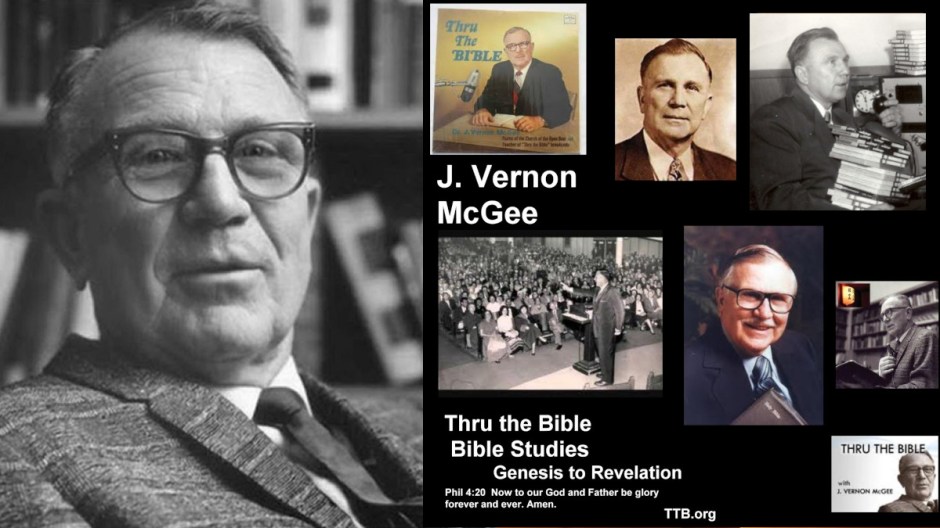
Dr. J. Vernon McGee: Mark 9-11

The audio on this video is the property of Thru the Bible. It is offered free of charge. If you wish to make a donation, do not send it to us. Visit http://www.ttb.org for information. The audio is attributed to Dr. J. Vernon McGee and Thru the Bible. Intellectual property rights are those of Thru the Bible. Please contact us if you feel our understanding of the terms of use are in error. Copyright information obtained from https://ttb.org/about/copyright-policy

In his sermon on Mark chapters 9 through 11, Dr. McGee begins by examining the Transfiguration in Mark 9, highlighting Mark’s detailed account and suggesting it reveals Christ’s perfect humanity rather than primarily his deity, which is John’s focus. He connects this event to Peter’s later testimony as an eyewitness of Christ’s power and coming. Dr. McGee explains Jesus taking Peter, James, and John to the mountain, not as favoritism, but perhaps due to their spiritual immaturity. The appearance of Moses and Elijah signifies the law and the prophets testifying to Jesus. Despite this glory, the disciples fail to cast out a demon at the foot of the mountain, illustrating the contrast between heavenly glory and earthly struggles. Dr. McGee emphasizes that the Transfiguration itself doesn’t save; it points towards the necessity of Christ’s death and resurrection.

Continuing in Mark 9, Dr. McGee interprets the disciples’ failure as a reflection of the church’s present-day ineffectiveness in a world he describes as troubled and even “demon possessed”. He criticizes the church for engaging in various activities while neglecting the primary task of bringing people to Jesus. Jesus’ rebuke of a “faithless generation” and his statement “bring him unto me” are central to this point. The disciples’ subsequent inability to cast out the demon is attributed to a lack of prayer. Dr. McGee also touches upon Jesus’ second announcement of his death and resurrection, the disciples’ misunderstanding and argument about greatness, and Jesus’ teaching against a sectarian spirit after John forbids an outsider from casting out demons in Jesus’ name. He notes Jesus’ stern warning against offending little ones and his direct teaching about hell.

Moving into Mark 10, Dr. McGee discusses marriage and divorce, noting the Pharisees’ attempt to entrap Jesus. Jesus shifts the focus from divorce back to God’s original design for marriage as a union of one flesh created at the beginning. He explains that divorce was permitted due to the “hardness of your heart” but was not God’s ideal. Dr. McGee addresses adultery in the context of remarriage and clarifies why Mark’s account of divorce differs slightly from Matthew’s, considering Mark’s Roman audience. He then examines the blessing of the little children, highlighting their importance and suggesting adults should embrace a childlike faith. The encounter with the Rich Young Ruler is analyzed as an example of someone relying on outward obedience to the law while lacking a true relationship with God, hindered by his wealth. Jesus’ teaching on the difficulty for the rich to enter the kingdom is explained, emphasizing that salvation comes through God, not human effort or riches.

Finally, in Mark 10 and 11, Dr. McGee addresses Jesus’ final journey to Jerusalem, including his repeated predictions of his death and resurrection. He interprets James and John’s request for positions of power and Jesus’ response about those places being prepared by God. The core of Jesus’ mission is emphasized: to minister and give his life as a ransom for many. Dr. McGee briefly mentions the healing of blind Bartimaeus. Transitioning to Mark 11, he describes Jesus’ public entry into Jerusalem as a presentation of himself as the Messiah, which ultimately led to rejection. He suggests this entry occurred over three days and was not a triumphal procession in the worldly sense. The cursing of the fig tree is interpreted as a symbol of Israel’s fruitless religious outward appearance. The cleansing of the temple is depicted as Jesus purging a corrupt religious system. This event leads to a discourse on the power of prayer through faith in God, clarifying that this power is for spiritual strength rather than literal miracles, and emphasizing the importance of forgiveness. The sermon concludes with Jesus’ skillful handling of the chief priests and elders who question his authority, using a counter-question about John the Baptist to silence them.