A few words about prayer

JEFF TURNER

The Bible gives guidance on prayer, including how to pray, what to pray for, when to pray, and why prayer matters. Even with all these instructions, Paul says believers often do not know the right way to pray. In Romans 8:26, he explains that the Holy Spirit helps us in prayer, even expressing what we cannot put into words.

The reason people struggle with prayer is that they do not always know what is best. For example, when praying for someone who is seriously ill, it may not be clear whether to ask for healing, strength, or another outcome that God sees as better. God’s plans may involve using life’s difficulties to teach, humble, or guide a person in ways we cannot foresee.

Scripture encourages praying for salvation, guidance, and other needs, but the specific results are left to God. Believers are called to pray with sincerity and focus on their intentions, while trusting God to determine the ultimate outcome. In this way, prayer is both an act of personal devotion and a surrender to God’s wisdom.

Do not be anxious about anything, but in everything by prayer and pleading with thanksgiving let your requests be made known to God.

Philippians 4:6

When the church must Act in discipline

JEFF TURNER

The Bible gives clear steps for dealing with a believer who falls into sin. We are told to love that person and to pray for them. We are also called to correct and guide them. These actions seem natural to many Christians. But there is another instruction that may sound severe.

In First Epistle to the Corinthians chapter 5, Paul writes that when someone who claims to be a believer refuses to turn from sin, the church must hand that person over to Satan for the destruction of the flesh. These words can seem hard to accept, yet they are written plainly in Scripture.

I believe Paul is speaking about removing that person from the fellowship of the church. To be part of the church is to live within its care, teaching, and protection. When someone is put outside of that circle, they are no longer sheltered in the same way. Paul explains this by saying that a little leaven spreads through the whole batch of dough. In simple terms, one sinful influence can affect many others. Like a spoiled apple left in a box, the damage does not stay in one place.

There are times when people argue that such a person should remain in the church so they can be shown patience and kindness. Love and patience do matter. The church should correct gently at first. However, when a person’s sin begins to spread and harm others, and when that person will not repent, stronger action is required. If the behaviour continues without change, the church must remove the person from fellowship.

Church discipline is not meant to be cruel. It serves two purposes. First, it guards the church from harmful influence. Second, it may lead the sinner to face the weight of their actions and turn back to God. The goal is both protection and restoration.

Scripture also teaches, “Brothers, if anyone is caught in any transgression, you who are spiritual should restore him in a spirit of gentleness.” Epistle to the Galatians 6:1

Why I don’t ‘preach politics’ on Christian radio

DAVID INGRAM

Throughout my adult life I’ve been asked to support this or that political cause. While there is nothing wrong with standing for one’s principles, I would not post political causes I support on a website like this, or use the microphone to proclaim my political stance on on a Christian radio station. I realize there are a lot of people in Christian radio advocating for one cause or another, and that’s between them and God. But today I don’t partake in such a thing because for me, the question of whether or not it’s the right thing to do is clear. Why? Because we should do NOTHING that would push others away from the message of salvation through Jesus.

I realize my stand on this may anger some Christians. I’ve had conversations about this with people who say “Oh, you think such-and-such is OK?” or “Why won’t you speak out against them because they support such-and-such?” Now to be clear, I will speak out against people who do evil things, even political parties who do, but I won’t do so on a Christian platform that is supposed to spread the Gospel of Jesus.

How many times have you heard over-generalized complaints about Christians that centre around some extreme political position? The implication being that if some Christians are extremists, then all Christians must be? By the way, judging an entire group, Christians or any other identifiable group, based on a subset is called a fallacy of composition. It’s irrational to do so, but this is the way people often function. Here is the important part: Whatever you do, do it for glorification of God. How can you glorify God by pushing people away from Jesus?

So, am I saying to ignore sin? Not at all. I am saying that people repent of sin when they realize their focus should be on Jesus, not because I gave them a stern talking to, or because they want to be a good member of this or that political organization. Once a person has accepted redemption for their sins through the blood of Jesus, they will ask questions about all sorts of things. Isn’t this a better time to talk to them about such matters? I have yet to meet a man or woman who said they came to Jesus because someone complained about their politics.

Throughout history man has tried to set up governments based on Christianity. Isn’t this something Christians should want? History also teaches us that some very evil people who realized that the only way they can get power in a theocracy is to claim to be Christian. We have seen time and time again how their very non-Christian acts have led to bad things being done in the name of God. So-called Christian governmental leaders doing bad things is also something often exploited by anti-theists who want to convince others that Christianity is bad.

The Bible tells people how to live in a corrupt society. But can you find any verse where Jesus ever advocated for regime change by force or politics? As I write this I think of when Judas and armed men came to abduct Jesus in Matthew Chapter 26. Starting with verse 50 it says, “…Then they came and laid hands on Jesus and arrested Him. And behold, one of those who were with Jesus reached and drew his sword, and struck the slave of the high priest and cut off his ear. Then Jesus said to him, “Put your sword back into its place; for all those who take up the sword will perish by the sword. Or do you think that I cannot appeal to My Father, and He will at once put at My disposal more than twelve legions of angels? How then would the Scriptures be fulfilled, which say that it must happen this way?”

People can vote their conscience, and I hope Christians are guided in their decisions. Not guided by me, but by the scriptures and by prayer. But I don’t advocate for politics in the pulpit, or on Christian radio. The Bible’s message isn’t one of social change. It’s about salvation and the changes that come after one is saved.

Living in constant connection with God

JEFF TURNER

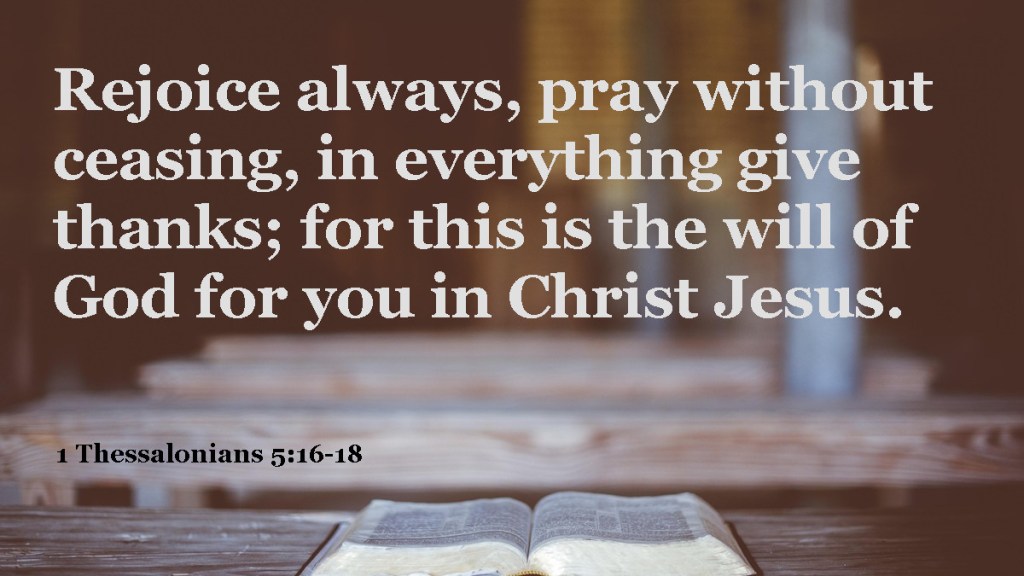
When Paul tells believers to pray without ceasing, some people respond by feeling discouraged. They wonder how anyone could possibly pray all the time. The answer is simpler than it seems.

This command does not mean we need to walk around praying out loud every moment of the day. Some religious groups in ancient times tried to do exactly that, but they missed the point entirely. They spent so much time with their heads bowed in prayer that they kept bumping into things around them.

What Paul meant was something different. He was telling us to keep an attitude of prayer at all times. Think of prayer like breathing. You cannot live without breathing, and if you are alive, you breathe automatically. The air pressure around you fills your lungs without you thinking about it.

Prayer works the same way in our spiritual lives. It means living every moment aware that God is with you. When something happens during your day, you naturally turn it into a conversation with God. Good things become reasons to thank him. Difficult situations become requests for help. The needs of others become chances to pray on their behalf.

Praying without ceasing simply means staying closely connected to God throughout everything you experience.

A Willing Heart to Hear God

FLOYD ROGERS

To hear God’s voice, we must first admit that we need to learn. This begins with having a teachable spirit. We need a heart that is open and humble. When someone believes they already know everything, they close themselves off from growth. Pride becomes a barrier to hearing from God.

Being teachable means being ready to receive truth, not just from personal reading or prayer, but also by learning from others. It means being willing to try, to apply what we learn, and to grow from experience. This kind of attitude invites God to speak, because it shows that we are ready to listen.

If we want to hear from God regularly and clearly, we need to stay open, eager, and honest before Him.

Therefore, ridding yourselves of all filthiness and all that remains of wickedness, in humility receive the word implanted, which is able to save your souls.

James 1:21