The purpose of a Church gathering

JEFF TURNER

In 1 Corinthians, the apostle Paul addressed serious problems in the church. One issue involved the misuse of spiritual gifts during their meetings. Instead of bringing order and understanding, their gatherings had become disorderly. Paul described the result with one clear word: confusion.

The situation had become so chaotic that if an unbeliever entered their meeting, the reaction could be alarming. Observers might look around and decide that the people were behaving as if they had lost their senses. This picture showed how far the church had moved away from the purpose of a proper gathering. With this in mind, Should a church service be planned mainly with unbelievers in mind, or should it focus on believers?

To understand my answer, it helps to first remember what a church is. A church is the gathering of people who have been redeemed by God. When these believers come together, the purpose of the meeting is centered on their relationship with Him and with one another. During these times, believers worship God together. They give praise to Him and honour Christ. Their focus is not on entertainment or on adjusting the message to attract outsiders. Instead, the gathering is meant to direct hearts and minds toward God.

Church meetings are also a time for believers to strengthen one another. Fellowship with other Christians is an important part of spiritual life. By being together, they encourage each other to continue walking in faith.

I believe another key part of a church gathering is the teaching of Scripture. God’s Word is read, explained, and applied so that believers grow in their understanding. Through this process, they become stronger in their faith and better prepared to live according to God’s truth.

Prayer also holds an important place in these meetings. Believers come before God together, bringing their needs and requests to Him. They confess their sins, ask for His mercy, and seek the strength that only He can give.

All of these elements form the heart of a Christian gathering. Please don’t think I’m writing a how-to-do manual. I’m speaking of things that should be part of our gathering as the Church. The purpose is to build up believers and deepen their worship of God. Because of this, shaping a church service mainly for unbelievers does not match the design of the church.

There is, however, a place for events that focus on reaching those who do not yet believe. Special gatherings can be arranged where the message of the gospel is clearly presented to them. These occasions can help people hear the truth about Christ.

But if a church replaces its regular worship gatherings with constant outreach events, a different problem can develop. The church may become spiritually weak. In some cases, people who do not truly believe may feel comfortable in that setting without realizing their real need for salvation.

Do you agree? disagree? I would love to see your comments below.

What is the outcome then, brothers and sisters? When you assemble, each one has a psalm, has a teaching, has a revelation, has a tongue, has an interpretation. All things are to be done for edification.

1 Corinthians 14:26
When the church must Act in discipline

JEFF TURNER

The Bible gives clear steps for dealing with a believer who falls into sin. We are told to love that person and to pray for them. We are also called to correct and guide them. These actions seem natural to many Christians. But there is another instruction that may sound severe.

In First Epistle to the Corinthians chapter 5, Paul writes that when someone who claims to be a believer refuses to turn from sin, the church must hand that person over to Satan for the destruction of the flesh. These words can seem hard to accept, yet they are written plainly in Scripture.

I believe Paul is speaking about removing that person from the fellowship of the church. To be part of the church is to live within its care, teaching, and protection. When someone is put outside of that circle, they are no longer sheltered in the same way. Paul explains this by saying that a little leaven spreads through the whole batch of dough. In simple terms, one sinful influence can affect many others. Like a spoiled apple left in a box, the damage does not stay in one place.

There are times when people argue that such a person should remain in the church so they can be shown patience and kindness. Love and patience do matter. The church should correct gently at first. However, when a person’s sin begins to spread and harm others, and when that person will not repent, stronger action is required. If the behaviour continues without change, the church must remove the person from fellowship.

Church discipline is not meant to be cruel. It serves two purposes. First, it guards the church from harmful influence. Second, it may lead the sinner to face the weight of their actions and turn back to God. The goal is both protection and restoration.

Scripture also teaches, “Brothers, if anyone is caught in any transgression, you who are spiritual should restore him in a spirit of gentleness.” Epistle to the Galatians 6:1

A few words about the foundation of the church

JEFF TURNER

When Jesus spoke to Peter in Matthew 16:18, he made a statement that has been understood in different ways. He said that upon a certain rock, he would build his church, and the gates of Hades would not be able to overcome it. The question is what did Jesus mean by this rock.

The Roman Catholic Church has long taught that Peter himself was the rock Jesus mentioned. According to this view, Peter traveled to Rome and became the first leader in what would become the papacy. The church, they say, was built on Peter as a person. However, I believe this understanding faces problems when we look at what the Bible shows us about Peter.

Right after Jesus made this statement about building his church, he had to rebuke Peter harshly. Jesus told him to get behind him and called him Satan. This happened because Peter was trying to prevent Jesus from going to the cross. It would seem strange for Jesus to say he would build his church on someone he had to correct so strongly just moments later.

Peter also showed weakness at other times. When Jesus was arrested and taken away, Peter denied even knowing him. He did this not just once but three separate times. These actions show that Peter was not a stable foundation on which to build anything lasting. He struggled and failed like any other person.

The actual meaning becomes clearer when we look at what happened just before Jesus made his statement. Peter had declared that Jesus was the Christ, the son of the living God. Jesus praised Peter for this confession because God the Father had revealed this truth to him. It was not something Peter figured out on his own.

When Jesus said he would build his church on the rock, he used different Greek words. For Peter’s name, he used the word that means a small stone or pebble. But for the rock on which he would build his church, he used a different word that means a large rock formation or bedrock. I believe Jesus was making a clear distinction between Peter the person and the truth Peter had just spoken.

Was the rock Jesus spoke about the confession itself? The truth that Jesus is the Christ and the son of the living God. He is the foundation of the church. This truth came from God through Peter’s mouth, but it is the truth itself that matters, not the man who spoke it. The church stands on who Jesus is, not on any human leader.

Our faith is not in any human being, no matter how devoted they are. Our faith is in Jesus Christ and the truth of who he is.

“For no one can lay any foundation other than the one already laid, which is Jesus Christ.” – 1 Corinthians 3:11

Why believers need to gather in person

JEFF TURNER

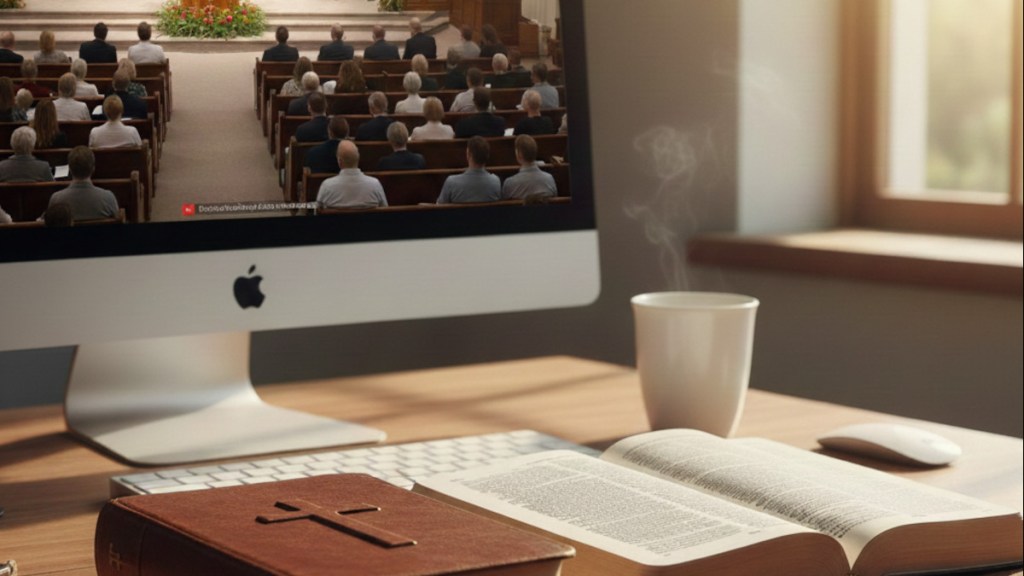
Technology has made religious content easier to access than at any point in history. Television programs, internet streams, and radio broadcasts bring teaching into homes across the country. This convenience has led some people to believe they can get everything they need spiritually without attending a church in their community. They watch online services and listen to podcasts, thinking this replaces gathering with other believers.

(IRS Images, 2025)

This approach misses something important that Scripture addresses. The Bible speaks about communities of real people who meet together in person. These are groups with shepherds who know their members, leaders who serve face-to-face, and individuals who care for each other in tangible ways. The concept of receiving spiritual input only through screens finds no support in biblical teaching.

Some recent publications (as I am writing this) have even suggested that consuming religious media is better than participating in a physical congregation. This idea contradicts what the New Testament teaches. A church consists of people who have been saved coming together for specific purposes. They pray as a group, share meals that remember Christ’s sacrifice, demonstrate their faith through baptism, and support one another in their spiritual growth.

The New Testament contains many instructions about how believers should interact. They are told to pray for each other, show love to one another, build each other up, encourage one another, and even correct each other when needed. These actions require personal interaction. They cannot happen through a screen. Only when people gather in person can they fulfill what Christ established for His followers. Every believer needs to commit to being an active, consistent member of a local gathering.

Suicide bomber targets Christian celebrations in Aleppo, Syria on New Year’s Eve

TEXAS GOSPEL VOLUNTEER

A suicide bomber detonated an explosive belt in the northern Syrian city of Aleppo on New Year’s Eve, killing one police officer and injuring two others in what authorities described as a failed attempt to attack Christian worshippers, according to The Syrian Interior Ministry.

The Syrian Interior Ministry said on its Telegram channel that the attack occurred in the Bab al-Faraj neighbourhood when the assailant, identified by local authorities as a member of the Islamic State, opened fire during a police interrogation. A police officer physically restrained the attacker, at which point the bomber detonated his explosive belt. According to authorities, the attacker was attempting to reach a nearby Christian neighbourhood and religious sites, including a Greek Orthodox church, to target New Year’s celebrations.

The Aleppo bombing represents the latest in a series of recent Islamic State attacks in Syria. Just a week earlier, an explosion at an Alawite mosque in Homs killed eight people. Saraya Ansar al-Sunna, which analysts believe operates as a front for IS, claimed responsibility for that attack. On December 13, an IS attack in Palmyra killed two U.S. soldiers and one American civilian.

These incidents come as Syria continues military operations against Islamic State remnants under President Ahmed al-Sharaa, an Islamist leader who previously fought against IS during the Syrian civil war. In November, Syria officially joined the U.S.-led coalition against IS and has since been conducting coordinated raids with U.S. Central Command targeting IS sleeper cells throughout the country.