The story of Emmanuel is journey of hope, anticipation, and divine promise spanning thousands of years. Throughout centuries of waiting, the people of Israel held onto a belief in a coming Messiah who would bring redemption and hope.
The prophecy of Emmanuel, meaning “God with us,” was a promise of divine presence and salvation. Foretold by the prophet Isaiah 800 years before its fulfillment, this prophecy spoke of a virgin who would bear a son, a child destined to be more than a mere political leader. God’s plan extended far beyond the expectations of the time, promising a savior not just for Israel, but for all people.
The birth of Jesus was a humble yet extraordinary event. Born in Bethlehem, not in a royal palace but in a simple manger, this child represented a different kind of kingdom. Shepherds were the first to receive the miraculous announcement. This message wasn’t just for rulers, Shepherds and ordinary people received it. It was for everyone – the lowly and the great alike. The divine plan was meticulously orchestrated, with the child’s name and purpose predetermined before his conception.
The significance of Emmanuel goes beyond a historical moment. It represents God’s intimate involvement with humanity, a promise of hope and redemption. It is a testament to patient hope, divine planning, and the transformative power of God’s love.
Luke wrote his gospel account with great care as a historian. God inspired him to record these events with accuracy and detail. The angel Gabriel appears in this narrative, the same heavenly messenger who spoke to the prophet Daniel in the Old Testament. Gabriel looked like a man in appearance, though he was clearly not human based on how he appeared and departed.
The priest Zechariah and his wife Elizabeth were righteous people who followed God’s commandments. However, they had no children because Elizabeth could not bear children, and both were now advanced in years. The culture of that time wrongly believed that childlessness meant God was judging a person. This explains why Elizabeth felt shame about her situation. When she later became pregnant, she said God had taken away her disgrace among the people.
Mary and Elizabeth, IRS Images, 2025
Elizabeth was likely in her sixties while Mary was probably only a teenager, around fourteen or fifteen years old. Girls were often promised in marriage at this young age in that culture. The age gap between these two women was significant, with Elizabeth old enough to be Mary’s grandmother. God was preparing to work two miracles through these women from very different stages of life.
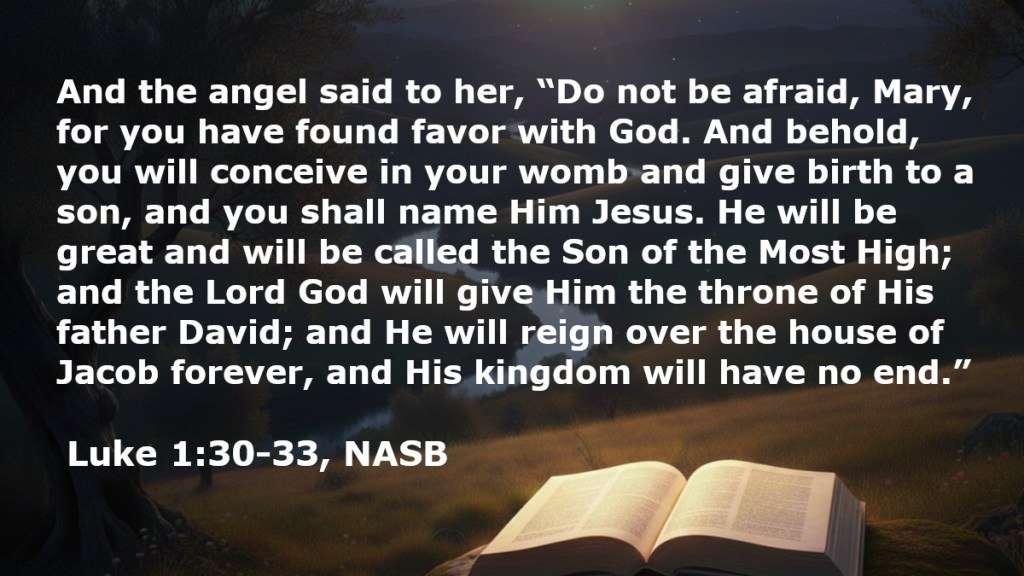
Gabriel told Mary to rejoice because she was highly favored. God was with her. Mary felt troubled by these words and wondered what this greeting meant. The angel told her not to fear because she had found favor with God. She would become pregnant and give birth to a son named Jesus. He would be great and called the Son of the Highest. God would give him the throne of his ancestor David, and his kingdom would never end.
Mary asked a logical question about how this could happen since she had not been with a man. Gabriel explained that the Holy Spirit would come upon her and the power of God would overshadow her. The child born would be holy and called the Son of God. As proof that nothing was impossible for God, Gabriel told Mary that her relative Elizabeth had also become pregnant in her old age. Elizabeth was now six months along, even though people had called her unable to have children.
Mary submitted to God’s plan. She called herself the servant of the Lord and said let it happen according to God’s word. The angel then left her. Mary’s response showed faith and courage. She accepted what seemed impossible.
Joseph had to receive his own message from an angel in a dream, as Matthew’s gospel records. Without this divine message, Joseph would have assumed the worst about Mary’s pregnancy. He was a just man who planned to end the betrothal quietly to avoid bringing shame on Mary. The angel told him not to fear taking Mary as his wife. Joseph was not royalty in appearance, but royal blood from David’s line flowed through him. Jesus became legally his firstborn son with all the rights that came with that position, even though Joseph’s blood did not flow in Jesus.
Mary traveled quickly from Nazareth to an unnamed city in the hill country of Judea, probably a journey of two or three days. She went to visit Elizabeth. When Elizabeth heard Mary’s greeting, the baby inside her moved suddenly. Elizabeth was filled with the Holy Spirit. She spoke loudly, saying Mary was blessed among women and the child in her womb was blessed. Elizabeth wondered why the mother of her Lord would come visit her. She said that when she heard Mary’s voice, the baby in her womb jumped for joy.
John was filled with the Holy Spirit even before birth. His movement in the womb was his first act of prophecy, recognizing the holy child that Mary carried. John’s entire purpose would be to point people toward Jesus as the promised rescuer. Even before his birth, he was already doing this work. His ministry began three months before he entered the world.
Elizabeth called Mary blessed because she believed what the Lord had told her. Both women carried miracle babies. Elizabeth gave birth to the last prophet of the old way, while Mary carried the one all those prophets had spoken about. The one who would bring in God’s kingdom. John would announce that people should turn from their sins because God’s kingdom was near. Jesus would declare that the kingdom of God had arrived and was among them.
These two women could encourage each other in what God had done for them and for all people. They shared faith in God’s promises. This same kind of mutual encouragement happens in churches today. Believers share common faith in what God has revealed, common experience of new life through Jesus, and common hope in God’s promises.
A blessed person is someone who knows God’s favor on their life. This favor only comes through trusting in Jesus and what he accomplished through his death. God is pleased with his son and pleased with all who trust in him for forgiveness of sins. Mary herself needed this savior, as she would later acknowledge. She was honored to bear the one who would save her and all who believe.
The Bible teaches that Jesus rose from the dead, and this truth gives hope to all who believe in him. In the first man, Adam, death came into the world. Because of him, every person faces sin and death. But through Jesus, called the new Adam, there is a new future. His resurrection is described as the first fruit, meaning it is the beginning of what is to come for those who follow him.
The order is clear. Christ was raised first, and when he returns, those who belong to him will also be raised. What happened to Jesus will one day happen to his people. Just as we shared in Adam’s weakness, we will share in Christ’s victory over death. Our story does not end in the grave, but in life with him.
This hope is not only for later but also for today.
For if we believe that Jesus died and rose from the dead, so also God will bring with Him those who have fallen asleep [a]through Jesus.
Hope can appear in quiet and simple ways. It can rise in moments when nothing else seems certain. Here’s a short story as an illustration. Two men were out at sea when one of them was thrown overboard. Alone in the dark water with no life jacket and no way to call for help, he had every reason to believe he would not survive. Yet he found a small idea to hold on to. He used his boots as makeshift flotation devices and waited. Hours later, after long searching, rescuers found him alive. What kept him going was a faint but stubborn belief that help could still come.
A lot of us know this kind of waiting. Hope can be a flicker of light when everything feels heavy. Now, in the season leading to Christmas, many people reflect on hope in a deeper way. This time teaches that hope is not only an emotion but also a promise. It connects the past, the present, and what is still ahead.
A well-known account from the first chapter of Luke shows how hope can come to people who have waited for years. Zachariah and Elizabeth lived faithfully, yet they carried the pain of not having children. They were older now, long past the age when change seemed possible. Still, they lived with steady devotion. Then, on an ordinary day, everything changed. A message came announcing that their long prayers had been heard. They would have a son, and his life would prepare people for the work of the Lord.
Their story reminds us that hope does not expire. It may take time before it becomes clear. It often grows slowly, shaped by patience. Many generations before them had longed for God to complete his promise. People faced times of peace and times of struggle. Yet through all of this, the promise of a coming Saviour stayed alive.
Prophets spoke of this future. They described a child who would bring peace and justice, one who would carry the very presence of God. These words carried forward through hundreds of years.
When the message finally came to Zachariah, it renewed the hope that people had held onto for generations. Though he struggled to believe at first, the news spread quickly among the people. Their waiting was not wasted. Their hope was not empty.
Today many people still wrestle with hard questions. What does hope mean in illness, broken relationships, financial strain, or deep loss? What does hope offer when answers do not come quickly? The message at the heart of this season is that hope is not based on perfect circumstances. It is rooted in the presence of God, who stays near in the darkest places.
Scripture shows that God meets people in their fear, pain, and loneliness. There are moments when hope feels far away. Many people sit quietly with fears they never speak aloud. But hope is still offered. It comes through Jesus, who entered this world not simply to inspire, but to save. He came to restore what sin has broken and to bring life that does not end. The hope he gives does not depend on how strong we feel. It depends on who he is.
For those who have never placed their trust in him, hope begins by receiving what he offers.
Light has always pushed back darkness, but the way people have lived with light has changed over time. Long before electric bulbs, homes were lit with kerosene lamps. They worked, but they were smoky, messy, and at times unsafe. When electricity arrived, some people resisted it because they could not see the power behind it. Others felt it was too bright or unnecessary. Yet once people accepted it, entire communities changed. Electricity did not simply improve the old system. It offered a completely different way to live.
This picture helps explain how many of us respond when God brings something new into our lives. We may ask for change, but when the change arrives, it often feels uncomfortable. We pray for new chances, and God gives new duties. We ask for peace, and old hurts rise to the surface so that healing can begin. We ask for open doors, and God prepares our hearts before opening anything at all. Growth often feels like shrinking and stretching at the same time. Before God expands our life, He works on our pride. Before He sends us outward, He shapes us inward. Every new season calls for a new version of who we are becoming.
We sometimes pray for joy, and God uses discomfort to expose what needs attention inside us. We ask Him to fix situations around us, and He starts by working on our reactions, habits, and patterns. We pray for purpose, and God sends interruptions that pull us out of our routines. We want His work to fit our old rhythm, but His new work does not sit well with our old ways. There is a pull inside each of us between what feels familiar and what leads to growth. At some point, what is familiar can get in the way of what is fruitful.
This tension is clear in the story found in Mark chapter 2. People questioned why Jesus’ followers did not fast like others. Fasting was not wrong, but the timing was wrong. They were trying to fit a good practice into a moment where it did not belong. Jesus used this to teach that He is the one who defines what is new and when it arrives.
He then gave two images. One was a torn piece of clothing. Sewing new cloth onto an old garment makes the tear worse because the new cloth shrinks. The other picture was of wine skins. New wine was still expanding. Old wine skins were stiff and could not stretch, so they would burst. The lesson was simple: new life from God needs a willing and flexible heart.
Have thine own way, Lord! Have thine own way! Thou art the potter, I am the clay. Mold me and make me after thy will, while I am waiting, yielded and still.
In these images, “old” does not refer to age but to attitude. Old means unwilling to change. New means willing to be shaped by God. Some people who have lived many years remain open and teachable. Their hearts can stretch. Others, no matter their age, can grow rigid. A rigid spirit cannot hold the fresh work of God because His movement brings expansion. His question to us is simple: If He pours more into us, will we stretch?
Many people can look back and see how God has stretched them through responsibility, challenge, or service. These moments push us toward prayer, toward Scripture, and toward deeper love for others. They form new patterns inside us. When God stretches us, He is not punishing us. He is preparing us.
Jesus does not attach new life to old habits. He gives a new heart and a new spirit to those who receive Him. For anyone who has not placed their trust in Him, the first step is to admit the need for Him, believe in His life, death, and resurrection, and confess Him as Lord. This is how a person becomes able to carry what He wants to give.
For those who already follow Him, there is still a warning. It is possible to walk with Jesus for years and still become rigid if the relationship fades into routine. When prayer becomes an afterthought, the heart grows stiff. Prayer keeps us soft, teachable, and ready. It opens the door for God’s shaping work. It keeps us flexible enough to hold what He wants to pour into our lives.
Practicing simple daily prayer can help with this. A short morning surrender. A pause before reacting. A quiet moment to listen. Praying Scripture. The invitation is the same for all of us: to be willing, flexible, and open. To let God shape us so we can carry what He wants to give.
Therefore if anyone is in Christ, this person is a new creation; the old things passed away; behold, new things have come.