
Amazing Grace: It’s All You Need

TEXAS GOSPEL VOLUNTEER

Have you ever felt the weight of your mistakes, those things you wish you could take back? Imagine a debt so large you could never repay it. This is the situation we all find ourselves in when it comes to our wrongdoings, our sins, against God.

The good news is that there’s a solution, a way out that doesn’t depend on our ability to be “good enough.” It’s called grace, which means God’s undeserved kindness and favor towards us. It’s something freely given, even when we don’t deserve it.

Click here to hear audio of this article

Think about John Newton, the writer of the famous hymn “Amazing Grace”. Before becoming a pastor, he was involved in the slave trade, a life marked by recklessness and immorality. But when faced with death during a storm at sea, he cried out to God. As he came to understand the gospel, the message of forgiveness through Jesus Christ, he was overwhelmed by God’s grace in forgiving his terrible sins. It was this profound experience that led him to write the words, “Amazing grace, how sweet the sound, that saved a wretch like me!”. The realization of his own deep sinfulness made God’s grace all the more astonishing.

Sadly, it seems many lose this sense of amazement. Perhaps it’s because we lose sight of how serious our sins truly are to God. Our wrong thoughts and hidden actions are just as significant as the more visible sins we might judge in others. We tend to put ourselves on a pedestal, thinking we are better than others.

Jesus once told a story that helps illustrate this. A man had two people who owed him money – one a large sum (500 denarii) and the other a much smaller amount (50 denarii). Neither could pay back what they owed, so the man freely forgave both debts. Jesus then asked which one would love him more, and the answer was clear: the one who had been forgiven more.

This story demonstrates how God’s grace works. Some might think their sins are small and therefore God’s forgiveness is not a big deal. But whether the debt is large or small, it’s still a debt. True appreciation and love for God come when we recognize the enormity of our sin and the incredible grace it takes for God to forgive us.

In Luke chapter 7, we read about a woman known as a sinner (understood to be a prostitute) who came to Jesus while he was eating at the house of a self-righteous religious leader named Simon, a Pharisee. She wept at Jesus’ feet, washed them with her tears and her hair, kissed them, and poured expensive perfume on them. Simon was disgusted, thinking that if Jesus knew what kind of woman this was, he wouldn’t allow her to touch him.

But Jesus knew Simon’s thoughts and told him the story of the two debtors. Then, turning to the woman, Jesus pointed out how Simon had failed to show common courtesy, while this woman had shown extravagant love and humility. Jesus then declared, “Therefore I say to you, her sins, which are many, are forgiven, for she loved much. But to whom little is forgiven, the same loves little” (Luke 7:47). He concluded by saying to the woman, “Your faith has saved you. Go in peace” (Luke 7:50). It wasn’t her tears or the expensive oil that saved her, but her faith in Jesus.

Those who recognize their deep need for forgiveness are the ones who truly understand and appreciate God’s grace. The self-righteous, like Simon, feel little need for it.

The core message of the early followers of Jesus, like the Apostle Paul, was this incredible grace of God. When Paul first preached in places like Antioch, Iconium, and Lystra (cities in the region of Galatia), the message was clear: forgiveness of sins comes through Jesus, and by him everyone who believes is justified from all things from which he could not be justified by the law of Moses (Acts 13:38-39). The Gentiles who heard this were glad and believed. In Iconium, Paul and Barnabas spoke boldly about the word of His grace, granting signs and wonders to be done by their hands (Acts 14:1-3). Even after facing opposition and persecution, they returned to these cities, strengthening the souls of the disciples, exhorting them to continue in the faith, and saying, “We must through many tribulations enter the kingdom of God” (Acts 14:20-22). They had preached the gospel of God’s grace.

However, Paul was shocked to hear that these very churches in Galatia were turning away from this message. They were being influenced by others who taught that following the Jewish Law was necessary for salvation, adding works to God’s grace. This is a perversion of the true gospel.

Paul’s reaction was strong. He wrote in his letter to the Galatians: “I marvel that you are turning away so soon from Him who called you in the grace of Christ, to a different gospel, which is not another; but there are some who trouble you and want to pervert the gospel of Christ” (Galatians 1:6-7). He even issued a stark warning: “But even if we, or an angel from heaven, preach any other gospel to you than what we have preached to you, let him be accursed. As we have said before, so now I say again, if anyone preaches any other gospel to you than what you have received, let him be accursed” (Galatians 1:8-9).

Paul was so firm because his understanding of the gospel didn’t come from human teaching but directly from Jesus Christ himself. He said, “But I make known to you, brethren, that the gospel which was preached by me is not according to man. For I neither received it from man, nor was I taught it, but it came through the revelation of Jesus Christ” (Galatians 1:11-12).

The danger of adding anything to God’s grace for salvation is that it diminishes the sufficiency of what Jesus Christ has already done. It suggests that His sacrifice alone wasn’t enough. The truth is, we have a debt we could never repay, the debt of our sins. Jesus Christ, the sinless Son of God, came and paid that debt for us through his death on the cross. He lived a perfect life so that His righteousness could be given to us. We have nothing to offer God to earn our forgiveness.

For by grace you have been saved through faith, and that not of yourselves; it is the gift of God, not of works, lest anyone should boast (Ephesians 2:8-9).

This doesn’t mean that good works are unimportant. In fact, the Bible goes on to say, “For we are His workmanship, created in Christ Jesus for good works, which God prepared beforehand that we should walk in them” (Ephesians 2:10not explicitly cited but related concept). When we are truly saved by grace through faith, our lives will be transformed, and we will naturally want to do good works as a response to God’s love. But these works are a result of salvation, not the cause of it.

The message is clear: salvation is a free gift from God, received through faith in Jesus Christ. It is not earned by our efforts or good deeds. We cannot add anything to the perfect sacrifice of Jesus. Our focus should be on trusting in His grace alone. This amazing grace is what sets us free from the consequences of our sins and offers us eternal life. Let us never lose our amazement at this incredible gift.

Understanding the Good News of Jesus: Insights from Galatians

JEFF TURNER

The good news about Jesus is something special. It comes from God and helps people grow in their faith. A letter in the Bible, the book of Galatians, talks about this good news. This letter was written a long time ago by Paul, a person chosen by Jesus to spread the word.

Paul wrote to churches in a place called Galatia. These were churches that Paul had started. He really cared about these churches, but he heard that some people were teaching something different from what he had taught them. This different teaching was that believing in Jesus wasn’t enough. People also needed to do good things, like following old rules, to be right with God.

Paul wanted the people in Galatia to know that this wasn’t the real good news. He said that he was an apostle, not chosen by people, but by Jesus Christ and God the Father, who brought Jesus back to life. Paul explained that he wasn’t made an apostle by a group of people picking him. Instead, God himself chose him in a special way to tell others about Jesus. Paul said that the message he preached came from Jesus himself.

Paul was not the only one who believed this good news. He said that other believers who were with him also shared the same message. When Paul went to Jerusalem to talk to the other important apostles, like Peter and John, they agreed that the good news Paul was sharing was true. They gave Paul and his friend Barnabas their support to go and tell the Gentiles (people who were not Jewish) about Jesus.

The good news is about God’s grace and peace. Paul said, “Grace to you and peace from God the Father and our Lord Jesus Christ, who gave himself for our sins, that he might deliver us from this present evil age, according to the will of our God and Father, to whom be glory forever and ever. Amen”. Grace is like a free gift from God. We don’t earn it by doing good things; God gives it to us because he loves us. This grace brings us peace with God.

Paul made it clear that we are made right with God by believing in Jesus, not by doing good works or following rules. He said that if we could be saved by our own efforts, then Jesus wouldn’t have needed to die for us. The Bible says, “For the wages of sin is death, but the gift of God is eternal life in Jesus Christ our Lord”. Our sins deserve punishment, but God offers us eternal life as a free gift through Jesus.

Paul also said, “For by grace you have been saved through faith, and that not of yourselves; it is the gift of God, not of works, lest anyone should boast. For we are his workmanship, created in Christ Jesus for good works, which God prepared beforehand, that we should walk in them”. This means that God saves us through his kindness, and we receive this by believing in Jesus. It’s not because of anything good we have done so that we can’t brag about it. Instead, God made us to do good things, which he has already planned for us.

Paul warned the Galatians about turning to a different message that said they needed to do certain things to be saved. He said this was not the true good news. The law was given to show people that they couldn’t perfectly follow God’s rules and that they needed Jesus.

Paul wanted the Galatians to remember the good news he first told them: that Jesus gave himself to save us from our sins and from this bad world, because that was God’s plan. This is why Paul gave glory to God forever. He knew that our salvation is all because of what God has done for us through Jesus.

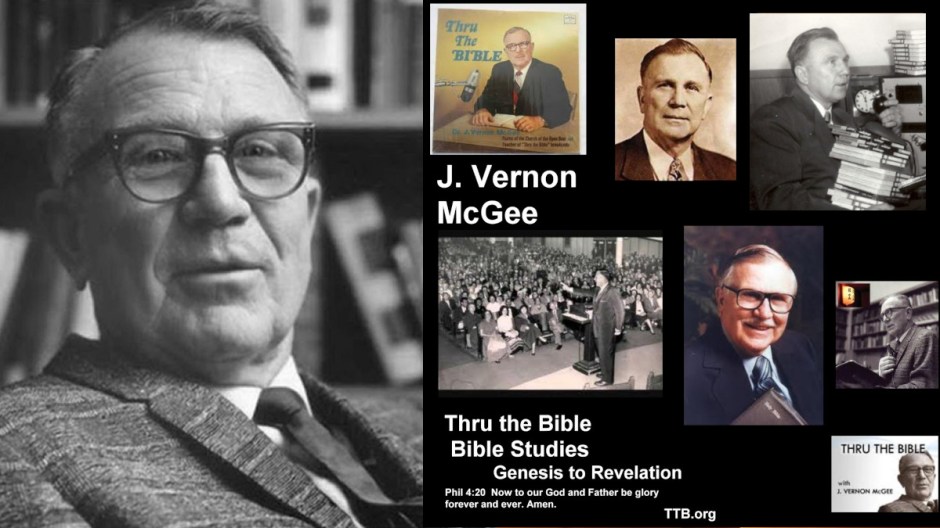
Thru the Bible: Matthew 25-28

Matthew 25-28 – The audio on this video is the property of Thru the Bible. It is offered free of charge. If you wish to make a donation, do not send it to us. Visit http://www.ttb.org for information. The audio is attributed to Dr. J. Vernon McGee and Thru the Bible. Intellectual property rights are those of Thru the Bible. Please contact us if you feel our understanding of the terms of use are in error. Copyright information obtained from https://ttb.org/about/copyright-policy

Dr. McGee’s sermon covers Matthew chapters 25 through 28, focusing on his interpretations of the parables, the events leading to the crucifixion, the crucifixion itself, and the resurrection of Jesus Christ.

In chapter 25, Dr. McGee discusses the parable of the ten virgins. He refutes the idea of a partial Rapture based on this parable, stating that he believes every believer will be taken in the Rapture by God’s grace, not merit. He argues that the ten virgins refer to the nation of Israel, not the church. He also touches upon the parable of the talents, emphasizing the principle of using whatever gifts God has given until Christ’s return. Dr. McGee then interprets the Judgment of the Nations in Matthew 25 as occurring during the Great Tribulation, where nations will be judged based on their treatment of Christ’s brethren (the 144,000 sealed messengers). He believes the terms “sheep” and “goats” refer to ethnic groups or nations, not individual lost or saved people.

Moving into chapter 26, Dr. McGee narrates the events leading up to Jesus’s crucifixion. He highlights Jesus’s repeated predictions of his death during the Passover. He describes the anointing of Jesus at Bethany by a woman (identified as Mary in John’s Gospel), emphasizing the significance of her act as an anticipation of his burial. He recounts Judas’s betrayal for 30 pieces of silver and the institution of the Lord’s Supper during the Passover meal. Dr. McGee also discusses Jesus’s prediction of Peter’s denial and the events in the Garden of Gethsemane, where he believes Jesus won the victory over the horror of bearing the sins of the world. He continues with the betrayal by Judas, the arrest of Jesus, and his trial before Caiaphas and the Sanhedrin, including Peter’s denial.

Chapter 27 details the crucifixion of Jesus. Dr. McGee mentions Judas’s remorse and suicide after Jesus’s condemnation. He recounts Jesus’s trial before Pontius Pilate, the crowd’s choice of Barabbas over Jesus, and Pilate’s reluctant decision to have Jesus crucified. He describes the mockery and suffering Jesus endured at the hands of the Roman soldiers before his crucifixion. Dr. McGee notes that the Gospel writers do not give graphic details of the crucifixion itself, suggesting a divine reverence for this event. He highlights the supernatural events that occurred at Jesus’s death, including the tearing of the temple veil from top to bottom (symbolizing open access to God) and the earthquake. He also mentions the burial of Jesus by Joseph of Arimathea and Nicodemus. The chapter concludes with the sealing of the tomb and the setting of a guard by the chief priests and Pharisees who remembered Jesus’s prediction of his resurrection.

Finally, chapter 28 focuses on the resurrection of Jesus and the Great Commission. Dr. McGee emphasizes that the death and resurrection of Christ are the two great pillars of the Gospel. He describes the women coming to the tomb, the earthquake, the angel rolling back the stone, and the angel’s announcement that Jesus had risen. He recounts Jesus’s appearances to the women and later to the eleven disciples in Galilee. Dr. McGee then discusses the Great Commission in Matthew 28:19-20, seeing it as having an application for today, as well as a future fulfillment during the Great Tribulation and the Millennium. He notes the omission of the Ascension in Matthew’s Gospel, suggesting it is because Matthew focuses on the kingdom being upon the Earth and the King remaining. Dr. McGee concludes by affirming that Jesus was born a king, lived as a king, died a king, rose again a king, and will return as the King of Kings and Lord of Lords.

Thru the Bible: Matthew 22-24

The audio on this video is the property of Thru the Bible. It is offered free of charge. If you wish to make a donation, do not send it to us. Visit http://www.ttb.org for information. The audio is attributed to Dr. J. Vernon McGee and Thru the Bible. Intellectual property rights are those of Thru the Bible.
Please contact us if you feel our understanding of the terms of use are in error.
Copyright information obtained from https://ttb.org/about/copyright-policy

Dr. McGee’s sermon covers Matthew chapters 22 through 24, starting with the verbal clash between Jesus and the religious rulers. Chapter 22 begins with the parable of the king who made a marriage feast for his son. This parable is a continuation of Jesus’ answer to the chief priests and elders and parallels the parables in Matthew 13, focusing on how and why the current age began. The king sends servants to call those who were bidden (the lost sheep of the House of Israel), but they refused to come. He sent other servants, but the invited guests made light of it, going to their farms and merchandise, while others mistreated and killed the servants. In response, the king sent his armies to destroy the murderers and their city, which Dr. McGee believes is a reference to the destruction of Jerusalem in 70 AD. Then, the invitation goes out to everyone found on the highways, both good and bad, and the wedding is furnished with guests. However, a man without a wedding garment (the righteousness of Christ, essential for salvation) is found, bound, and cast into outer darkness, illustrating that while many are called, few are chosen and must come on the king’s terms.

Following this, the religious leaders launch their final attack on Jesus. First, the Herodians question him about paying tribute to Caesar, a political trick to trap him. Jesus, perceiving their wickedness, calls them hypocrites and uses their own coin to state, “Render therefore unto Caesar the things which are Caesar’s, and unto God the things that are God’s,” marvelously answering their question without falling into their trap. Next, the Sadducees, who deny the resurrection, question him about a woman married to seven brothers. Jesus responds that they err by not knowing the Scriptures nor the power of God, stating that in the resurrection, people neither marry nor are given in marriage but are like the angels. He further proves the resurrection by quoting God as saying, “I am the God of Abraham, the God of Isaac, and the God of Jacob,” asserting that God is not the God of the dead but of the living. This silences the Sadducees. Finally, the Pharisees, after hearing that Jesus silenced the Sadducees, gather together and ask him which is the great commandment in the law. Jesus answers, “Thou shalt love the Lord thy God with all thy heart, and with all thy soul, and with all thy mind. This is the first and great commandment. And the second is like unto it, Thou shalt love thy neighbor as thyself. On these two commandments hang all the law and the prophets”. Then, Jesus questions the Pharisees about the Christ, asking whose son he is. They reply, “The Son of David”. Jesus then asks how David, in the Spirit, calls him Lord (Psalm 110:1), highlighting the impossibility of David calling his natural son Lord, implying a supernatural birth. No one is able to answer him, ending the verbal clash.

Chapter 23 marks Jesus’ denouncement of the scribes and Pharisees and his weeping over Jerusalem. He warns the multitude against the scribes and Pharisees who sit in Moses’ seat but do not practice what they preach. He pronounces a series of “woes” upon them, calling them hypocrites for binding heavy burdens on others, doing their works to be seen, loving titles and recognition, and shutting up the Kingdom of Heaven. He criticizes their outward piety and inward corruption, comparing them to whitewashed sepulchers full of dead men’s bones. He also rebukes their meticulous tithing of insignificant items while neglecting the weightier matters of the law: judgment, mercy, and faith. Dr. McGee emphasizes the harshness of Jesus’ language, contrasting it with the liberal conception of a gentle Jesus. Jesus condemns their rejection of the prophets and foretells the persecution of those he will send. He concludes this chapter with a lament over Jerusalem’s rejection of him.

Chapter 24 begins the Olivet Discourse, where Jesus’ disciples ask him privately three questions: when will the temple be destroyed, what will be the sign of his coming, and what will be the sign of the end of the age. Dr. McGee states that the destruction of the temple (fulfilled in 70 AD) is primarily addressed in Luke’s Gospel. Matthew focuses on the signs of his coming and the end of the age, which relate to his coming to establish his kingdom, not the church. Jesus warns them to “take heed that no man deceive you,” as many will come in his name saying, “I am Christ,” and will deceive many. He speaks of wars and rumors of wars, but these are not the sign of the end. Nation will rise against nation, and there will be famines, pestilences, and earthquakes, which are the beginning of sorrows. Dr. McGee believes they are currently in the age leading up to the Great Tribulation. He then discusses the Great Tribulation period, during which the nation Israel will be afflicted and hated by all nations. False prophets will arise, and iniquity will abound. He clarifies that the gospel of the Kingdom will be preached in all the world as a witness before the end comes, distinguishing it from the gospel of grace preached today. The sign of the end will be the “abomination of desolation” standing in the Holy Place. Those in Judea are instructed to flee to the mountains. This period will be a time of great tribulation, unprecedented in history. False Christs and false prophets will perform great signs and wonders, but believers should not be deceived. The coming of the Son of Man will be like lightning, visible to all. Following the tribulation, the sun will be darkened, the moon will not give its light, and the stars will fall from heaven. The sign of the Son of Man will appear in heaven, and all the tribes of the earth will mourn when they see him coming in the clouds with power and great glory. He will send his angels to gather his elect (the nation Israel).

Jesus then gives the parable of the fig tree, which Dr. McGee interprets as the nation Israel. When the fig tree’s branch becomes tender and puts forth leaves, it indicates that summer is near. Similarly, when they see all these signs, they will know that his coming is near. Jesus states, “Verily I say unto you, this generation shall not pass, till all these things be fulfilled,” which Dr. McGee believes could refer to the Jewish race or the generation living at that time. He emphasizes that heaven and earth will pass away, but Jesus’ words will not. However, the specific day and hour are unknown, not even to the angels, but only to the Father. Jesus compares his coming to the days of Noah, where people were eating, drinking, marrying, and giving in marriage until the flood came and took them all away. The phrase “two in the field; the one shall be taken, and the other left” refers to judgment, not the Rapture of the church; the wicked will be taken away in judgment, and the others will be left to enter the millennial kingdom. Therefore, they are to “watch,” a watching characterized by fear and anxiety in that day, unlike the comforting hope of believers watching for the Lord’s return today. The sermon concludes with a call to be ready, as the Son of Man will come at an unexpected hour, and to live in light of the fact that everyone will stand in the presence of Christ to give an account.

Saved and Surrendered or Selfish?Acts 8:5-24

JEFF TURNER

The story in Acts 8:5-24 presents a striking contrast between true salvation and selfish ambition. It begins with Philip bringing the gospel to Samaria following persecution in Jerusalem. As he preached Christ, many believed, and miracles confirmed the power of God. The people rejoiced, but as history shows, whenever God moves, Satan seeks to counterfeit His work. One such deception came through Simon, a sorcerer who had long held influence over the people. They believed he had divine power, yet his miracles were born of deception, not truth.

Simon appeared to believe in Jesus. He was baptized and followed Philip, captivated by the signs and wonders. However, belief alone is not enough—many profess faith, yet their hearts remain unchanged. Jesus Himself warned that not all who say, “Lord, Lord,” will enter the kingdom of heaven (Matthew 7:21-23).

The arrival of Peter and John in Samaria marked a significant moment. As they laid hands on the believers, imparting the Holy Spirit, Simon’s true motives were exposed. He saw this power and desired it—not to glorify God, but for his own ambition. Offering money, he attempted to purchase what only God freely gives. Peter rebuked him sharply: “Thy money perish with thee, because thou hast thought that the gift of God may be purchased with money” (Acts 8:20). Instead of genuine repentance, Simon sought only to avoid consequences, revealing his unchanged heart.

Consider these verses a warning: true salvation is not about power, experiences, or outward displays. It is about humble surrender to Christ, trusting in His finished work on the cross. Many pursue religion for personal gain, but Jesus calls us to a relationship with Him. Satan may counterfeit miracles, but he cannot counterfeit a transformed heart. The challenge for every believer is to ask: Have we truly surrendered to Christ, or are we merely seeking blessings?

If you are unsure of your salvation, remember that Jesus alone is the way, the truth, and the life (John 14:6). Faith in Him brings true transformation, not just outward change but a renewal of the heart. In a world filled with spiritual deception, we must hold fast to our faith, love one another sincerely, and remain steadfast in Christ.