In writing to the church at Corinth, the apostle Paul urges believers not to receive the grace of God in vain. This warning can be understood in two distinct ways. The first considers the possibility that some members of the Corinthian congregation were not genuinely converted, prompting Paul’s later instruction that they examine themselves to confirm they were truly in the faith. People can sit under gospel preaching for years without the message taking root in a saving way.
The second application addresses believers who had truly received God’s grace but had drifted into legalistic living. Paul’s letter to the Galatians raises a similar concern, asking whether those who began their Christian life through the Spirit were now trying to reach maturity through their own effort. Grace can be rejected outwardly by those who never truly believed, or it can be replaced inwardly by a reliance on works among those who did believe. Both represent ways of receiving grace without letting it accomplish its intended purpose.
You have been severed from Christ, you who are seeking to be justified by the Law; you have fallen from grace.
Let’s consider sin within the Christian life. It’s worth emphasizing how scripture distinguishes between sin’s ultimate consequence for unbelievers and the ongoing experience believers face even after salvation.
While sin’s wages remain death for anyone outside of Christ, those already forgiven through faith continue wrestling against sin’s pull throughout their earthly lives, a struggle that itself testifies to genuine spiritual transformation rather than indicating a lack of salvation.
This recurring biblical theme reassures believers that internal conflict over sin is not evidence of spiritual failure but rather confirmation of authentic new life within them, since only those possessing God’s Spirit experience this particular kind of resistance against wrongdoing. Recognizing this distinction helps believers avoid both unwarranted despair over continued struggle and false confidence rooted in misunderstanding grace.
The hope offered throughout scripture is that this present tension will ultimately resolve completely when believers receive glorified bodies in eternity.
Therefore there is now no condemnation at all for those who are in Christ Jesus. For the law of the Spirit of life in Christ Jesus has set you free from the law of sin and of death.
I did my best to boil this down to “just the facts,” and this is not intended to be anything more than getting quickly to the point: Faith is a gift. When a person dies, their time on earth ends and they face what comes next. The apostle Paul taught that death happens once to each person, and after that comes judgment. This means every human being will eventually stand before God who created them.
At this judgment, theologians explain that people will be in one of two positions. The first position is being found in Adam, which means standing in your own sin and facing the full weight of that sin yourself. The second position is being found in Christ, the second Adam, where a person is covered by Jesus who has already borne the full weight of sin on their behalf.
Humans exist in a state of spiritual death because of their wrongdoing. People are naturally inclined toward anger and follow the impulses of their sinful nature. This is the condition everyone is born into. God requires complete holiness, and no amount of human effort can reach that standard. People cannot earn their way to salvation because their best attempts will always fall short of what God demands.
God offers salvation as a gift. This gift comes through faith and grace rather than through anything a person does on their own. Nobody can claim credit for their salvation or take pride in earning it themselves. While salvation does come through works, these are not human works. Instead, salvation comes through the perfect works of Jesus Christ. His actions, not ours, make salvation possible.
This does not mean that what believers do has no importance. People are not saved by their good deeds, but they are saved for good deeds. Those who believe are God’s creation, made new in Christ Jesus for the specific purpose of doing good works. God prepared these works in advance for believers to do. What people do in their lives matters as a demonstration and expression of their faith. Faith is not just a pass to enter heaven but something that shows itself through actions.
God gave the law to serve a particular function. The law works like a mirror that reflects God’s holiness and shows people their sinfulness. When someone looks into this mirror, they see how unclean they are. A common mistake is trying to clean yourself with the mirror itself. The law reveals the problem but cannot fix it. Just as a mirror shows dirt on your face but cannot wash it away, the law shows sin but cannot remove it. To become clean, a person needs something external to the law, something that can actually cleanse them, much like a shower washes away dirt that a mirror only reveals.
The foundation of salvation rests on three essential truths. Salvation happens through faith alone, not through any human achievement. It comes through Christ alone, not through any other means. And it exists for the glory of God alone, not for human pride or accomplishment. These pillars support the entire understanding of how God saves people.
“For by grace you have been saved through faith. And this is not your own doing; it is the gift of God, not a result of works, so that no one may boast.” – Ephesians 2:8-9
The Gospel of Matthew contains a genealogy that lists the ancestors of Jesus. Within this family record appear some surprising names. Tamar had an incestuous relationship with her father-in-law Judah. Rahab worked as a prostitute in the city of Jericho. Bathsheba committed adultery with King David. These three women all engaged in conduct that brought scandal and shame. Their presence in this ancestry raises an important question about why God would include such troubled history in the lineage of Christ.
The answer reveals something essential about our relationship with God. Every person has different failures and wrongdoings in their past, but ultimately God must choose from among sinners because that describes all of humanity. Nobody comes to God with a clean record.
These women appear in the genealogy. Their inclusion demonstrates grace. The family line also contains Abraham, who displayed his sinfulness through his failure to trust God. David appears as well, and his actions as both an adulterer and a murderer mark him as someone who committed serious wrongs. Yet these women carry particular significance because they illustrate how God’s plan to redeem humanity moves forward through people who have received grace rather than earned their place.
If God’s purposes depended on people who deserved to participate in them, nothing would ever happen. Everyone who receives anything from God receives it through grace, not merit. The apostle Paul described himself as a murderer and someone who spoke against God, yet he received grace and God placed him in ministry. This pattern shows how God works.
God accomplishes his remarkable plan to rescue and restore people by working through individuals who are what they are solely because of grace. Their presence in scripture shows us that God’s redemptive work does not require perfect people. It requires people who acknowledge their need for mercy and receive what God offers freely.
“For by grace you have been saved through faith. And this is not your own doing; it is the gift of God, not a result of works, so that no one may boast” (Ephesians 2:8-9, ESV).
Life in community often reveals how easily people disagree, even about small matters. Many conflicts come from personal habits, background, or old convictions that feel important but are not matters of right and wrong. When people hold tightly to these non-essential issues, frustration and criticism grow. Yet unity depends on how we treat one another when we see things differently.
Ephesians 4:2-3 with all humility and gentleness, with patience, bearing with one another in love, being diligent to keep the unity of the Spirit in the bond of peace. IRS Images, 2025
A person’s past shapes how they see certain choices. Some people feel strong freedom in areas that others find uncomfortable. One person may feel free to enjoy certain foods or activities, while another avoids them because of past experiences or a sensitive conscience. Neither person is better than the other. Both are learning and growing, and both belong to God.
Grace reminds us that none of us came to God because we were good. We were welcomed through mercy. If God can accept imperfect people, then we can accept one another. No one matures overnight. Some struggles last years. God keeps working on each person, leading them at the right pace. Because of this, no believer has the right to treat another as inferior or to act as if they are the judge of someone else’s progress.
Have thine own way, Lord! Have thine own way! Thou art the potter, I am the clay. Mold me and make me after thy will, while I am waiting, yielded and still.
We also remember that every believer answers to God, not to us. Each person lives before the Lord, and the Lord is the one who helps them stand firm. God is the master, not other people. He sees the whole story, the wounds, the habits, the fears, and the victories. When we try to control someone else’s growth, we forget that God is already doing the work.
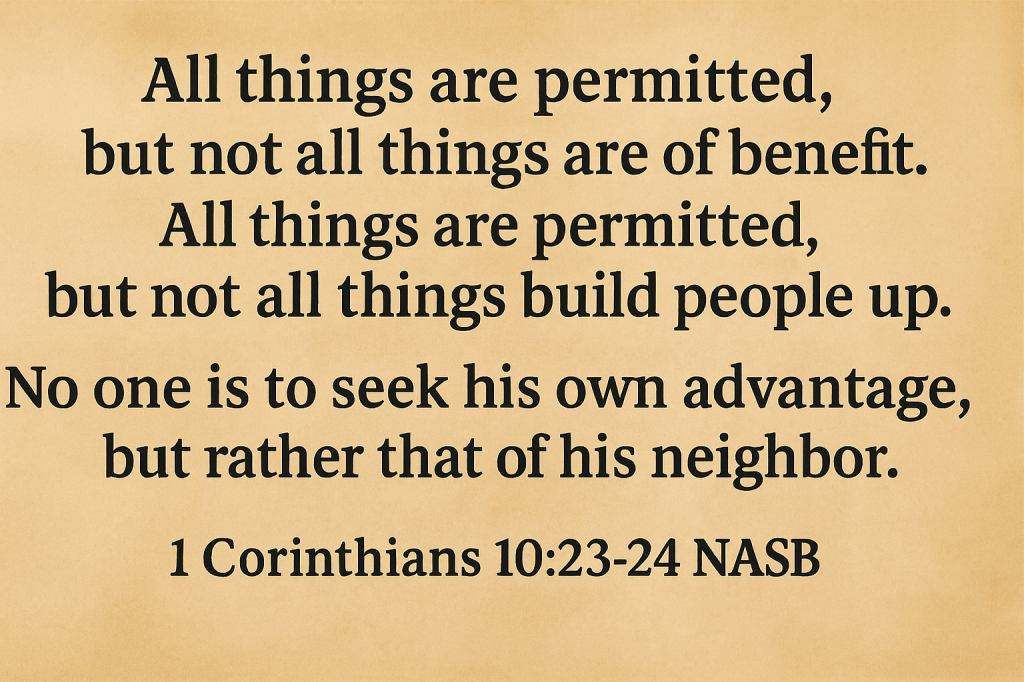
Everything a believer does, whether eating certain foods, following certain traditions, or avoiding them, is acceptable when it is done with a clear conscience and a desire to honour Christ. What makes an action meaningful is not the thing itself, but whether it is offered to the Lord. This keeps us from policing each other. Instead of asking, “Are they doing it the way I prefer?” we ask, “Does this help them honour Christ in their own walk?”
We belong to God because Christ died and rose again. He is Lord over every believer, whether young in faith or mature. He leads both the strong and the weak. Remembering this changes how we see disagreements. When Christ’s glory is our focus, small arguments fade. His cross and resurrection make our personal preferences seem small and temporary.
Sometimes loving others means limiting our own freedoms. A mature believer may choose not to do something harmless to them personally if it would discourage someone who is still healing or learning. That kind of love sends a powerful message. It shows that people matter more than preferences.
Families, churches, and communities all include people who need extra patience. God often surrounds us with those who stretch us, not by accident, but for our growth. Unity is not built through winning arguments. It is built through humility, patience, and a willingness to care more about people than about being right in non-essential matters.
When we focus on what is central, Christ’s grace, his death, his resurrection, and his work in people’s lives, then we stop majoring in the minors. We choose peace over pride. We choose to let others grow at God’s pace. And we choose to treat each other the way God has treated us: with kindness, patience, and room to grow.
Therefore, accept one another, just as Christ also accepted us, for the glory of God.