In his letter to the Galatians, Paul speaks about the freedom believers have through faith in Jesus Christ. He uses the story of Abraham, Sarah, and Hagar as an illustration to show the difference between living under the law and living under God’s promise. This story helps us understand that our salvation is not earned by human effort or religious rules but comes from trusting in Christ alone.
Paul was writing to Christians in Galatia who were being influenced by teachers known as Judaizers. These men insisted that believers had to follow the laws of Moses, such as circumcision, to be truly saved. Paul strongly opposed this message. He reminded the Galatians that salvation is through faith, not through the works of the law. Good works are the fruit of salvation, not the cause of it. They are evidence that someone truly belongs to Christ, but they do not earn a person’s place with God.
To illustrate his point, Paul reminded the Galatians of Abraham’s two sons. Ishmael was born from Hagar, the servant, as a result of human planning. Isaac was born to Sarah, the free woman, as the fulfilment of God’s promise. Paul used this as a picture of two covenants. Hagar represents Mount Sinai, where the law was given, and this covenant leads to bondage because no one can perfectly keep the law. Sarah represents God’s promise, which leads to freedom through faith. Those who trust in Christ are like Isaac. They are children of promise, born not of human effort but by the Spirit of God.
Paul told the Galatians that believers must “cast out the bondwoman,” meaning they must turn away from the idea that human effort can bring salvation. Only those who rely on the promise of God through faith in Jesus are heirs of eternal life. Trying to earn salvation through good deeds is like returning to slavery after being set free.
Even today, many people believe that doing good works or following certain traditions will make them right with God. But scripture teaches that eternal life is a gift, not a payment for good behaviour. Paul wrote in Romans that “the wages of sin is death, but the gift of God is eternal life in Christ Jesus our Lord.” This truth reminds us that no human effort can remove sin. Only God, through His mercy and grace, offers forgiveness and freedom in Christ.
Paul urged the Galatians to stand firm in that freedom. To be free in Christ does not mean living carelessly, but living gratefully and obediently because of what Jesus has done. Obedience is no longer a way to earn salvation, it is a response of love. When we follow God’s ways, we do it not out of fear of punishment, but out of joy in belonging to Him.
It was for freedom that Christ set us free; therefore keep standing firm and do not be subject again to a yoke of slavery.
When a new year begins, people take time off work to celebrate. They gather with loved ones for meals and write down goals that most will forget about later. For Christians wanting to focus their hearts on what matters most in the coming year, there is an important question to consider. What does God want for His people?
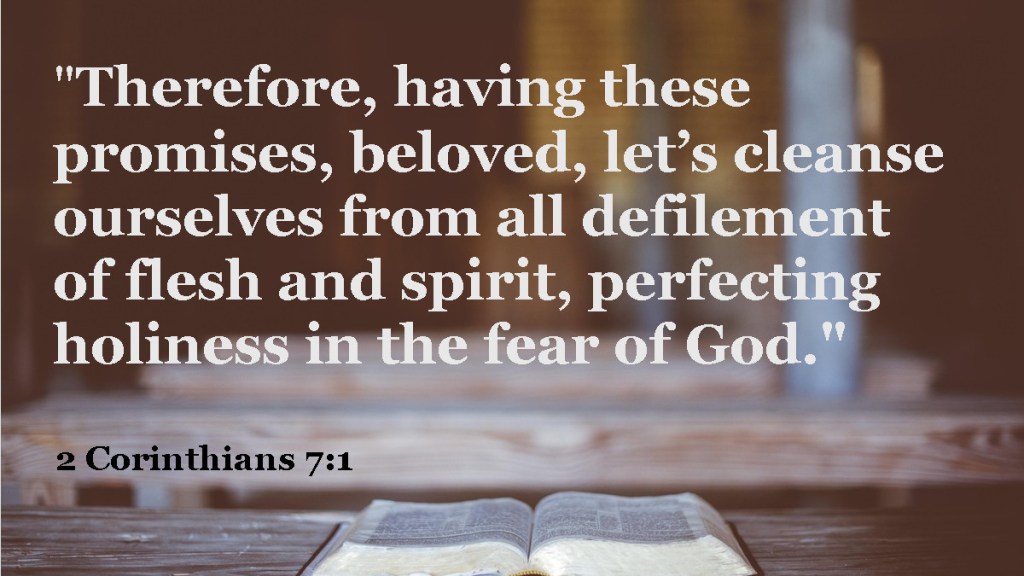
I believe God desires holiness for those who follow Him. He wants His people to grow in purity and become more like Christ. This is not just one priority among many. It is the central reason God gave believers the Holy Spirit.
Church leaders are given their role to feed and nurture God’s people toward this same goal. The apostle Paul wrote with deep emotion about his longing to see believers mature in their faith. He told one church he wanted to present them to Christ as a pure bride. He told another group that he felt like he was in labor pains, waiting for Christ to be fully formed in them. These were not casual wishes. They came from the core of his spiritual concern.
Shouldn’t every Christian pray for holiness in their own life and in the lives of other believers?
The case began when police registered an FIR based on a complaint alleging that the accused had hosted religious gatherings at his residence. The complaint described the use of an LED screen, the delivery of sermons, and the distribution of Bibles during these gatherings.
However, the court found that these activities alone do not violate the Uttar Pradesh Prohibition of Unlawful Conversion of Religion Act, 2021. The judges noted that the FIR failed to identify any individual who had been subjected to coercion, inducement, or threats. At the time the complaint was filed, there was no identifiable victim in the case. The court emphasized that coercion, inducement, or fraudulent means are essential elements required to invoke the 2021 Act. The absence of any allegation of actual or attempted conversion was a central reason for the court’s intervention.
The bench was particularly critical of the Uttar Pradesh Police for their handling of the matter. The court faulted officers for registering an FIR without identifying any victim and for acting in haste in a case where no person had claimed to have been converted.
As a result of its findings, the court granted bail to the accused and issued notice to the complainant in the case. The ruling clarified that simply distributing Bibles or preaching does not automatically trigger the anti-conversion law. More broadly, the judgment reaffirmed constitutional protections for lawful religious expression in India.
For millions of Canadians, Christmas is a public and joyful time. Streets are filled with lights, churches welcome everyone to services, and families gather freely. Around the world, however, there are Christians who experience Christmas very differently. In many countries, celebrating the birth of Jesus can lead to arrest, prison, or even death. As a result, countless believers are forced to celebrate Christmas in secret, if they can celebrate at all.
Those living in high-persecution areas often keep their Christmas joy hidden. Singing carols, decorating a tree, or attending church can be dangerous. For these believers, faith is something practiced quietly, behind closed doors, where safety comes before celebration.
In some countries, Christmas is completely banned. North Korea is one of the harshest examples. The government sees Christianity as a direct threat to its leadership. All Christmas worship and holiday displays are illegal, and even owning a Bible is considered a serious crime. Since 2016, citizens have been ordered to honour Kim Jong-suk, the dictator’s grandmother, who was born on December 24, instead of celebrating Christmas. Any attempt to recognize the birth of Jesus can result in severe punishment, including forced labour or worse.
In Somalia, public Christmas celebrations have been illegal since 2015. The country’s ministry of religion has instructed police and national security forces to actively stop Christmas events. Christians who attempt to gather openly face danger not only from authorities but also from extremist violence, making Christmas a time of fear rather than joy.
Other countries allow Christmas only under strict legal limits. In Brunei, public Christmas displays have been banned since 2014. The government says the ban is meant to protect Muslims from being influenced away from Islam. Christians are allowed to celebrate privately in homes or churches, but public celebrations are forbidden. Muslims who take part in Christmas activities, such as wearing Santa hats or joining festivities, can face up to five years in prison. It is also illegal for Christians to share their faith with Muslims.
In other regions, the main threat comes not from laws but from violence. In northern Nigeria, Christian communities are frequently targeted by ISWAP, an extremist group linked to the Islamic State. Kidnappings and executions are common, especially around major Christian holidays. These attacks create constant fear and make public Christmas worship extremely dangerous.
Despite all of this, many Christians continue to mark Christmas in quiet and personal ways. Some meet secretly in small groups. Others pray alone in their homes. Many remember the meaning of Christmas without decorations, music, or public worship.
For Canadians, these stories are a reminder that freedoms often taken for granted. For millions around the world, Christmas still comes, but it arrives quietly, behind closed doors, and at great personal cost.
After four centuries of silence, heaven finally spoke again. For 400 years, no prophetic voice had been heard in Israel since the close of the Old Testament. Then God broke the silence with announcements that would prepare the way for the promised Messiah.
The Apostle Paul, IRS Images, 2025
The apostle Paul described this moment when he wrote about Christ, who existed in the form of God yet chose not to cling to His divine status. Instead, He emptied Himself and took on the nature of a servant, becoming fully human and demonstrating complete humility and obedience, even to death on a cross.
Throughout the Hebrew scriptures, promises had pointed toward this coming deliverer. The Messiah would offer His life as payment to satisfy God’s requirement that sin must be answered with sacrifice. Early followers of Christ (Around 335 AD) set aside December 25th to commemorate His birth, though the actual date remains unknown. The church established this winter date and began observing the four weeks leading up to Christmas as a time of spiritual preparation.
This season carries special importance today. The world focuses almost entirely on decorations, entertainment, and gift-giving, while very few pause to consider that Christmas marks the birth of Christ Himself. Taking time to prepare our hearts helps us celebrate the true meaning behind the season.
The word “advent” speaks of arrival and appearance. It points to the coming of the Messiah whose arrival the ancient prophets foretold. Isaiah wrote that a virgin would conceive and give birth to a son named Emmanuel. He prophesied that a child would be born whose shoulders would carry the weight of government, called Wonderful Counselor, Mighty God, Everlasting Father, and Prince of Peace. Micah specified that this ruler would come from Bethlehem, though it was among the smallest towns in Judah.
Go, tell it on the mountain, Over the hills and everywhere. Go, tell it on the mountain That Jesus Christ is born.
The New Testament writers confirmed these prophecies. Matthew recorded that Mary was found to be carrying a child through the Holy Spirit before she and Joseph came together. Luke wrote of shepherds watching their flocks when a messenger appeared, announcing that a Savior had been born in David’s city. John wrote that in the beginning, the Word already existed with God and was God, and everything came into being through Him.
Three major announcements marked the beginning of this new era. First came the announcement to a priest named Zachariah that he and his wife would have a son who would prepare people for the Messiah’s arrival. Second came the announcement to Mary that she would carry the Son of God. Third came the announcement to shepherds that a Savior had been born.
Consider the people who received these announcements. Zachariah was a humble priest of no great prominence. Mary was a humble young woman of no reputation. The shepherds ranked among the lowest in society. They were uneducated, overlooked, dismissed as nobodies. Yet the messenger came to them.
During the reign of Herod, king of Judea, there lived a priest named Zachariah from the division of Abijah. His wife Elizabeth also came from a priestly line. Both were righteous before God, living blamelessly according to all the commandments. Yet they had no children because Elizabeth was unable to conceive, and both were now very old.
Being childless carried a heavy burden in their culture because people viewed it as punishment from God for hidden sin. But God saw them differently. He saw that they were both righteous, walking in His commandments, living blamelessly. People judge by outward appearances, but God looks at the heart.
God uses humble people who recognize their place before Him, who acknowledge their own sinfulness, who have turned from their sins and placed their trust in Christ. They are righteous not through their own righteousness but through Christ’s righteousness credited to them, and they walk daily in obedience to God’s word.
While Zachariah was faithfully serving in the temple, chosen by lot to burn incense, a messenger from God appeared to him at the right side of the incense altar. When Zachariah saw him, he was startled and overcome with fear. This messenger was Gabriel, who often appears in scripture to make important announcements.
Gabriel told Zachariah not to be afraid, for his prayer had been heard. His wife Elizabeth would bear a son, and they were to name him John. He would bring joy and gladness to them. He would be great in God’s sight, filled with the Holy Spirit even before birth. He would bring many Israelites back to God and go before the Lord in the spirit and power of Elijah, preparing a people ready for the Lord.
Zachariah and Elizabeth had prayed for years that God would give them a child. By this point, they had likely stopped praying because they had reached old age and childbearing was impossible. But God remembered their prayer even though they had forgotten it. Believers should never think God forgets their prayers. He remembers them even when they have been forgotten, and often answers them much later.
God’s timing is always perfect. He ordained that a child should be born to them in their old age, a child who would be a messenger announcing the arrival of Jesus. This child had to be born around the same time as Jesus to be the right age to announce His coming.
But Zachariah doubted. He said to the messenger, “How can I be sure of this? I am an old man, and my wife is very old.” Too often believers offer prayers without really believing God will answer. This is unbelieving prayer. When Zachariah expressed doubt, there were consequences. The messenger answered, “I am Gabriel, who stands in the presence of God. I was sent to speak to you and tell you this good news. But now, because you did not believe my words, which will come true at their proper time, you will be silent and unable to speak until the day this happens.”
When Zachariah came out of the temple, he could not speak. The people realized he had seen a vision because he kept making signs to them but remained speechless. He finished his week of service, then returned home to Elizabeth, still unable to tell her the amazing things he had heard.
The Bible teaches that God disciplines those He loves. Though Zachariah was righteous and obedient, he still failed to trust God. He was silenced until the day God’s promise came to pass. He would have been so excited to tell his wife that in their old age they would have a son, but God closed his mouth. He could not do the very thing he most wanted to do.
But this did not stop God from doing what He had promised. Even though His servant had been disobedient, God did not withdraw His promise. After those days, Elizabeth conceived and remained in seclusion for five months. When Elizabeth realized she had conceived, she kept herself hidden. She wanted to be certain of her pregnancy before appearing publicly.
She and Zachariah rejoiced just as Gabriel had said they would. Elizabeth particularly rejoiced because God took away her disgrace. For years she had been the subject of jokes and accusations. Now she would have a child—not just any child, but a special child who would be a messenger preparing people for the arrival of the Messiah.
This was the first announcement after 400 years of complete silence from God. God had now spoken, and His Son was about to enter the world. But first, the messenger had to be born. God does not forget His people or their prayers. When believers serve Him faithfully, that is often when He speaks most clearly.







 Texas Gospel Canada Southern Gospel Radio