The Meaning of the Resurrection

AMY TURNER

The Christian faith stands on the truth of Jesus rising from the dead. Without the resurrection, the message of the gospel would have no foundation, and faith would be empty. Christianity is not only a way of thinking, nor is Jesus remembered simply as a wise teacher. Believers confess him as the eternal Son of God who entered the world, took on human life, suffered, and died to bring forgiveness for sin.

Jesus himself promised that if his body was destroyed, he would bring it back to life in three days. No other person has ever broken the power of death in this way. His resurrection is not just a part of the story; it is the very core.

The statement is trustworthy: For if we died with Him, we will also live with Him;

2 Timothy 2:11

The Promise of Resurrection Life

AMY TURNER

In his letter to the Colossians, Paul describes Jesus as the beginning and the first to rise from the dead in a way that gives Him first place in all things. The Bible shows that other people were brought back to life, such as Lazarus, but their return was temporary. They would face death again.

Jesus, however, was raised in a different way. His resurrection was not only a return to life but a transformation. He was given a body filled with glory and strength, a body that will last forever. Scripture calls Him the first fruit from among the dead. This means He is the beginning of something greater that is promised to all who belong to Him.

When Jesus rose, He showed what lies ahead for those who trust in Him. As He was raised with a body fit for eternity, so one day His people will share in that same kind of life. The resurrection of Christ is both a victory over death and a promise of what is to come.

But the fact is, Christ has been raised from the dead, the first fruits of those who are asleep.

1 Corinthians 15:20

Hope Found in the Risen Christ

AMY TURNER

John 20:13 tells of a moment when Mary Magdalene, heartbroken, stood outside Jesus’ empty tomb. When angels asked why she was crying, she explained her sorrow, believing someone had taken Jesus’ body. Earlier that morning, several women had come to the tomb, only to find the stone moved. Mary ran to tell Peter and John, while others remained behind.

In her grief, Mary could not recognise what was happening. Even when Jesus stood before her, she thought he was a gardener. It wasn’t until he spoke her name that she realised it was him. Sorrow had clouded her vision, keeping her from seeing what was right before her.

Many experience times when pain and worry hide the truth from them. But the resurrection reminds us that death and fear no longer hold the final word.

Blessed be the God and Father of our Lord Jesus Christ, who according to His great mercy has caused us to be born again to a living hope through the resurrection of Jesus Christ from the dead,

1 Peter 1:3

Mark Bishop tells the story of Lazarus with inspired songwriting

SPECIAL CROSSROADS MUSIC

Southern Gospel music favorite Mark Bishop is so widely acclaimed for his singing that it’s easy to overlook the depth of his songwriting. Yet as his new Sonlite Records single, “Now Lazarus Can Sing” shows, he’s a conscientious and inspired craftsman whose unique way of looking at things has led to powerful affirmations of faith and salvation.

“I was watching the news as someone was being ushered through a bunch of shouting reporters, trying to get information from him,” Bishop recalls. “His people led him to a waiting car where he jumped in, and they took off. My songwriter brain kicked in, and for some reason I began to wonder about the story of Lazarus and the questions people would have lined up for hours to ask him.

“He had seen it. And he was standing right here in front of them. How could you not ask him what it was like? I’m sure what he saw was beyond description.”

Mark Bishop shares the story behind how he wrote “Now Lazarus Can Sing.”
With these thoughts in mind, Bishop has created a compelling vehicle that, in a profoundly Biblical way, embodies — by illuminating through down-to-earth dialogue rather than proclaiming in grand turns of speech — the miraculous story of Lazarus:

Have you seen Lazarus since that day?
Something about him has changed.
You know the day that I’m talking ’bout.
The day Jesus called out his name.

I spoke to him just the other day.
At the market I pulled him aside.
Can you remember the things you saw?
He put his hand on my shoulder and cried.

So I talked to his sister Martha.
“Martha, what’s he said to you?”
She said “he looks out of the window and smiles,
That his worrying days are all through.”

And even as the music swells and subsides, Bishop’s distinctive voice keeps the listener focused on the essentials, framed in a way that only he could have created.

“Just as important as what he saw… what about how he felt? He was a recipient of perfect love. He lost all of his worry… his doubt… his regrets… everything negative.

“He was no doubt the most changed man in the history of the world.

“And maybe,” the singer-songwriter concludes, “… just maybe… he brought back some other traits… a little bit of residue from heaven. That’s what this song is about; how heaven rubbed off on Lazarus.”

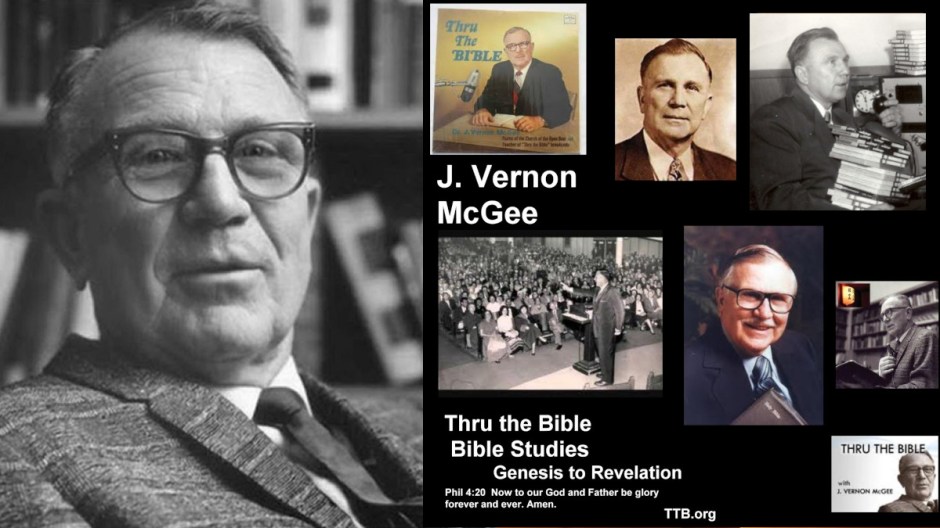
Thru the Bible: Matthew 25-28

Matthew 25-28 – The audio on this video is the property of Thru the Bible. It is offered free of charge. If you wish to make a donation, do not send it to us. Visit http://www.ttb.org for information. The audio is attributed to Dr. J. Vernon McGee and Thru the Bible. Intellectual property rights are those of Thru the Bible. Please contact us if you feel our understanding of the terms of use are in error. Copyright information obtained from https://ttb.org/about/copyright-policy

Dr. McGee’s sermon covers Matthew chapters 25 through 28, focusing on his interpretations of the parables, the events leading to the crucifixion, the crucifixion itself, and the resurrection of Jesus Christ.

In chapter 25, Dr. McGee discusses the parable of the ten virgins. He refutes the idea of a partial Rapture based on this parable, stating that he believes every believer will be taken in the Rapture by God’s grace, not merit. He argues that the ten virgins refer to the nation of Israel, not the church. He also touches upon the parable of the talents, emphasizing the principle of using whatever gifts God has given until Christ’s return. Dr. McGee then interprets the Judgment of the Nations in Matthew 25 as occurring during the Great Tribulation, where nations will be judged based on their treatment of Christ’s brethren (the 144,000 sealed messengers). He believes the terms “sheep” and “goats” refer to ethnic groups or nations, not individual lost or saved people.

Moving into chapter 26, Dr. McGee narrates the events leading up to Jesus’s crucifixion. He highlights Jesus’s repeated predictions of his death during the Passover. He describes the anointing of Jesus at Bethany by a woman (identified as Mary in John’s Gospel), emphasizing the significance of her act as an anticipation of his burial. He recounts Judas’s betrayal for 30 pieces of silver and the institution of the Lord’s Supper during the Passover meal. Dr. McGee also discusses Jesus’s prediction of Peter’s denial and the events in the Garden of Gethsemane, where he believes Jesus won the victory over the horror of bearing the sins of the world. He continues with the betrayal by Judas, the arrest of Jesus, and his trial before Caiaphas and the Sanhedrin, including Peter’s denial.

Chapter 27 details the crucifixion of Jesus. Dr. McGee mentions Judas’s remorse and suicide after Jesus’s condemnation. He recounts Jesus’s trial before Pontius Pilate, the crowd’s choice of Barabbas over Jesus, and Pilate’s reluctant decision to have Jesus crucified. He describes the mockery and suffering Jesus endured at the hands of the Roman soldiers before his crucifixion. Dr. McGee notes that the Gospel writers do not give graphic details of the crucifixion itself, suggesting a divine reverence for this event. He highlights the supernatural events that occurred at Jesus’s death, including the tearing of the temple veil from top to bottom (symbolizing open access to God) and the earthquake. He also mentions the burial of Jesus by Joseph of Arimathea and Nicodemus. The chapter concludes with the sealing of the tomb and the setting of a guard by the chief priests and Pharisees who remembered Jesus’s prediction of his resurrection.

Finally, chapter 28 focuses on the resurrection of Jesus and the Great Commission. Dr. McGee emphasizes that the death and resurrection of Christ are the two great pillars of the Gospel. He describes the women coming to the tomb, the earthquake, the angel rolling back the stone, and the angel’s announcement that Jesus had risen. He recounts Jesus’s appearances to the women and later to the eleven disciples in Galilee. Dr. McGee then discusses the Great Commission in Matthew 28:19-20, seeing it as having an application for today, as well as a future fulfillment during the Great Tribulation and the Millennium. He notes the omission of the Ascension in Matthew’s Gospel, suggesting it is because Matthew focuses on the kingdom being upon the Earth and the King remaining. Dr. McGee concludes by affirming that Jesus was born a king, lived as a king, died a king, rose again a king, and will return as the King of Kings and Lord of Lords.