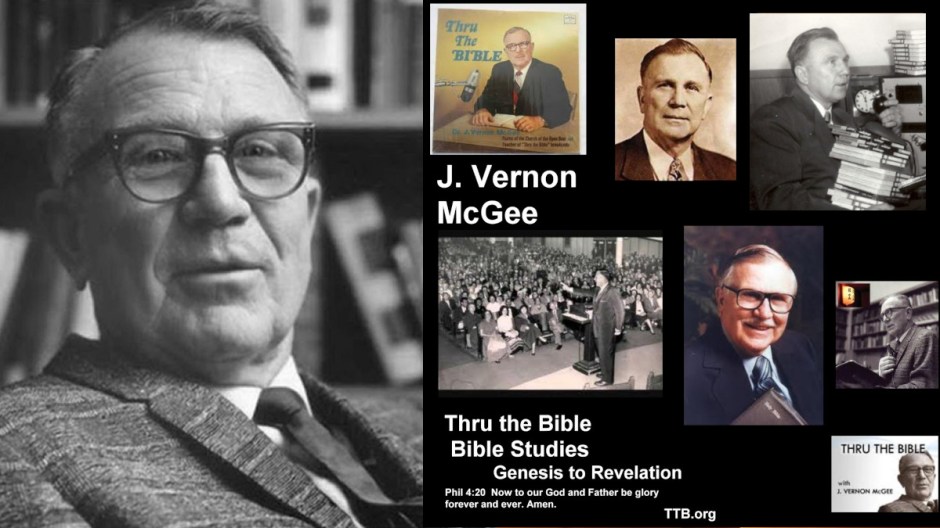
Dr. J. Vernon McGee – Matthew 1

The audio on this video is the property of Thru the Bible. It is offered free of charge. If you wish to make a donation, do not send it to us. Visit http://www.ttb.org for information. The audio is attributed to Dr. J. Vernon McGee and Thru the Bible. Intellectual property rights are those of Thru the Bible.
Please contact us if you feel our understanding of the terms of use are in error.
Copyright information obtained from https://ttb.org/about/copyright-policy

Dr. McGee’s message in this excerpt from his discourse on the Gospel of Matthew begins by underscoring the vital importance of understanding the approximately 400-year intertestamental period between the Old and New Testaments. During this time of divine silence, significant global shifts occurred, witnessing the decline of the Medo-Persian and Egyptian empires and the rise of Greece under Alexander the Great, who even visited Jerusalem. Subsequently, the Roman Empire emerged as the dominant world power by the time the New Testament opens. Internally, Judea underwent a radical transformation, with new cultural norms, institutions, and organizations developing, giving rise to the Jewish parties mentioned in the New Testament, such as the Pharisees (defenders of Jewish tradition and nationalists), the Sadducees (wealthy, liberal in theology, and opposed to tradition), the scribes (legal experts focused on the letter of the law), and the Herodians (political opportunists). Dr. McGee emphasizes that understanding this historical context is crucial for appreciating the New Testament.

He then turns his attention to the Gospel of Matthew, stating that it was written primarily for the nation of Israel, a religious people, and possibly was first penned in Hebrew. He considers Matthew a key book that bridges the Old Testament and the New, gathering numerous Old Testament prophecies and showing their fulfillment in Jesus Christ. A central theme in Matthew is the Kingdom of Heaven, an expression unique to this Gospel, which Dr. McGee defines as the reign of the heavens over the Earth, clearly distinguishing it from the church. The genealogy that opens Matthew’s Gospel is deemed a profoundly important document, establishing Jesus’ lineage from Abraham, which places him within the chosen nation, and from David, which gives him the legal claim to the throne. This genealogy was a matter of public record and its accuracy was not challenged in early times.

Dr. McGee draws a significant parallel between the “book of the generation of Adam” in Genesis and “the book of the generation of Jesus Christ” in Matthew, highlighting that while entrance into Adam’s family is by natural birth, entry into Christ’s family occurs through the New Birth by faith in Christ. He also points out the remarkable inclusion of four women—Tamar, Rahab, Ruth, and Bathsheba—and Gentiles in Jesus’ genealogy, which was unconventional for the time, suggesting themes of sin, faith, grace, and God’s redemptive purposes. He explains the seemingly broken pattern in verse 16, where it states “Jacob begat Joseph the husband of Mary, of whom was born Jesus,” clarifying that while Joseph provides the legal title to David’s throne (being in the line of David through Solomon), he was not Jesus’ biological father due to the curse on Jeconiah’s line; Mary, also of the lineage of David (through Nathan), was the one who bore Jesus.

A cornerstone of Dr. McGee’s message is the Virgin Birth of Jesus Christ. He emphasizes that Matthew explicitly teaches that Joseph was not Jesus’ father and sees this as the fulfillment of the prophecy in Isaiah 7:14: “Behold, a virgin shall be with child and shall bring forth a son, and they shall call his name Emmanuel“. He strongly criticizes liberal interpretations that attempt to translate the Hebrew word alma and the Greek word parthenos as “young woman” instead of “virgin,” arguing that the Septuagint translation by Hebrew scholars clearly understood it to mean virgin. Dr. McGee underscores the profound significance of the name Emmanuel, meaning “God with us,” asserting that Jesus can only be the Savior (Jesus) because he is Emmanuel through the Virgin Birth. He firmly believes that while one might initially come to Christ without fully understanding the Virgin Birth, a true child of God will not ultimately deny this foundational doctrine.

The audio on this video is the property of Thru the Bible. It is offered free of charge. If you wish to make a donation, do not send it to us. Visit http://www.ttb.org for information. The audio is attributed to Dr. J. Vernon McGee and Thru the Bible. Intellectual property rights are those of Thru the Bible.
Please contact us if you feel our understanding of the terms of use are in error.
Copyright information obtained from https://ttb.org/about/copyright-policy


Understanding God’s Love and Justice Through Jesus

TEXAS GOSPEL VOLUNTEER

God’s love and justice may seem at odds when it comes to human sin, but they are beautifully reconciled through Jesus Christ. Despite our transgressions against God’s laws, His deep love for us compelled Him to provide a way for salvation. This path, however, had to satisfy His perfect justice.

The solution came in an act of divine sacrifice. God Himself, in the person of Jesus, entered our world. Born of a virgin, Jesus was both fully divine and fully human. He lived a sinless life and then willingly bore the punishment for our sins on the cross. This supreme act of love fulfilled the demands of justice, as the penalty for sin was paid in full.

Through Christ’s sacrifice, God demonstrated His love while upholding His justice. As the apostle Paul writes in Romans 5:8, “But God demonstrates His own love toward us, in that while we were still sinners, Christ died for us.”

Now, because of Jesus’ work, we can receive forgiveness and eternal life. God remains both loving and just, having provided a way for sinners to be reconciled to Him without compromising His righteous standards.

Deception in the Last Days: A Warning for Believers

TEXAS GOSPEL VOLUNTEER

In discussions about the Second Coming, many focus on tribulation, war, and judgment. However, a crucial aspect often overlooked is deception. Jesus himself emphasized the prevalence of mass deception in the end times, particularly in Matthew 24. He cautioned his followers to be vigilant, stating, “Take heed that no man deceive you” (NASB).

This warning raises questions about the vulnerability of true believers to misleading influences. While it’s possible for Christians to be temporarily led astray, especially those new to the faith, the Bible assures us that those who genuinely belong to Christ will not be permanently deceived.
The Apostle Paul addresses this issue in Ephesians 4:14, comparing new believers to children who can be easily swayed by false teachings. This underscores the importance of spiritual growth and maturity in resisting deception.

Looking ahead to the future, Matthew 24 describes a time of intense deception. However, it also offers reassurance that God will protect His chosen ones by limiting the duration of this deceptive period. This divine intervention prevents even the elect from being hopelessly misled.

In our present day, the Holy Spirit plays a crucial role in safeguarding believers against deception. This protection extends into the future, where God’s constraining power will continue to shield His people from ultimate deception.

As we navigate these challenging times, it’s essential for believers to remain grounded in their faith, grow in spiritual maturity, and trust in God’s protective care.

A Journey of Faith: Libbi Perry Stuffle’s 54 Years in Gospel Music

AMY TURNER

On Christmas Day 2024, Libbi Perry Stuffle marked an incredible milestone in her career – 54 years of singing Gospel music. This remarkable journey has been filled with both triumphs and challenges, but through it all, Stuffle’s faith has remained unwavering.

Reflecting on her decades-long career, Stuffle shared, “You know, I look back and there’s been a lot of good times, there’s been a lot of bad times, there’s been a lot of tragic times.” Despite the ups and downs, she maintains a positive outlook, emphasizing that “there’s never been a day that God’s not been faithful and never been a morning that His mercies went new.”

Libbi Stuffle Courtesy Perrysministries.com

Stuffle acknowledges that during difficult periods, it was sometimes hard to see God’s presence. However, with hindsight, she recognizes His constant support. “Looking back, I mean, God has been with us every step of the way. He has provided, He has been everything that He said that He would be, that He would never leave us, never forsake us,” she affirmed.

While the length of her career might make her “feel old,” Stuffle remains grateful for the opportunity to continue her calling. She expressed, “I’m just honoured to be able to still get out here and do the calling that He’s placed on us.”

The Perry family’s commitment to Gospel music continues to thrive. Their latest project, titled “Long, Long Road,” features their current single, “You Can’t Hurry God.” This new release demonstrates that even after more than five decades, the Perrys’ passion for sharing their faith through music remains strong.

As Libbi Perry Stuffle looks back on 54 years of singing Gospel music, her journey serves as a testament to the power of faith, perseverance, and the enduring appeal of Gospel music.

Understanding God’s Promise of Protection

JEFF TURNER

God promises to protect his followers, so how come today we see mass shootings and other horrendous actions?

The promise of protection for followers of God does not mean that they will never face suffering or death. In fact, Jesus Himself told his disciples that in this world they will have trouble, but He also promised them peace in Him.

The reality is that we live in a fallen world where sin, evil, and suffering exists because of man’s introduction of sin. Mass shootings and other tragedies are a result of the brokenness of this world. However, as followers of Christ, we can take comfort in the fact that Jesus has overcome the world through His death and resurrection. While we may suffer in this life, God has promised to protect us from spiritual harm and eternal separation from him. Even in the face of tragedy, we can have hope and peace in knowing that ultimately, God is in control and has the power to bring good out of even the most difficult situations.

God’s promise of protection extends beyond physical safety and includes the assurance of His presence, comfort, and eternal life with Him.