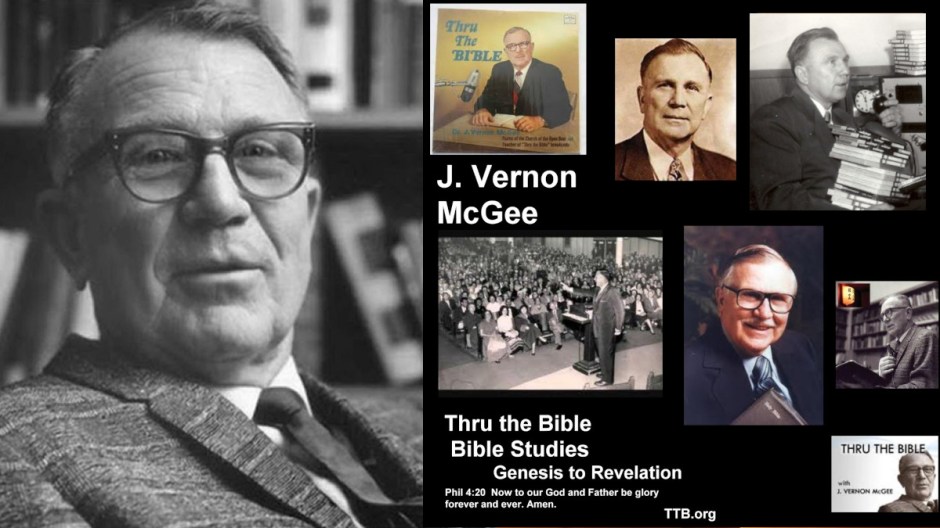
Thru the Bible: Matthew 5-7

The audio on this video is the property of Thru the Bible. It is offered free of charge. If you wish to make a donation, do not send it to us. Visit http://www.ttb.org for information. The audio is attributed to Dr. J. Vernon McGee and Thru the Bible. Intellectual property rights are those of Thru the Bible.
Please contact us if you feel our understanding of the terms of use are in error.
Copyright information obtained from https://ttb.org/about/copyright-policy

Dr. J. Vernon McGee in his exposition of Matthew 5-7, known as the Sermon on the Mount, emphasizes its significance while clarifying its proper interpretation. He notes that while excerpts appear in other gospels, Matthew provides the most extensive account. McGee believes Jesus likely repeated these teachings on multiple occasions. He highlights two contrasting and erroneous viewpoints on the Sermon: the “far left” liberal theologians who consider it the entirety of the gospel and the only crucial part of Scripture, sometimes even reducing it to the Golden Rule, and the “far right” hyper-dispensationalists who dismiss it as irrelevant to believers today.

McGee firmly states that the Sermon on the Mount is not the Christian Gospel. He contrasts it with Paul’s declaration of the gospel in Corinthians, which centers on Christ’s death for our sins, His burial, and His resurrection according to the Scriptures. These foundational elements of the Christian faith are absent from the Sermon on the Mount. Treating the Sermon as the gospel leads to hypocrisy because its ethical standards are impossibly high for unregenerate individuals to achieve. McGee argues that proclaiming to live by the Sermon while failing to do so creates hypocrites within the church.

He explains that the ermon on the Mount presents law lifted to its highest degree, even exceeding the demands of the Old Testament law. For instance, Jesus redefines murder as including anger towards a brother and adultery as including lustful looking. According to McGee, if one honestly examines the Sermon, they will realize their inability to measure up to its standards and recognize their need for a savior.

Furthermore, McGee clarifies that the modus operandi for Christian living in the present age is not found within the Sermon on the Mount. While it provides high ethical standards that are not contrary to Christian living and indeed express the mind of Christ, it lacks the dynamic power of the indwelling Holy Spirit, which is essential for believers to live righteously. The Sermon offers the ethic, but the Holy Spirit provides the power to live it out.

McGee posits that the primary purpose of the Sermon on the Mount is to set forth the law of the Kingdom of Heaven. He identifies Matthew’s Gospel as presenting Jesus as the King, and the Sermon as the King’s manifesto or the platform of the Prince of Peace. He believes this law will find its full fruition during the Millennium when Christ returns to Earth to rule, enforcing every word of it. While it is for us to learn and understand today, it is not fully in effect in the current age.

Despite this, McGee emphasizes that Christians who acknowledge Jesus as Lord should not despise the Sermon but seek to understand and apply its principles in light of other Scriptures, recognizing they can only obey through the power of the Holy Spirit. He notes that the Sermon on the Mount can bring conviction to the hearts of men, revealing their sinfulness and their falling short of God’s glory. It reveals Christ’s deeper definitions of sin, like murder and adultery of the heart.

McGee then delves into specific aspects of the Sermon. The Beatitudes describe the characteristics of the citizens of the Kingdom, such as being poor in spirit, mourning, and meek. He stresses that these are states of being, not achieved through human effort but produced by the Spirit of God. He points out that some of these promises, like the meek inheriting the earth, are not currently being fulfilled, indicating their future application in the Kingdom.

In chapters 6, McGee discusses the externalities of religion – giving of alms, prayer, and fasting – emphasizing that these should be done sincerely and privately as acts of devotion to God, not for public recognition or praise. He criticizes ostentatious displays of piety, noting that those who seek human glory have already received their reward. He considers the Lord’s Prayer a model prayer, offering guidance on how to pray with sincerity and simplicity, but cautions against its rote recitation, especially when its specific petitions don’t align with one’s present circumstances. He also addresses the topic of money, urging believers to invest in eternal treasures by supporting the Lord’s work. He touches on anxiety about material needs, encouraging trust in God’s provision while still exercising wisdom.

Chapter 7 addresses judging others, cautioning against harsh and condemning judgment of inward motives. However, McGee clarifies that this doesn’t forbid discerning fruits and judging wrong actions. He uses the analogy of a speck in a brother’s eye versus a log in one’s own to illustrate the hypocrisy of focusing on others’ minor faults while ignoring one’s own significant shortcomings. He also discusses the principle of not casting pearls before swine, implying a need for discernment in sharing spiritual truths. McGee highlights the importance of prayer in understanding how to interact with others and emphasizes the Golden Rule as a principle to operate by, within the broader context of seeking God’s will. He contrasts the straight and narrow way to life with the wide path to destruction and warns against false prophets, who are to be known by their fruits. He concludes by reiterating that not everyone who claims to follow Jesus will enter the Kingdom, but only those who do the will of the Father. True discipleship involves building one’s life on the rock foundation of Christ.

In a concluding summary, McGee explains that God governs mankind through three great systems: the Mosaic Law, which revealed sin; the present age of Grace, where salvation is by faith in Christ and believers live by the power of the Holy Spirit; and the future Kingdom, where the law of the Sermon on the Mount will be enforced by Christ. He stresses that salvation today is solely through faith in Christ’s death and resurrection not by adherence to any law, including the Sermon on the Mount. The human heart is the fundamental problem, requiring regeneration by God. The Christian life in this age is characterized by the fruit of the Spirit, not by striving to keep a code of conduct through human effort. The Sermon on the Mount, therefore, serves to highlight our spiritual inadequacy and drive us to seek salvation and the enabling power of the Holy Spirit in Jesus Christ.

Dr. J. Vernon McGee – Matthew 2-4

Dr. McGee’s message in these excerpts from his study of Matthew emphasizes that the Gospel of Matthew was specifically written to the nation of Israel and aims to demonstrate how the life and ministry of Jesus Christ fulfilled numerous Old Testament prophecies. He highlights the visit of the wise men, correcting the common misconception of there being only three and pointing out that their journey, prompted by a star (which he believes was a supernatural event, not merely astronomical), was in response to prophecies like Balaam’s prophecy of a star coming out of Jacob. The gifts they brought had symbolic significance, with gold representing his kingship, frankincense his life, and myrrh his death.

Dr. McGee explains the subsequent flight into Egypt and the return to Nazareth as literal fulfillments of Hosea 11:1 and Isaiah 11:1 (as it relates to being called a Nazarene) respectively, showing how God orchestrated events to align with prophecy. He underscores that these seemingly disparate prophecies were fulfilled literally and naturally.

The introduction of John the Baptist is presented as the fulfillment of Malachi’s prophecy of a messenger preparing the way for the Lord. John’s message was one of repentancebecause the Kingdom of Heaven was at hand, which Dr. McGee clarifies as the rule of heaven over the earth, present in the person of the King.

The baptism of Jesus by John was not for Jesus’ own repentance, as he was sinless, but rather for him to identify with sinful mankind and to fulfill all righteousness. Dr. McGee also notes that it set him aside for his office as priest, with the Holy Spirit descending upon him.

The temptation of Jesus in the wilderness was a genuine test, but Dr. McGee insists that Jesus could not have fallen. This test was to prove and demonstrate his perfect character, contrasting it with the temptation of Eve. Jesus consistently used scripture to overcome Satan’s temptations, highlighting the importance of knowing and using the Word of God. Dr. McGee also raises the point that the devil seemed to have the authority to offer Jesus the kingdoms of the world.

Dr. McGee then discusses Jesus moving his headquarters from Nazareth to Capernaum, explaining this as another fulfillment of prophecy from Isaiah, bringing light to the region of Galilee of the Gentiles. Jesus continued the message of repentance and the nearness of the Kingdom of Heaven, echoing John the Baptist. He called his first disciples, promising to make them “fishers of men”. Jesus’ ministry in Galilee involved teaching, preaching the gospel of the Kingdom, and performing numerous healings, demonstrating his power and authority. Dr. McGee concludes by mentioning the Sermon on the Mount as the manifesto of the King.

The audio on this video is the property of Thru the Bible. It is offered free of charge. If you wish to make a donation, do not send it to us. Visit http://www.ttb.org for information. The audio is attributed to Dr. J. Vernon McGee and Thru the Bible. Intellectual property rights are those of Thru the Bible.
Please contact us if you feel our understanding of the terms of use are in error.
Copyright information obtained from https://ttb.org/about/copyright-policy

Dr. J. Vernon McGee – Matthew 1

The audio on this video is the property of Thru the Bible. It is offered free of charge. If you wish to make a donation, do not send it to us. Visit http://www.ttb.org for information. The audio is attributed to Dr. J. Vernon McGee and Thru the Bible. Intellectual property rights are those of Thru the Bible.
Please contact us if you feel our understanding of the terms of use are in error.
Copyright information obtained from https://ttb.org/about/copyright-policy

Dr. McGee’s message in this excerpt from his discourse on the Gospel of Matthew begins by underscoring the vital importance of understanding the approximately 400-year intertestamental period between the Old and New Testaments. During this time of divine silence, significant global shifts occurred, witnessing the decline of the Medo-Persian and Egyptian empires and the rise of Greece under Alexander the Great, who even visited Jerusalem. Subsequently, the Roman Empire emerged as the dominant world power by the time the New Testament opens. Internally, Judea underwent a radical transformation, with new cultural norms, institutions, and organizations developing, giving rise to the Jewish parties mentioned in the New Testament, such as the Pharisees (defenders of Jewish tradition and nationalists), the Sadducees (wealthy, liberal in theology, and opposed to tradition), the scribes (legal experts focused on the letter of the law), and the Herodians (political opportunists). Dr. McGee emphasizes that understanding this historical context is crucial for appreciating the New Testament.

He then turns his attention to the Gospel of Matthew, stating that it was written primarily for the nation of Israel, a religious people, and possibly was first penned in Hebrew. He considers Matthew a key book that bridges the Old Testament and the New, gathering numerous Old Testament prophecies and showing their fulfillment in Jesus Christ. A central theme in Matthew is the Kingdom of Heaven, an expression unique to this Gospel, which Dr. McGee defines as the reign of the heavens over the Earth, clearly distinguishing it from the church. The genealogy that opens Matthew’s Gospel is deemed a profoundly important document, establishing Jesus’ lineage from Abraham, which places him within the chosen nation, and from David, which gives him the legal claim to the throne. This genealogy was a matter of public record and its accuracy was not challenged in early times.

Dr. McGee draws a significant parallel between the “book of the generation of Adam” in Genesis and “the book of the generation of Jesus Christ” in Matthew, highlighting that while entrance into Adam’s family is by natural birth, entry into Christ’s family occurs through the New Birth by faith in Christ. He also points out the remarkable inclusion of four women—Tamar, Rahab, Ruth, and Bathsheba—and Gentiles in Jesus’ genealogy, which was unconventional for the time, suggesting themes of sin, faith, grace, and God’s redemptive purposes. He explains the seemingly broken pattern in verse 16, where it states “Jacob begat Joseph the husband of Mary, of whom was born Jesus,” clarifying that while Joseph provides the legal title to David’s throne (being in the line of David through Solomon), he was not Jesus’ biological father due to the curse on Jeconiah’s line; Mary, also of the lineage of David (through Nathan), was the one who bore Jesus.

A cornerstone of Dr. McGee’s message is the Virgin Birth of Jesus Christ. He emphasizes that Matthew explicitly teaches that Joseph was not Jesus’ father and sees this as the fulfillment of the prophecy in Isaiah 7:14: “Behold, a virgin shall be with child and shall bring forth a son, and they shall call his name Emmanuel“. He strongly criticizes liberal interpretations that attempt to translate the Hebrew word alma and the Greek word parthenos as “young woman” instead of “virgin,” arguing that the Septuagint translation by Hebrew scholars clearly understood it to mean virgin. Dr. McGee underscores the profound significance of the name Emmanuel, meaning “God with us,” asserting that Jesus can only be the Savior (Jesus) because he is Emmanuel through the Virgin Birth. He firmly believes that while one might initially come to Christ without fully understanding the Virgin Birth, a true child of God will not ultimately deny this foundational doctrine.

The audio on this video is the property of Thru the Bible. It is offered free of charge. If you wish to make a donation, do not send it to us. Visit http://www.ttb.org for information. The audio is attributed to Dr. J. Vernon McGee and Thru the Bible. Intellectual property rights are those of Thru the Bible.
Please contact us if you feel our understanding of the terms of use are in error.
Copyright information obtained from https://ttb.org/about/copyright-policy

Sharing the Gospel: A Call to Action

TEXAS GOSPEL VOLUNTEER

Some believe that sharing the gospel is best done by waiting for opportunities that God provides. Others emphasize a more proactive approach, inspired by Jesus’ words in Matthew 28:19-20: “Go therefore and make disciples of all nations.” This call to action suggests no boundaries—every method and place can be used to spread the good news.

Evangelism can take many forms: speaking with neighbours, engaging in street or classroom discussions, building friendships, or even sharing faith in competitive or challenging environments. The key is to consistently proclaim the message of Christ wherever we are.

However, the method of sharing is less important than the message itself. It’s vital to ensure that the gospel is communicated truthfully and accurately. Becoming a follower of Christ involves more than a simple prayer; it requires recognizing one’s sin, turning to Jesus in repentance, and fully committing to Him as Lord and Master. This transformation brings deep joy and purpose to the believer’s life, as seen in Romans 6:22: “But now that you have been set free from sin and have become slaves of God, the benefit you reap leads to holiness, and the result is eternal life.”

Evangelism is an urgent mission for every believer. It’s a call to both action and truth, ensuring that the life-changing message of Christ reaches all.

Deception in the Last Days: A Warning for Believers

TEXAS GOSPEL VOLUNTEER

In discussions about the Second Coming, many focus on tribulation, war, and judgment. However, a crucial aspect often overlooked is deception. Jesus himself emphasized the prevalence of mass deception in the end times, particularly in Matthew 24. He cautioned his followers to be vigilant, stating, “Take heed that no man deceive you” (NASB).

This warning raises questions about the vulnerability of true believers to misleading influences. While it’s possible for Christians to be temporarily led astray, especially those new to the faith, the Bible assures us that those who genuinely belong to Christ will not be permanently deceived.
The Apostle Paul addresses this issue in Ephesians 4:14, comparing new believers to children who can be easily swayed by false teachings. This underscores the importance of spiritual growth and maturity in resisting deception.

Looking ahead to the future, Matthew 24 describes a time of intense deception. However, it also offers reassurance that God will protect His chosen ones by limiting the duration of this deceptive period. This divine intervention prevents even the elect from being hopelessly misled.

In our present day, the Holy Spirit plays a crucial role in safeguarding believers against deception. This protection extends into the future, where God’s constraining power will continue to shield His people from ultimate deception.

As we navigate these challenging times, it’s essential for believers to remain grounded in their faith, grow in spiritual maturity, and trust in God’s protective care.