Have you ever felt like being a good person just isn’t enough? Or maybe you thought that following Jesus meant adding a whole list of rules to your life? You’re not alone
The early church in Galatia faced a challenge. Some believers with Jewish backgrounds, known as Judaizers, were telling new Gentile (non-Jewish) Christians that believing in Jesus wasn’t enough. They insisted that these new believers also needed to follow Jewish customs like circumcision and dietary laws. It was like saying, “Yes, follow Jesus, but also…”.
This “Jesus plus something else” mentality still exists today. Maybe it’s the idea that you have to give a certain amount of money, dress a certain way, or follow specific rules to be truly accepted by God. But the Apostle Paul, who wrote the letter to the Galatians, strongly disagreed with this.
He starts his letter with a bit of a strong statement, calling the Galatians “Oh foolish Galatians!”. He reminds them that they initially received the Holy Spirit not by doing good works or following the law, but by “hearing with faith”. He asks, “Having begun by the Spirit, are you now being perfected by the flesh?”.
Paul uses the example of Abraham from the Old Testament to illustrate his point. In Genesis 12:1-4, God tells Abram (later Abraham) to leave his home and go to a land God would show him. Abram obeyed, not knowing exactly where he was going. And what was Abraham’s key to being right with God? “Abram believed God, and it was counted to him as righteousness”. Paul reiterates this in Galatians 3:6: “just as Abraham ‘believed God, and it was counted to him as righteousness.'” Like Abraham, we who came after Jesus are also saved by faith in God. Faith is what God requires for salvation.
The Holy Spirit plays a crucial role in our faith journey. As Paul writes in Ephesians 1:13: “In him you also, when you heard the word of truth, the gospel, and believed in him, were sealed with the Holy Spirit, who is the guarantee of our inheritance until we acquire possession of it, to the praise of his glory.”. The Spirit is promised to all who have faith. This same Spirit empowers believers today to serve and live for God.
The message in Galatians shows us a fundamental truth: the law cannot bring salvation; the law can only bring a curse. Paul quotes Deuteronomy when he says, “Cursed be everyone who does not abide by all things written in the Book of the Law, and do them”. James 2:10 further clarifies this: “For whoever keeps the whole law but fails in one point has become guilty of all of it.”. Since no one can perfectly follow all the laws, relying on them leads to a curse.
But there’s good news! Jesus broke the curse of the law by becoming a curse for us. Paul writes in Galatians 3:13: “Christ redeemed us from the curse of the law by becoming a curse for us—for it is written, ‘Cursed is everyone who is hanged on a tree.'”. Jesus, who was without sin, took our punishment so that we could be made right with God.
We all need to live by faith in all aspects of life. Just as salvation comes through faith in Jesus, so does our growth and service to God. It’s not about earning God’s favor through our efforts, but about trusting in what Jesus has already done for us. Are you living a life according to faith? It’s a question worth asking yourself today.
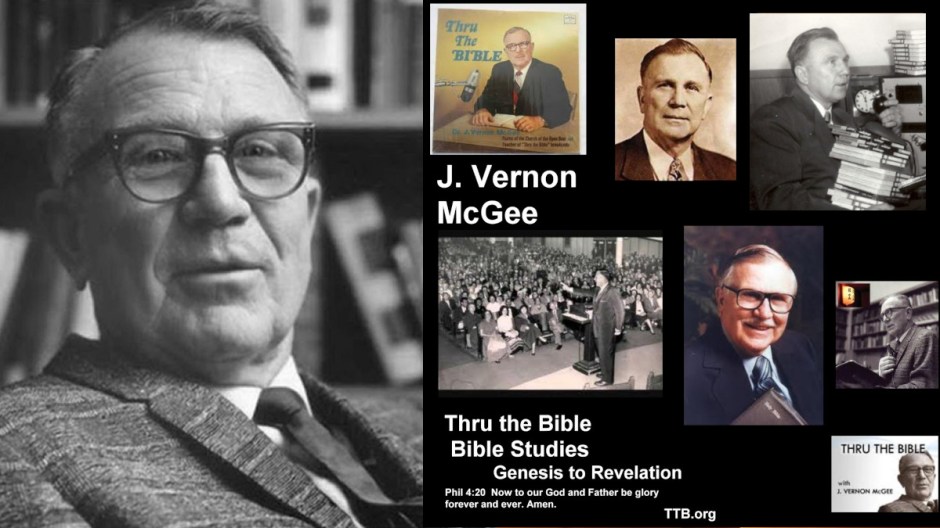
The audio on this video is the property of Thru the Bible. It is offered free of charge. If you wish to make a donation, do not send it to us. Visit http://www.ttb.org for information. The audio is attributed to Dr. J. Vernon McGee and Thru the Bible. Intellectual property rights are those of Thru the Bible. Please contact us if you feel our understanding of the terms of use are in error. Copyright information obtained from https://ttb.org/about/copyright-policy
Dr. McGee’s sermon covers Matthew chapters 22 through 24, starting with the verbal clash between Jesus and the religious rulers. Chapter 22 begins with the parable of the king who made a marriage feast for his son. This parable is a continuation of Jesus’ answer to the chief priests and elders and parallels the parables in Matthew 13, focusing on how and why the current age began. The king sends servants to call those who were bidden (the lost sheep of the House of Israel), but they refused to come. He sent other servants, but the invited guests made light of it, going to their farms and merchandise, while others mistreated and killed the servants. In response, the king sent his armies to destroy the murderers and their city, which Dr. McGee believes is a reference to the destruction of Jerusalem in 70 AD. Then, the invitation goes out to everyone found on the highways, both good and bad, and the wedding is furnished with guests. However, a man without a wedding garment (the righteousness of Christ, essential for salvation) is found, bound, and cast into outer darkness, illustrating that while many are called, few are chosen and must come on the king’s terms.
Following this, the religious leaders launch their final attack on Jesus. First, the Herodians question him about paying tribute to Caesar, a political trick to trap him. Jesus, perceiving their wickedness, calls them hypocrites and uses their own coin to state, “Render therefore unto Caesar the things which are Caesar’s, and unto God the things that are God’s,” marvelously answering their question without falling into their trap. Next, the Sadducees, who deny the resurrection, question him about a woman married to seven brothers. Jesus responds that they err by not knowing the Scriptures nor the power of God, stating that in the resurrection, people neither marry nor are given in marriage but are like the angels. He further proves the resurrection by quoting God as saying, “I am the God of Abraham, the God of Isaac, and the God of Jacob,” asserting that God is not the God of the dead but of the living. This silences the Sadducees. Finally, the Pharisees, after hearing that Jesus silenced the Sadducees, gather together and ask him which is the great commandment in the law. Jesus answers, “Thou shalt love the Lord thy God with all thy heart, and with all thy soul, and with all thy mind. This is the first and great commandment. And the second is like unto it, Thou shalt love thy neighbor as thyself. On these two commandments hang all the law and the prophets”. Then, Jesus questions the Pharisees about the Christ, asking whose son he is. They reply, “The Son of David”. Jesus then asks how David, in the Spirit, calls him Lord (Psalm 110:1), highlighting the impossibility of David calling his natural son Lord, implying a supernatural birth. No one is able to answer him, ending the verbal clash.
Chapter 23 marks Jesus’ denouncement of the scribes and Pharisees and his weeping over Jerusalem. He warns the multitude against the scribes and Pharisees who sit in Moses’ seat but do not practice what they preach. He pronounces a series of “woes” upon them, calling them hypocrites for binding heavy burdens on others, doing their works to be seen, loving titles and recognition, and shutting up the Kingdom of Heaven. He criticizes their outward piety and inward corruption, comparing them to whitewashed sepulchers full of dead men’s bones. He also rebukes their meticulous tithing of insignificant items while neglecting the weightier matters of the law: judgment, mercy, and faith. Dr. McGee emphasizes the harshness of Jesus’ language, contrasting it with the liberal conception of a gentle Jesus. Jesus condemns their rejection of the prophets and foretells the persecution of those he will send. He concludes this chapter with a lament over Jerusalem’s rejection of him.
Chapter 24 begins the Olivet Discourse, where Jesus’ disciples ask him privately three questions: when will the temple be destroyed, what will be the sign of his coming, and what will be the sign of the end of the age. Dr. McGee states that the destruction of the temple (fulfilled in 70 AD) is primarily addressed in Luke’s Gospel. Matthew focuses on the signs of his coming and the end of the age, which relate to his coming to establish his kingdom, not the church. Jesus warns them to “take heed that no man deceive you,” as many will come in his name saying, “I am Christ,” and will deceive many. He speaks of wars and rumors of wars, but these are not the sign of the end. Nation will rise against nation, and there will be famines, pestilences, and earthquakes, which are the beginning of sorrows. Dr. McGee believes they are currently in the age leading up to the Great Tribulation. He then discusses the Great Tribulation period, during which the nation Israel will be afflicted and hated by all nations. False prophets will arise, and iniquity will abound. He clarifies that the gospel of the Kingdom will be preached in all the world as a witness before the end comes, distinguishing it from the gospel of grace preached today. The sign of the end will be the “abomination of desolation” standing in the Holy Place. Those in Judea are instructed to flee to the mountains. This period will be a time of great tribulation, unprecedented in history. False Christs and false prophets will perform great signs and wonders, but believers should not be deceived. The coming of the Son of Man will be like lightning, visible to all. Following the tribulation, the sun will be darkened, the moon will not give its light, and the stars will fall from heaven. The sign of the Son of Man will appear in heaven, and all the tribes of the earth will mourn when they see him coming in the clouds with power and great glory. He will send his angels to gather his elect (the nation Israel).
Jesus then gives the parable of the fig tree, which Dr. McGee interprets as the nation Israel. When the fig tree’s branch becomes tender and puts forth leaves, it indicates that summer is near. Similarly, when they see all these signs, they will know that his coming is near. Jesus states, “Verily I say unto you, this generation shall not pass, till all these things be fulfilled,” which Dr. McGee believes could refer to the Jewish race or the generation living at that time. He emphasizes that heaven and earth will pass away, but Jesus’ words will not. However, the specific day and hour are unknown, not even to the angels, but only to the Father. Jesus compares his coming to the days of Noah, where people were eating, drinking, marrying, and giving in marriage until the flood came and took them all away. The phrase “two in the field; the one shall be taken, and the other left” refers to judgment, not the Rapture of the church; the wicked will be taken away in judgment, and the others will be left to enter the millennial kingdom. Therefore, they are to “watch,” a watching characterized by fear and anxiety in that day, unlike the comforting hope of believers watching for the Lord’s return today. The sermon concludes with a call to be ready, as the Son of Man will come at an unexpected hour, and to live in light of the fact that everyone will stand in the presence of Christ to give an account.
The Guardians recently had to change their plans due to severe weather. They were set to perform in Hartford, Alabama on March 15th, but the event was cancelled because of the weather. The group shared a message on their website, saying, “We’re praying for all of those in the path of the storm. Stay weather alert!”.
Despite this setback, The Guardians are continuing with their planned tour and are working to get their music played on the radio. Their new song “Kick Up My Heels and Sing“ has a positive message at a time we all need to hear something positive.
Provided to YouTube by Daywind Records Kick Up My Heels and Sing · The Guardians Kick Up My Heels and Sing ℗ 2025 Daywind Records Released on: 2025-01-31 Main Artist: The Guardians Producer: John Darin Rowsey Lyricist: John Darin Rowsey Composer: John Darin Rowsey Lyricist: Rodney Griffin Composer: Rodney Griffin Arranger: Wayne Haun
Pat Barker, who sings the bass part for The Guardians, believes that “the world today really needs something happy!”. He further explained his thoughts behind the song, stating, “It’s just it’s happy don’t we need happy right now we need happy it’s it’s quartet singing all the way around it sounds like the guardians it sounds like a quartet and yes that is me singing the bass many people have asked um yes that’s me we didn’t have to hire somebody in for this one,” he said. This highlights the group’s intention to spread joy through their music, especially during difficult times.
The lyrics of “Kick Up My Heels and Sing,” talk about a “Happy Feeling burst into a song”. It emphasizes the idea that “every day is brand new Mercy walking on the King’s Highway there is Joy on this journey every filled with grace”. The lyrics also encourage listeners to “lift up my voice kick up my heels and sing” and express gratitude for blessings received, as in “can’t stop Count the blessing he gives me”. The feeling of joy and anticipation for good things to come is evident in the lines “I’ve got too many Victory just waiting down the road I’m dancing in advance I’ve got to let it show”. Even when facing challenges, the song suggests that “no one is with me can’t stop counting the blessings He gives me.
The audio on this video is the property of Thru the Bible. It is offered free of charge. If you wish to make a donation, do not send it to us. Visit http://www.ttb.org for information. The audio is attributed to Dr. J. Vernon McGee and Thru the Bible. Intellectual property rights are those of Thru the Bible. Please contact us if you feel our understanding of the terms of use are in error. Copyright information obtained from https://ttb.org/about/copyright-policy
In the 18th chapter of Matthew, Dr. McGee highlights several key aspects of the Kingdom of Heaven. He emphasizes that entering the kingdom requires conversion and becoming like little children. This isn’t about reverting to childish behavior but rather experiencing a new spiritual birth, akin to starting life anew as a child spiritually. Dr. McGee notes that the disciples’ concern about who is greatest in the kingdom is secondary to the primary importance of securing entrance through the new birth. He underscores the Lord’s teaching that unless one is converted and becomes as a little child, they shall not enter the Kingdom of Heaven.
Dr. McGee stresses the immense value God places on children, stating that the evangelization of children is a Divine imperative. He cites the Lord’s strong words against those who would offend or cause these little ones to stumble. McGee interprets the passage about angels beholding the Father’s face as indicating that when little ones die, their spirits go immediately to be with God because Jesus died for them. He emphasizes the responsibility of parents and the church towards children, lamenting societal trends that harm them. Dr. McGee connects the Lord’s teaching on children to the discussion on divorce, noting that the well-being of children should be a paramount consideration for Christian couples.
Moving into Matthew 19, Dr. McGee addresses the crucial topic of marriage and divorce. He explains that Jesus takes the Pharisees back to God’s original ideal for marriage: one man and one woman becoming one flesh. While the Mosaic Law permitted divorce due to the hardness of hearts, Dr. McGee highlights that Jesus provides a new principle, stating that the only scriptural ground for divorce is fornication (adultery). He clarifies that while believers may separate on other grounds, remarriage after divorce is only permissible for the innocent party in cases of adultery. Dr. McGee also touches on the topic of singleness, noting that some are uniquely suited for it, and the decision to marry or remain single is ultimately a personal one.
As the narrative progresses, Dr. McGee discusses the concept of true greatness in the Kingdom. He explains that it is found not in seeking exalted positions but in humbling oneself and becoming a servant. This is exemplified by Jesus himself, who came not to be ministered to but to minister and give his life as a ransom for many. Dr. McGee emphasizes that rewards in heaven are determined by faithfulness to the task God has given, regardless of how significant or prominent it may seem. He notes Peter’s question about reward and Jesus’ response about judging the tribes of Israel, highlighting that sacrifice for Christ’s sake will be rewarded.
In the later chapters, Dr. McGee addresses Jesus’ entry into Jerusalem and his interactions with the religious leaders. He distinguishes between the initial entry and the true triumphal entry at the second coming. Dr. McGee interprets the cursing of the fig tree as symbolic of Israel’s fruitless religious system. He highlights the confrontation between Jesus and the chief priests regarding his authority, noting how Jesus skillfully exposes their hypocrisy. Through the parable of the two sons and the wicked husbandmen, Dr. McGee emphasizes that outward religious profession without genuine obedience and fruit is insufficient. He concludes by underscoring the importance of recognizing oneself as a sinner and coming to Christ for salvation.
Southern Gospel trio Southbound has released their latest single, “I Left It In The Water”. The digital release happened 11 October following the renewal of their recording relationship with Daywind Records. The song addresses the concept of baptism as a symbolic act of spiritual cleansing and forgiveness, as reflected in its lyrics.
The lyrics of “I Left It In The Water” reference past mistakes and the idea of being absolved through baptism. It begins with acknowledging our past errors: “I had a past I carried so long. Didn’t get it all right. Got a lot of it wrong”. The act of baptism is described as a form of burial: “When they laid me down in that watery grave, came up without a trace. It was covered by grace”.
The central theme of the song is expressed in the repeated line, “I left it in the water”. This phrase is directly linked to the concept of forgiveness received during baptism: “when I was baptized. I left it in the water. Buried in the tide, my past was forgiven. That very hour, guilt, sin, and shame no longer remain cuz I left it in the water”. The lyrics suggest a complete separation from the past self: “If you look for old me, friend, don’t even buy Father, there’s just a headstone saying that man is gone. Cuz I left it in the water”.
Clint Brown of Southbound gave us some context for the song’s message. He said while some people may consider themselves saved, baptism holds a specific significance. Brown explained that “I Left It In The Water” offers an opportunity to communicate the meaning of baptism as representing “the cleansing uh power of God in your life”.
The release of this single coincided with Southbound’s renewed partnership with Daywind Records. Clint said the continued collaboration comes with the value of associating with experienced professionals in the industry and expressed his anticipation for their ongoing work together to “bring hope, help, and blessing through the songs we sing”.




 Texas Gospel Canada Southern Gospel Radio