Almost 500 years ago, Martin Luther emphasized the core message of the gospel: justification is by grace alone, through faith alone, in Christ alone. If this is true, how should we understand a passage like James 2:24, which says, “You see that a person is justified by works and not by faith alone”? It might seem like this verse is saying that works do play a role in our salvation.
However, works do not provide our salvation. Instead, they have a very important role in showing that our salvation is real. Isn’t James saying that to other people who observe our lives, we are seen as justified by our actions, not just by our faith, which is invisible. We know that before God, we are justified by grace through faith. But to the world, both believers and non-believers, they cannot see our faith. Therefore, our good deeds demonstrate that we have been justified.
This is similar to what Paul said in Ephesians: “For by grace you have been saved through faith, and that not of yourselves; it is the gift of God, not as a result of works, so that no one may boast. For we are his workmanship, created in Christ Jesus for good works, which God prepared beforehand that we should walk in them” [Ephesians 2:8-10. Salvation is decided by faith alone, but it is shown by our obedience to God’s will.
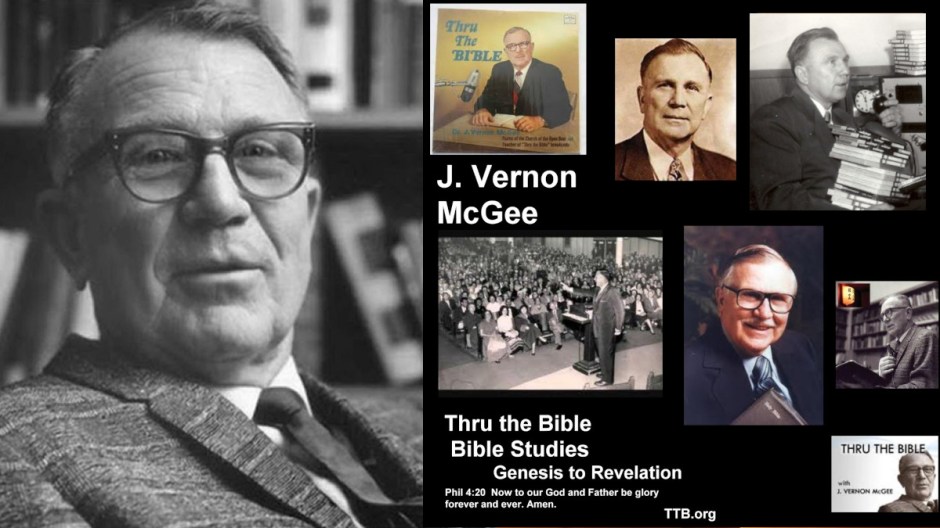
The audio on this video is the property of Thru the Bible. It is offered free of charge. If you wish to make a donation, do not send it to us. Visit http://www.ttb.org for information. The audio is attributed to Dr. J. Vernon McGee and Thru the Bible. Intellectual property rights are those of Thru the Bible. Please contact us if you feel our understanding of the terms of use are in error. Copyright information obtained from https://ttb.org/about/copyright-policy
Dr. J. Vernon McGee begins his sermon by highlighting the importance of the Gospel of Mark, which he describes as a gospel of action filled with miracles. He notes that Chapter 5 is particularly significant, featuring three outstanding miracles demonstrating the power of omnipotence: the casting out of demons from the man in Gadara, the healing of the woman with an issue of blood, and the raising of Jairus’s daughter. McGee delves into the account of the demon-possessed man, emphasizing his desperate condition of living among the tombs and possessing superhuman strength. He clarifies that the man, not the demons, worshiped Jesus, illustrating a struggle within the man’s being. The demons, upon being commanded by Jesus to leave, requested to be sent into a herd of swine, which then perished in the sea. McGee defends Jesus’s action, pointing out the Gadarines’ disregard for God’s law by engaging in pig farming. He further discusses several facts about demons, emphasizing their reality, their prevalence during Jesus’s ministry, their desire to indwell mankind, and Christ’s ultimate power over them.
Moving on, Dr. McGee discusses the healing of the woman with the issue of blood and the raising of Jairus’s daughter, both found in Mark 5. He points out the woman’s 12 years of suffering and her faith in touching Jesus’s garment to be healed, coinciding with the 12 years of Jairus’s daughter’s life. McGee underscores Jesus’s deliberate action in healing the woman before going to Jairus’s house, where he then raised the daughter from the dead with the Aramaic words “Talitha koum,” which McGee interprets as “Little lamb, wake up”. He emphasizes the practical nature of Jesus’s command to feed the girl after she was raised. McGee sees these miracles as demonstrations of Jesus’s power and his role as God’s servant who came to minister and give his life as a ransom.
Transitioning to Mark 6, McGee discusses Jesus’s return to Nazareth, where he was met with astonishment and offense by his own people who questioned his origins and were familiar with his family. McGee clarifies that this was likely Jesus’s second visit to Nazareth, contrasting it with the account in Luke 4 where no miracles were performed initially. He explains that the unbelief of the people in Nazareth limited Jesus’s ability to perform mighty works there, illustrating that faith is necessary to release God’s power. McGee then describes Jesus sending out the twelve disciples two by two, giving them power over unclean spirits and instructing them to travel lightly, focusing on their urgent mission to preach repentance. He also touches on Herod’s reaction to the spreading fame of Jesus, linking it to his guilt over the beheading of John the Baptist. The disciples later returned and reported their experiences, leading Jesus to take them to a deserted place to rest before the account of the feeding of the 5,000.
Finally, Dr. McGee addresses the confrontation between Jesus and the Pharisees and scribes who questioned his disciples’ traditions of washing hands before eating in Mark 7. Jesus rebukes their hypocrisy, quoting Isaiah and stating that their worship is in vain because they substitute the commandments of God with the traditions of men. He uses the example of the tradition of “Corban” to illustrate how they circumvented the commandment to honor one’s parents. McGee emphasizes that true defilement comes from within the heart of man, listing various evil thoughts and actions. He then discusses the healing of the deaf and dumb man in the Decapolis, noting Jesus’s unique method as aids to faith. McGee briefly touches on the feeding of the 4,000 in Mark 8, distinguishing it from the feeding of the 5,000 by several factors. He concludes with the healing of a blind man at Bethsaida in stages, using this as an analogy for spiritual sight, and Peter’s confession of faith in Jesus as the Christ. McGee underscores the importance of acknowledging and following Christ, urging listeners to examine their own faith and relationship with Him.
The audio on this video is the property of Thru the Bible. It is offered free of charge. If you wish to make a donation, do not send it to us. Visit http://www.ttb.org for information. The audio is attributed to Dr. J. Vernon McGee and Thru the Bible. Intellectual property rights are those of Thru the Bible. Please contact us if you feel our understanding of the terms of use are in error. Copyright information obtained from https://ttb.org/about/copyright-policy
Dr. McGee begins his exposition of Mark chapter 2 by highlighting its connection to chapter 1, emphasizing the connective word “and” that binds the narrative. He notes Jesus’ return to Capernaum after some days, reiterating that Capernaum became the central location for the Lord’s three-year earthly ministry. The reason for Jesus’ prior withdrawal was the disobedience of the healed leper, who spread news of his healing against Jesus’ wishes, leading to overwhelming crowds that hindered Jesus’ spiritual work. Dr. McGee expresses his concern about the modern overemphasis on miracles like healing and tongues, arguing that the primary focus should be on preaching the gospel of salvation through Christ’s death on the cross. Upon his return, it was noised that Jesus was in “the house,” which Dr. McGee identifies as likely Simon Peter’s house mentioned at the end of chapter 1.
The narrative then shifts to the arrival of a paralytic carried by four men, who, unable to enter the crowded house, uncovered the roof and lowered him before Jesus. Seeing their faith, Jesus declared to the sick man, “Son, thy sins be forgiven thee”. Dr. McGee clarifies that while salvation comes through individual faith, it was the faith of these stretcher bearers that brought the paralytic to a place where he could encounter Jesus and hear these words. This act of forgiveness provoked criticism from certain scribes who reasoned in their hearts that only God could forgive sins. Jesus, perceiving their thoughts, challenged their reasoning and then, to demonstrate his authority to forgive sins, commanded the paralytic to arise, take up his bed, and walk, which he immediately did, astonishing the onlookers.
Following this, Dr. McGee recounts Jesus’ calling of Levi (Matthew), a publican, to be a disciple. He notes the subsequent dinner hosted by Levi, attended by many publicans and sinners, which drew criticism from the scribes and Pharisees. Jesus responded to their criticism by stating that healthy people do not need a physician, but the sick do, clarifying that he came to call sinners to repentance, not those who considered themselves righteous. The topic of fasting also arises, as John’s disciples and the Pharisees were fasting while Jesus’ disciples were not. Jesus used the analogy of the bridegroom’s presence and the metaphors of old and new garments and wine skins to illustrate that his ministry represented something new, a break from the old system, rather than a mere continuation or improvement of it.
Dr. McGee then addresses two Sabbath controversies: the disciples plucking grain in the fields and Jesus healing a man with a withered hand in the synagogue. The Pharisees accused the disciples of breaking the Sabbath by harvesting grain, but Dr. McGee explains that their actions were within the bounds of the law, which permitted plucking grain by hand. Jesus defended his disciples by referencing David’s actions and declaring that “the Sabbath was made for man, and not man for the Sabbath” and that the Son of Man is Lord also of the Sabbath. In the synagogue, Jesus healed a man with a withered hand, knowing that the religious leaders were watching to accuse him. He challenged them on whether it was lawful to do good or evil on the Sabbath, and despite their silence, he healed the man, leading to the religious rulers plotting his destruction. Subsequently, Jesus withdrew with his disciples, and the crowds followed him from various regions. He then chose the twelve apostles, emphasizing his sovereign choice in this matter.
In the latter part of the sermon, Dr. McGee discusses the unpardonable sin, which occurred when the scribes accused Jesus of casting out demons by the power of Beelzebub, attributing the work of the Holy Spirit to Satan. He clarifies that this specific act of rejecting the direct testimony of both the Son and the Holy Spirit cannot be committed today in the same way. Jesus’ interaction with his physical family is also mentioned, where he emphasized that those who do the will of God are his true mother, brother, and sister. Finally, Dr. McGee introduces chapter 4 and the parables, noting that even Mark’s presentation of parables emphasizes action. He touches on the parable of the sower, the candle, the unique parable of the growing seed, and the mustard seed, explaining their significance in understanding the kingdom of God and the reception of the word. The sermon concludes with the miracle of Jesus stilling the storm, highlighting his power over nature and the disciples’ awe and fear in response.
The song “Deep Waters” by the Triumphant Quartet, written by Wayne Haun and Allison Wells, offers a message rooted in faith and scripture. It is part of their 2024 album God Is Listening, released under StowTown Records. This song began airing on Texas Gospel this week, bringing its message of hope and perseverance to listeners.
Provided to YouTube by StowTown Records Deep Waters · Triumphant Quartet God Is Listening ℗ 2024 StowTown Records, LLC Released on: 2024-06-07 Arranger, Composer, Orchestrator, Producer: Wayne Haun Composer: Allison Wells Electric Guitar: Kelly Back
“Deep Waters” draws inspiration from passages like Isaiah 43, emphasizing God’s promise to be with His people during life’s challenges. The lyrics speak to those enduring difficult times, offering reassurance that they are never alone. The song reminds listeners of the strength and peace found in trusting God, who walks with them through life’s metaphorical deep waters.
The song’s structure is reflective and contemplative, featuring Clayton Inman as the lead vocalist. Its slow tempo complements the emotional depth of the lyrics. The composition captures the essence of Christ’s promise in John 16:33, where Jesus encourages believers to find courage because He has overcome the world.
As part of the God Is Listening album, “Deep Waters” continues the group’s tradition of delivering Southern Gospel music with a progressive style. The album showcases the talents of vocalists David Sutton, Sean Barber, Clayton Inman, and Eric Bennett. Each track on the album contributes to a central theme of faith and resilience.
For Gospel music enthusiasts, “Deep Waters” stands out as a heartfelt reminder of God’s unwavering presence in times of trouble. It is a testament to the enduring power of faith and scripture in providing comfort and strength.
LYRICS PROVIDED BY STOWTOWN RECORDS:
Deep Waters Writers: Wayne Haun, Allison Wells
Sometimes life is hard, at times you’ve questioned why And there are moments when you really struggle to survive But there’s a peace that passes understanding, and grace enough to keep your faith alive
When you go through deep waters you never go alone You are loved by the father, and He calls you His own Through storms and waves, He makes a way when all your hope is gone When rivers rise, He hears your cries so just keep holding on When you go through deep waters you never go alone
When the pain is real you’ve lost the words to pray And all the fear is paralyzing your will to be brave Trust the one who speaks to winds and oceans Take His hand, for He is strong to save
He’s your strength and refuge; He will never leave you A present help and He wants you to know When you go through deep waters you never go alone You are loved by the father, and He calls you His own Through storms and waves, He makes a way when all your hope is gone When rivers rise He hears your cries so just keep holding on When you go through deep waters you never go alone When you go through deep waters you never go alone
The audio on this video is the property of Thru the Bible. It is offered free of charge. If you wish to make a donation, do not send it to us. Visit http://www.ttb.org for information. The audio is attributed to Dr. J. Vernon McGee and Thru the Bible. Intellectual property rights are those of Thru the Bible. Please contact us if you feel our understanding of the terms of use are in error. Copyright information obtained from https://ttb.org/about/copyright-policy
Dr. J. Vernon McGee introduces the Gospel of Mark as chronologically the first Gospel written and emphasizes that its author, John Mark, was not an apostle but had close associations with key figures like Paul, Barnabas (his uncle), and Peter (his spiritual son). Mark’s Jewish name was John, and Mark was his Latin surname. His mother, Mary, was a prominent Christian in Jerusalem whose home served as a meeting place for the church. Mark initially accompanied Paul and Barnabas on their first missionary journey but turned back, causing a disagreement between Paul and Barnabas, with Barnabas later taking Mark to Cyprus. However, Mark eventually redeemed himself, becoming profitable for the ministry later in Paul’s life. Dr. McGee also notes the early church tradition, supported by figures like Papias, that Mark’s Gospel is essentially Peter’s account.
Dr. McGee explains that the Gospel of Mark was specifically written for the Romans, catering to the Roman mind which valued strength and action. He contrasts this with Matthew, written for the nation of Israel and the religious man; Luke, for the thinking man; and John, for the wretched man. The Romans, while bringing peace, justice, and order, did so through force, representing active human power and a tendency towards dictatorship. Mark presents Jesus not as the king (like in Matthew) but as God’s servant, a man of action, with “Flaming headlines” like “Jesus came” and “He is risen”. The style of Mark is described as brief, blunt, pertinent, pithy, and action-oriented, evident in the frequent use of the connective “and”. Unlike Matthew, Mark does not include a genealogy because Romans were more concerned with a servant’s ability to do the job than their lineage.
Moving into Mark chapter 1, Dr. McGee highlights the beginning of the Gospel, which focuses on Jesus’ coming into the world, his public ministry, death, and resurrection. He discusses John the Baptist as the messenger preparing the way for the Lord, baptizing not for the remission of sins but “unto the remission of sins,” preparing people for Jesus’ arrival. Jesus’ baptism by John in the Jordan River marked his identification with mankind, accompanied by the Trinity appearing with the Spirit descending like a dove and the Father’s voice declaring, “Thou art my beloved Son”. Immediately after, the Spirit drove Jesus into the wilderness for 40 days where he was tempted by Satan, alongside wild beasts, while angels ministered to him. Following John’s imprisonment, Jesus began his ministry in Galilee, preaching the gospel of God, calling his first disciples (Simon, Andrew, James, and John) to become “fishers of men”.
Dr. McGee describes a typical busy day in Jesus’ ministry in Capernaum, starting on the Sabbath where he taught with authority, astonishing the people. The first recorded miracle in Mark is the casting out of an unclean spirit in the synagogue, demonstrating Jesus’ power in the spiritual realm. This was followed by the healing of Simon’s mother-in-law who had a fever. That evening, the entire city gathered, and Jesus healed many who were sick and cast out demons, who recognized him. Despite his busy schedule, Jesus made time to pray early in the morning and then decided to move on to other towns to preach. The chapter concludes with the healing of a leper, emphasizing Jesus’ compassion as he touched and cleansed him. Jesus instructed the man to remain silent but to show himself to the priest according to Mosaic law; however, the man disobeyed and publicized his healing widely.



 Texas Gospel Canada Southern Gospel Radio