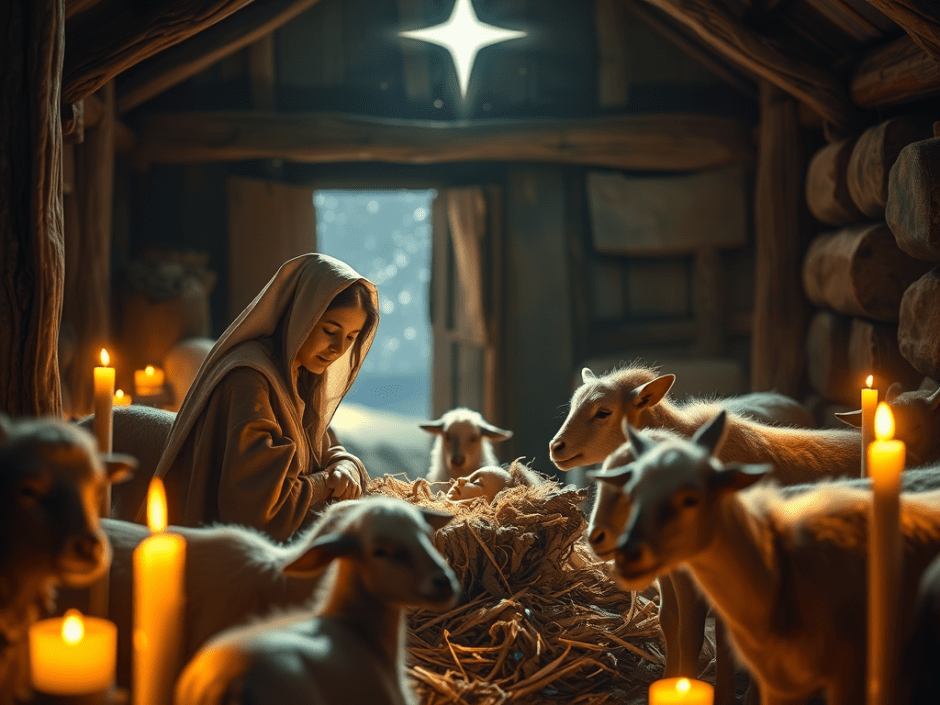
The Significance of Jesus Birth in Bethlehem

JEFF TURNER

The story of Jesus’s birth in Bethlehem gives us some theological insights about God’s divine plan and grace. In the small, unremarkable town of Bethlehem—whose name means “house of bread”—God chose to bring forth His most significant promise: the birth of the Messiah.

This humble village, too small to even raise an army, became the birthplace of Jesus Christ through divine intention. God deliberately selected an obscure location to demonstrate His power, showing that His greatest works often emerge from the most unexpected places. The choice of Bethlehem highlights God’s ability to use the weak and insignificant to display His extraordinary glory.

The prophecy by Micah, delivered 700 years before Jesus’s birth, foretold a remarkable event where the eternal ruler would emerge from this tiny town. This ruler would not come from a grand city, but from a place of humble origins, symbolizing that God’s salvation is accessible to all, regardless of social status or perceived importance.

God’s selection of Bethlehem and the birth of Jesus shows us a fundamental truth about divine grace: salvation is not earned through human achievement, but freely given. Just as Bethlehem was chosen despite its smallness, individuals are invited into God’s redemption not because of their own merit, but because of God’s boundless mercy.

God demonstrated that He can bring hope, light, and redemption through the most unexpected channels. Today, He invites everyone, regardless of their background, to experience His love.

Insight into the Star and the Wise Men’s Journey

JEFF TURNER

They knew the stars well. For years, the wise men of the East had studied the ancient prophecies and watched the night sky, knowing that one day a special star would appear – one that would lead them to a king unlike any other. When that brilliant light finally pierced the darkness, they knew their journey had begun.

These learned men gathered their most precious treasures: gold fit for a king, sweet-smelling frankincense used in temple worship, and myrrh, the burial spice that spoke of mortality. Though the journey would be long and dangerous, they set out with determination, following the star that called them westward. As recorded in Matthew 2:1-2, they arrived in Jerusalem asking, “Where is He that is born King of the Jews? For we have seen His star in the east and are come to worship Him.”

Their arrival caused quite a stir in Jerusalem. The whole city was troubled, especially King Herod, who gathered his religious advisors to learn where this prophesied king would be born. The scholars knew the answer immediately – Bethlehem. Yet strangely, though these religious leaders knew the prophecies by heart, not one of them made the short five-mile journey to seek this newborn king.

When the wise men finally reached the house where the young Jesus stayed with Mary, they didn’t hesitate or question. These educated, wealthy men immediately fell to their faces in worship. They recognized something the religious scholars had missed – this child was more than just another king. He was worthy of complete adoration. Their expensive gifts carried deep meaning: gold for a king, frankincense for a priest, and myrrh pointing toward His future sacrifice.

Their encounter with Jesus changed everything. Though Herod had asked them to return with news of the child’s location, they heeded God’s warning in a dream and chose a different route home. Like so many who truly meet Jesus, they left walking a new path – one of obedience to God rather than earthly authorities.

The Meaning Behind ‘He Made A Way In A Manger’

AMY TURNER

Lee Black’s Christmas song “He Made A Way In A Manger” tells a powerful story. The song, now 20 years old, was written by Black and his friend Steve Merkel.

The idea came from a Christmas card Merkel received. It had a simple drawing of a manger on the front with part of a famous Christmas lyric. Inside, it showed Jesus on the cross, finishing the lyric.
This inspired them to write a song connecting Jesus’ birth to his death. Black wrote the words, and Merkel composed the music.

Provided to YouTube by DistroKid He Made A Way In A Manger · Lee Black ‘Tis The Season â„— 2796642 Records DK Released on: 2022-11-04

The song reminds us of a scripture from Jeremiah 33:15-16:
“In those days and at that time
I will make a righteous Branch sprout from David’s line;
he will do what is just and right in the land.
In those days Judah will be saved
and Jerusalem will live in safety.
This is the name by which it will be called:
The Lord Our Righteous Savior.”

This prophecy points to Jesus as the savior, born in a manger but destined for the cross.

Black reflected on the song’s meaning, “I think the joy of Christmas is tinged with just a bit of melancholy, knowing that the baby in the manger is going to be the Christ of the cross. But what a gift we’ve been given in that.”

The song captures both the joy of Christmas and the sorrow of Jesus’ sacrifice. It helps us see the whole story of Jesus, from his humble birth to his redemptive death.

A Gift of Love: Sharing the Spirit of Christmas

JEFF TURNER

In this busy Christmas season, Jeff Treece of Sunday Drive reminds us of a precious gift we can give that doesn’t cost a thing – the gift of love and kindness.

Treece suggests, “At Christmas time, it’s the perfect time to share joy and be a light in the world.” He points out that while many people are rushing around trying to find the perfect present, Christians have an opportunity to make a real difference.

“If we, as Christians, just slow down a little bit and share the love when we get out amongst people,” Treece says, we can have a positive impact on those around us. This simple act of kindness aligns with the true spirit of Christmas.

Treece emphasizes the importance of this gesture, stating, “We want to take people to heaven with us, that’s the ultimate goal.” This reflects the Christian belief in sharing God’s love and message with others.

He adds a personal touch, saying, “Me, personally, I want the Lord to put his arms out and say, ‘Jeff Treese, you told body.'” This shows his deep desire to fulfill what he sees as a Christian duty to spread love and joy.

Treece concludes with a call to action: “So let’s share love. Let’s be the light out in the world this Christmas season.” This echoes the biblical teaching found in Matthew 5:16, which encourages believers to “let your light shine before others.”

The Divine Prophecy: Birth of Jesus in Bethlehem

JEFF TURNER

The world stood on the brink of a divine moment. Prophecies whispered through generations were about to be fulfilled in the most unexpected way. Caesar Augustus, unknowingly playing a part in God’s grand design, issued a decree that would force a young couple to travel to Bethlehem – exactly as the ancient prophecies had foretold.

Mary and Joseph journeyed from Nazareth, a trip of about 70 miles, to the small town of Bethlehem. Every step was predetermined, every detail orchestrated by a plan far greater than human understanding. The prophecy from Micah was clear – the Messiah would be born in Bethlehem, the “house of bread,” a place that would become synonymous with hope.

When they arrived, there was no grand welcome. No palace awaited the King of kings. Instead, a humble stable became the birthplace of Jesus – the eternal God who had always existed, now entering human history as a vulnerable infant. This was no ordinary birth, but the arrival of the Redeemer Isaiah had spoken about – Emmanuel, “God with us.”

The significance was profound. This child was the fulfillment of God’s promise of redemption. He came not to be served, but to serve. From his birth in a lowly manger to his future sacrifice, Jesus embodied God’s love for humanity. He would become the “Lamb of God” who takes away the sin of the world, offering salvation to all who would believe.

Just as people then weren’t ready for his first coming, the sermon warned that many remain unready for his return. The message was clear – salvation is available to everyone, not through personal perfection, but through believing in Jesus Christ. The invitation stood then as it stands now: come as you are, and believe.