Hope and Belonging in the Christmas Story

AMY TURNER

In the heart of the Christmas story lies a message of hope and belonging. Jesus came not just as a distant savior, but as a family-maker, bridging the gap between humanity and God.

Our world is fundamentally broken – a home fractured by sin and separation. Yet Christ’s arrival offers a radical restoration, transforming our understanding of family and belonging. Through his incarnation, Jesus becomes fully human, experiencing our struggles and limitations, with a divine purpose of reconnecting us to God.

The theological core of this narrative centers on adoption and redemption. Jesus enters human experience to defeat the powers of death and darkness, offering humanity a new familial identity. We are no longer outsiders or enemies, but beloved children invited into God’s own family. This invitation transcends biological relationships, creating bonds deeper than blood – a spiritual kinship that outlasts earthly limitations.Christ’s journey from heavenly throne to humble manger represents the ultimate act of solidarity.

He descends not as a distant ruler, but as a brother, experiencing human vulnerability to ultimately rescue humanity. By becoming like us, he opens a pathway home – not just to a physical place, but to restored relationship with God.

The invitation remains open: to believe in this transformative love, to accept the new family Christ offers, and to journey towards a hope that redefines what it means to truly be home. In Jesus, we discover a belonging that heals, restores, and gives eternal purpose.

Christmas in the Shadows: Millions of Christians Celebrate in Secret

JEFF TURNER

For millions of Canadians, Christmas is a public and joyful time. Streets are filled with lights, churches welcome everyone to services, and families gather freely. Around the world, however, there are Christians who experience Christmas very differently. In many countries, celebrating the birth of Jesus can lead to arrest, prison, or even death. As a result, countless believers are forced to celebrate Christmas in secret, if they can celebrate at all.

Those living in high-persecution areas often keep their Christmas joy hidden. Singing carols, decorating a tree, or attending church can be dangerous. For these believers, faith is something practiced quietly, behind closed doors, where safety comes before celebration.

In some countries, Christmas is completely banned. North Korea is one of the harshest examples. The government sees Christianity as a direct threat to its leadership. All Christmas worship and holiday displays are illegal, and even owning a Bible is considered a serious crime. Since 2016, citizens have been ordered to honour Kim Jong-suk, the dictator’s grandmother, who was born on December 24, instead of celebrating Christmas. Any attempt to recognize the birth of Jesus can result in severe punishment, including forced labour or worse.

In Somalia, public Christmas celebrations have been illegal since 2015. The country’s ministry of religion has instructed police and national security forces to actively stop Christmas events. Christians who attempt to gather openly face danger not only from authorities but also from extremist violence, making Christmas a time of fear rather than joy.

Other countries allow Christmas only under strict legal limits. In Brunei, public Christmas displays have been banned since 2014. The government says the ban is meant to protect Muslims from being influenced away from Islam. Christians are allowed to celebrate privately in homes or churches, but public celebrations are forbidden. Muslims who take part in Christmas activities, such as wearing Santa hats or joining festivities, can face up to five years in prison. It is also illegal for Christians to share their faith with Muslims.

In some places, Christmas is permitted only if the government tightly controls it. In China, celebrations are limited to government-approved churches and groups, and the rules vary by region. People under the age of 18 are legally banned from attending church services, including those held at Christmas. Churches are also pressured to include communist ideology in sermons and worship, reshaping religious messages to match state values.

In Iran, Christmas gatherings are allowed only in registered churches and approved areas. Unregistered house churches, especially those made up of converts from Islam, are often raided. In November 2025, two Christian converts were sentenced to two years in prison after authorities broke up a Christmas planning meeting. Church services are not allowed to be held in Farsi, the country’s main language. Instead, they must use minority languages such as Armenian or Assyrian, a rule designed to limit the spread of Christianity.

In other regions, the main threat comes not from laws but from violence. In northern Nigeria, Christian communities are frequently targeted by ISWAP, an extremist group linked to the Islamic State. Kidnappings and executions are common, especially around major Christian holidays. These attacks create constant fear and make public Christmas worship extremely dangerous.

Despite all of this, many Christians continue to mark Christmas in quiet and personal ways. Some meet secretly in small groups. Others pray alone in their homes. Many remember the meaning of Christmas without decorations, music, or public worship.

For Canadians, these stories are a reminder that freedoms often taken for granted. For millions around the world, Christmas still comes, but it arrives quietly, behind closed doors, and at great personal cost.

The Transformative Power of Jesus in Isaiah

JEFF TURNER

The biblical prophecy of Jesus Christ foretold in Isaiah 6:6-7 gives us a message of hope and divine purpose. At the heart of this prophecy lies a transformative understanding that God’s gift of salvation was not for His own benefit, but entirely for humanity’s redemption.

The prophecy from Isaiah highlights Jesus as a multifaceted divine figure, offering humanity exactly what it needs. His identity is defined by extraordinary qualities: Wonderful Counselor, Mighty God, Everlasting Father, and Prince of Peace. Each title represents a unique aspect of divine intervention designed to address human spiritual needs.

As a Wonderful Counselor, Jesus provides wisdom beyond human comprehension. His love transcends all limitations, demonstrated through unconditional grace that offers salvation not based on human merit, but on divine compassion. John 3:16 powerfully encapsulates this love: “For God so loved the world that He gave His only begotten son.”

The prophecy emphasizes that God’s strength is not just a rescue mechanism for moments of weakness, but a transformative power intended to elevate human potential. Jesus represents divine strength that enables individuals to accomplish purposes far beyond their own capabilities, inviting people to lean into a higher spiritual empowerment.

Ultimately, this prophecy reveals that God’s intervention through Jesus was a deliberate, selfless act of love. The phrase “unto us” repeatedly underscores that this divine gift was given not for divine benefit, but as an extraordinary expression of grace specifically designed for human restoration and hope.

The Journey of Hope in the Story of Emmanuel

JEFF TURNER

The story of Emmanuel is journey of hope, anticipation, and divine promise spanning thousands of years. Throughout centuries of waiting, the people of Israel held onto a belief in a coming Messiah who would bring redemption and hope.

The prophecy of Emmanuel, meaning “God with us,” was a promise of divine presence and salvation. Foretold by the prophet Isaiah 800 years before its fulfillment, this prophecy spoke of a virgin who would bear a son, a child destined to be more than a mere political leader. God’s plan extended far beyond the expectations of the time, promising a savior not just for Israel, but for all people.

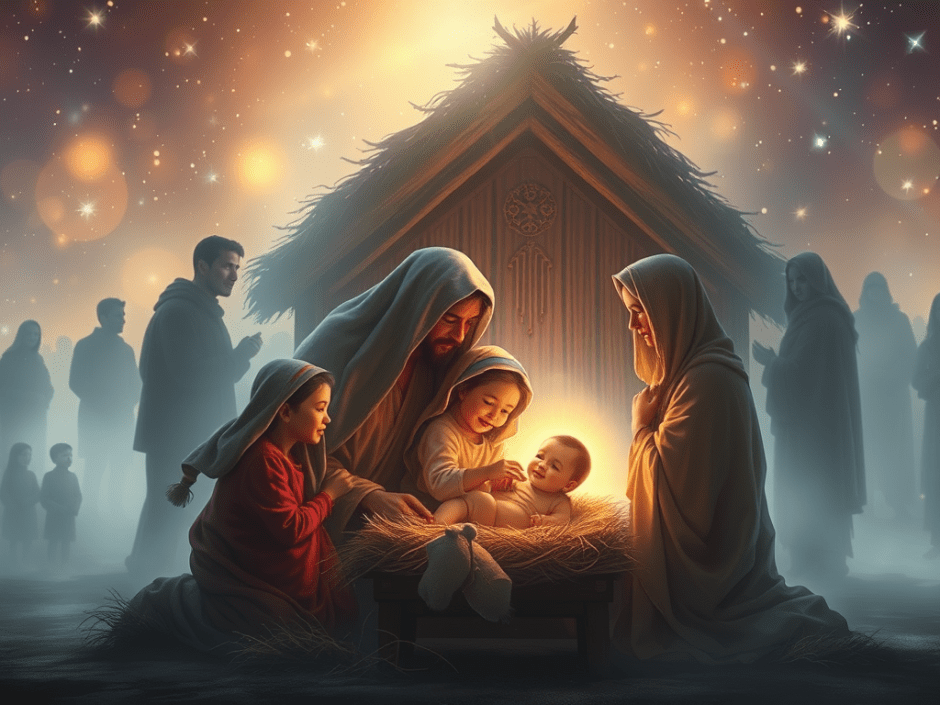
The birth of Jesus was a humble yet extraordinary event. Born in Bethlehem, not in a royal palace but in a simple manger, this child represented a different kind of kingdom. Shepherds were the first to receive the miraculous announcement. This message wasn’t just for rulers, Shepherds and ordinary people received it. It was for everyone – the lowly and the great alike. The divine plan was meticulously orchestrated, with the child’s name and purpose predetermined before his conception.

The significance of Emmanuel goes beyond a historical moment. It represents God’s intimate involvement with humanity, a promise of hope and redemption. It is a testament to patient hope, divine planning, and the transformative power of God’s love.

The Journey of Ancient Seekers Transforming into Worshippers

JEFF TURNER

In ancient Persia, a group of scholars spotted an unusual star blazing in the night sky. This celestial sign set them on an extraordinary journey that would transform them from astronomers into worshippers. These learned men understood that the star heralded something big – the birth of a prophesied king. Despite the lengthy and dangerous thousand-mile trek ahead, they gathered precious gifts and set out toward Jerusalem.

These seekers from the East carried gold fit for royalty, sweet-smelling frankincense used in temple worship, and myrrh – an aromatic resin used in burial customs. While these physical gifts were valuable, their greatest offering was their wholehearted devotion. As Luke 2:11 records, they sought “a Savior, who is Christ the Lord.” Unlike the religious scholars in Jerusalem who knew the prophecies but remained unmoved, these travelers acted on what they discovered.

The visitors’ encounter with King Herod revealed two starkly different responses to Jesus. While Herod reacted with fear and hostility toward a potential rival, the Eastern scholars approached with humility and worship. When warned in a dream to avoid returning to Herod, they immediately obeyed, protecting the young Jesus from harm. Their responsiveness to divine guidance demonstrated that wisdom isn’t just about having knowledge – it’s about acting on it.

Throughout his life, Jesus demonstrated this same attitude of humble obedience. From his birth in a humble manger to washing his disciples’ feet with a servant’s towel, he consistently showed that true greatness comes through service. Even in death, he was wrapped in burial linens, fulfilling ancient prophecies. But the story didn’t end there – he now reigns wrapped in majesty and glory.

The journey of these ancient seekers shows us the most precious gift we can offer isn’t gold or incense, but our very selves. Like humble gift wrap that draws attention to what’s inside rather than itself, our lives can point others to Christ through attitudes of obedience, worship, and service.