The Bible tells us in Hebrews 8:8that, “The days are coming,” says the Lord, “when I will establish a new covenant with the house of Israel and the house of Judah.” This new promise would be unlike the first, one that would last forever.
Imagine purchasing a car with a seven-year warranty. During those years, you feel secure, knowing that any issue is covered. As the warranty nears its end, the dealer calls to offer you a free lifetime warranty—an agreement far better than the first. Who would refuse such a generous offer?
Similarly, the old covenant served its purpose, but it was only temporary. Through Jesus, God brought a new covenant that is eternal, unchanging, and available to everyone. This promise, sealed by Christ’s blood, offers complete assurance and peace.
As believers, we are called to trust in this everlasting covenant. Just as the old gave way to the new, God’s promise in Jesus is far greater, providing a lasting relationship with Him.
“For this reason, Christ is the mediator of a new covenant” (Hebrews 9:15)—a promise we can rely on forever.
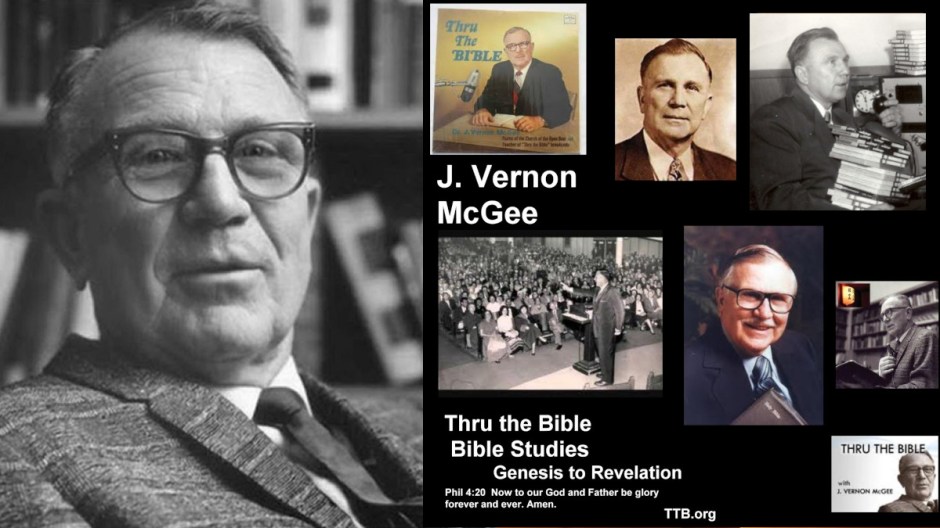
The audio on this video is the property of Thru the Bible. It is offered free of charge. If you wish to make a donation, do not send it to us. Visit http://www.ttb.org for information. The audio is attributed to Dr. J. Vernon McGee and Thru the Bible. Intellectual property rights are those of Thru the Bible. Please contact us if you feel our understanding of the terms of use are in error. Copyright information obtained from https://ttb.org/about/copyright-policy
In Matthew chapter 14, Dr. McGee begins by discussing Herod’s reaction to the fame of Jesus, believing him to be John the Baptist risen from the dead. Herod’s superstitious nature and guilt over the beheading of John are highlighted. The circumstances surrounding John’s death, influenced by Herodias and her daughter, are recounted as a “sadistic sad sorted sorry account”. Following this, the narrative shifts to Jesus withdrawing and then performing the miracle of feeding the 5,000. This miracle is emphasized as being recorded in all four gospels, highlighting its importance. The disciples’ initial suggestion to send the multitude away contrasts with Jesus’ command to feed them.
Dr. McGee then details the event of Jesus walking on the water, which occurs after he sends the multitude away to pray. The disciples’ fear at seeing him, believing him to be a spirit, is mentioned. Peter’s attempt to walk on water and his subsequent sinking when he loses focus on Jesus are described, emphasizing the importance of keeping one’s eyes on the Lord. The disciples’ eventual worship of Jesus as the Son of God after the wind ceases is noted. The speaker then transitions to Jesus healing multitudes in the land of Gennesaret.
A significant portion of the discussion revolves around Jesus’ confrontation with the scribes and Pharisees who questioned his disciples about not washing their hands before eating. Jesus rebukes them for prioritizing their traditions over the commandments of God, using the example of honoring parents. He accuses them of hypocrisy, quoting Isaiah to highlight the disparity between their outward actions and inward hearts. Jesus clarifies that it is not what goes into the mouth that defiles a man, but what comes out of the mouth, proceeding from the heart, listing evils such as evil thoughts, murders, adulteries, etc.. This confrontation is described as the real break between Jesus and the religious leaders.
Dr. McGee then delves into the Transfiguration of Jesus in Matthew 17. This event is presented as a vision shown to Peter, James, and John, where Jesus’ face shone like the sun, and Moses and Elijah appeared talking with him. The speaker emphasizes that the Transfiguration sets forth the perfect humanity of Christ and the hope of humanity for future glorification. God the Father’s voice from the cloud declaring, “This is my beloved Son, in whom I am well pleased; hear ye him,” is highlighted as God’s ultimate testimony and the final authority. The disciples’ fearful reaction and Jesus’ reassuring touch are mentioned, culminating in them seeing “no man save Jesus only”.
Finally, Dr. McGee covers the healing of a demon-possessed boy that the disciples were unable to cure due to their unbelief. Jesus’ powerful rebuke of the demon and the subsequent healing are described as the “worst case” he dealt with. Jesus reiterates his impending betrayal, death, and resurrection to his disciples, who react with sorrow. The chapter concludes with the incident of the tribute money, where Jesus instructs Peter to catch a fish containing the necessary coin, demonstrating his power and provision. The speaker concludes by noting that the disciples were slow to believe and understand, and that Jesus is patient with believers today.
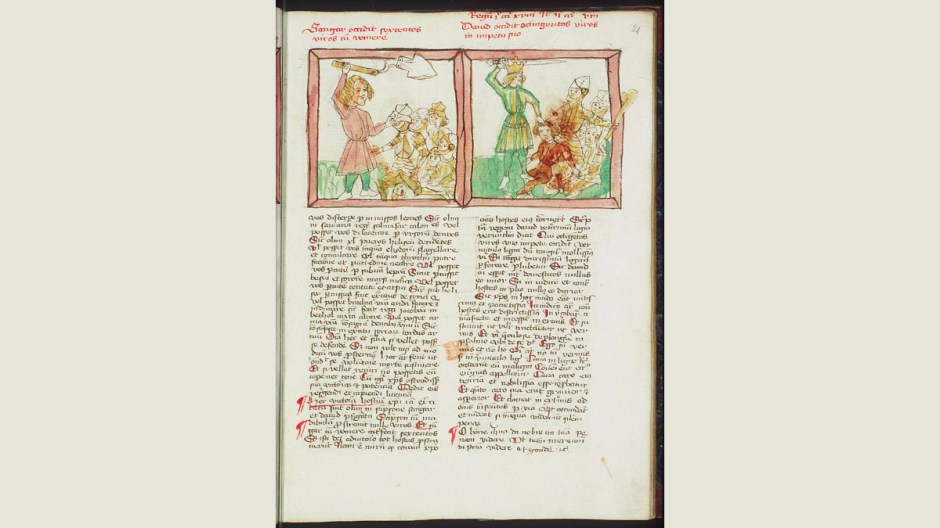
God calls ordinary people to do extraordinary things. This truth shines through in the story of Shamgar, a little-known judge in ancient Israel. Shamgar’s tale reminds us that God can use anyone, no matter how unremarkable they may seem, to bring about His purposes.
In Shamgar’s time, Israel was facing a dire situation. The Philistines had taken control of the main roads, cutting off supplies and wearing down the Israelites through a war of attrition. The people were forced to use winding back roads and mountain paths just to get around. It seemed like a hopeless situation, but God had a plan.
Enter Shamgar, an ordinary man with no special qualifications mentioned in the Bible. There was no dramatic calling like a burning bush or a blinding light. Yet God chose this everyday person to save Israel. Armed only with an ox goad, Shamgar struck down 600 Philistines and brought peace to the land.
Shamgar’s story teaches us that God’s word is always useful and profitable, even in the brief mentions that might seem unimportant at first glance. As it says in 2 Timothy 3:16, “All Scripture is God-breathed and is useful for teaching, rebuking, correcting and training in righteousness.” Every part of the Bible, including the short account of Shamgar, has something valuable to teach us.
This year, as we think about making changes in our lives, we should ask ourselves: “Am I where God wants me to be, and am I doing what God wants me to do?” Like Shamgar, we may feel ordinary or ill-equipped, but God can use us in mighty ways if we’re willing to answer His call. We don’t need special qualifications or dramatic experiences – just a willingness to serve where God places us
The audio on this video is the property of Thru the Bible. It is offered free of charge. If you wish to make a donation, do not send it to us. Visit http://www.ttb.org for information. The audio is attributed to Dr. J. Vernon McGee and Thru the Bible. Intellectual property rights are those of Thru the Bible. Please contact us if you feel our understanding of the terms of use are in error. Copyright information obtained from https://ttb.org/about/copyright-policy
In chapter 11, Dr. McGee begins by noting that after Jesus enunciated his ethic, performed miracles, and sent out his disciples, the reception of his message was rejection. This chapter marks a turning point in Jesus’ ministry. Even John the Baptist, in prison, sent two disciples to ask Jesus, “Art thou he that should come, or do we look for another?”. Dr. McGee finds this a logical question, as John might have expected Jesus to have assumed power by this time. Jesus did not rebuke John but told his disciples to report what they had seen and heard – the blind receiving sight, the lame walking, lepers cleansed, the deaf hearing, the dead raised, and the poor having the gospel preached to them. These were the credentials of the Messiah prophesied in Isaiah. Jesus then defended John to the multitudes, emphasizing that John was not a “reed shaken with the wind” but a strong voice. He was rugged and more than a prophet, being the forerunner prophesied in Malachi 3:1. Jesus stated that there had not arisen anyone greater than John the Baptist among those born of women, yet the least in the Kingdom of Heaven is greater than he because of being in Christ. Dr. McGee interprets the difficult verse about the Kingdom of Heaven suffering violence as referring to both external forces seeking to destroy it and the wholehearted commitment needed to enter it. He notes that John is the Elijah who was to come if they had received Christ. Jesus then likens that generation to spoiled children who were never pleased. They criticized John for his austerity and Jesus for eating and drinking. A significant change occurs as Jesus begins to upbraid the cities where most of his mighty works were done because they did not repent, pronouncing judgment on Chorazin, Bethsaida, and Capernaum, stating it would be more tolerable for Tyre and Sidon, and even Sodom, in the day of judgment than for them due to the greater light they rejected. Jesus then thanks the Father for hiding these things from the wise and prudent and revealing them to babes. He declares that all things are delivered to him by the Father and invites all who labor and are heavy laden to come to him for rest, offering his easy yoke and light burden, which Dr. McGee identifies as the burden of sin.
Chapter 12 marks open conflict with the religious rulers. The conflict begins when Jesus’ disciples pluck and eat corn on the Sabbath, and the Pharisees accuse them of harvesting. Jesus defends his disciples by referring to David eating the showbread and the priests working in the temple on the Sabbath, claiming that “in this place is one greater than the temple” and that “the Son of Man is Lord even of the Sabbath day”. This claim of superiority leads to greater bitterness from the Pharisees. In the synagogue, Jesus heals a man with a withered hand on the Sabbath, further provoking the Pharisees who then take counsel to destroy him. Despite this, great multitudes followed Jesus, and he healed them all, charging them not to make him known, fulfilling Isaiah’s prophecy about his servant. A man possessed by a demon, blind and dumb, is brought to Jesus, and he heals him, causing the people to wonder if he is the Son of David. However, the Pharisees accuse him of casting out demons by Beelzebub, the prince of demons. Jesus refutes this, warning that a kingdom divided against itself cannot stand and that if he casts out demons by the Spirit of God, then the kingdom of God has come. He speaks of the unpardonable sin as blasphemy against the Holy Spirit, which occurred when they attributed his works to Satan despite the Holy Spirit’s power. Dr. McGee clarifies that this specific sin cannot be committed today, but resisting the Holy Spirit’s work in offering forgiveness still leads to a lack of remedy. Jesus then rebukes that generation as vipers, stating that out of the abundance of the heart, the mouth speaks. When the scribes and Pharisees ask for a sign, Jesus says the only sign will be the sign of Jonah – three days and three nights in the heart of the earth, a resurrection sign. He contrasts their rejection with the repentance of the men of Nineveh and the wisdom-seeking of the Queen of Sheba, both of whom will condemn that generation. He gives the parable of the unclean spirit returning with seven more wicked spirits to an empty house, illustrating that reformation without true conversion is insufficient and leaves one in a worse state. Jesus then emphasizes that the strongest relationship is the spiritual one with Christ and fellow believers, not blood ties.
Chapter 13 is described as one of the high points of Matthew’s Gospel and key to understanding the Kingdom of Heaven. Dr. McGee asserts that the Kingdom of Heaven is not synonymous with the church but is Christendom, encompassing the church. He interprets the seven (or eight) parables in this chapter as revealing the mysteries or the condition of the Kingdom of Heaven during Jesus’ rejection. The first is the Parable of the Sower, which Dr. McGee considers the key to the other parables because Jesus himself interprets it. The sower is the Son of Man, sowing the seed, which is the Word of God, in the world. The wayside hearers are those from whom the devil snatches the word. The stony ground hearers receive the word with joy but lack root and fall away during tribulation. The thorny ground hearers are choked by the cares of the world and the deceitfulness of riches. The good ground hearers understand the word and bear fruit. The next parable is the Parable of the Tares and Wheat, where an enemy (Satan) sows tares (false doctrine, children of the wicked one) among the wheat (children of the Kingdom). The householder (Jesus) instructs the servants not to pull up the tares prematurely, but to let both grow until the harvest (end of the age), when the angels will separate them. This illustrates the current state of Christendom. The Parable of the Mustard Seed describes the Kingdom of Heaven as a small seed that grows into a large tree where birds (evil, Satan) lodge, representing the outward growth of the organized church (Christendom) becoming influenced by evil. The Parable of the Leaven likens the Kingdom of Heaven to leaven (always a symbol of evil and corruption) hidden by a woman (a principle of evil in doctrine) in three measures of meal (the Word of God), signifying the corruption of the Word. Dr. McGee considers this a key verse in the Bible, illustrating how various isms and cults use and distort the Bible. Jesus interprets the Parable of the Tares and Wheat again for his disciples. The Parable of the Hidden Treasure in a field (the world) represents the nation Israel, hidden and scattered but to be bought (redeemed) by the man (Christ) who sells all he has. The Parable of the Pearl of Great Price depicts the merchant man as Christ, seeking a goodly pearl (the church), who sells all he has (his riches, becoming poor, shedding his blood) to buy it, with the pearl formed by sin (foreign matter) being covered by Christ’s righteousness. The Parable of the Dragnet cast into the sea gathering all kinds of fish represents the end of the age when angels will separate the wicked from the just. Finally, the parable of the householder (every scribe instructed in the Kingdom of Heaven) brings forth things both new and old from his treasure (the Word of God). Dr. McGee concludes by noting the rejection Jesus faced in his own country, Nazareth, where their unbelief limited his mighty works. This unbelief can limit God’s power today as well. The sermon ends by introducing chapter 14, highlighting the growing antagonism towards Jesus, leading to the slaying of John the Baptist, and foreshadowing the ultimate crisis.
In the Old Testament, the phrase “Thus saith the Lord” appears 222 times, especially in the writings of the prophets. These words carried God’s message to His people, often calling them back from straying into harmful ways. The prophets delivered God’s correction, urging His people to return to the path of life and avoid the dangers of the wrong road.
Isn’t it true that we all lose our way at times? Each of us needs guidance and correction. Scripture shines a light on the wrong choices we make and redirects us to the right path. It helps protect us as we walk forward, ensuring we stay on solid ground.
God’s voice should never be ignored or taken lightly. It is a voice full of grace, working to repair what is broken and restore what has been lost. As Proverbs 3:12 reminds us, “For whom the Lord loves He disciplines, Just as a father disciplines the son in whom he delights.” His words guide us not out of anger, but out of deep love and a desire to see us thrive.
Let us listen to His voice, embracing its call to life and renewal.