
Thru the Bible: Matthew 22-24

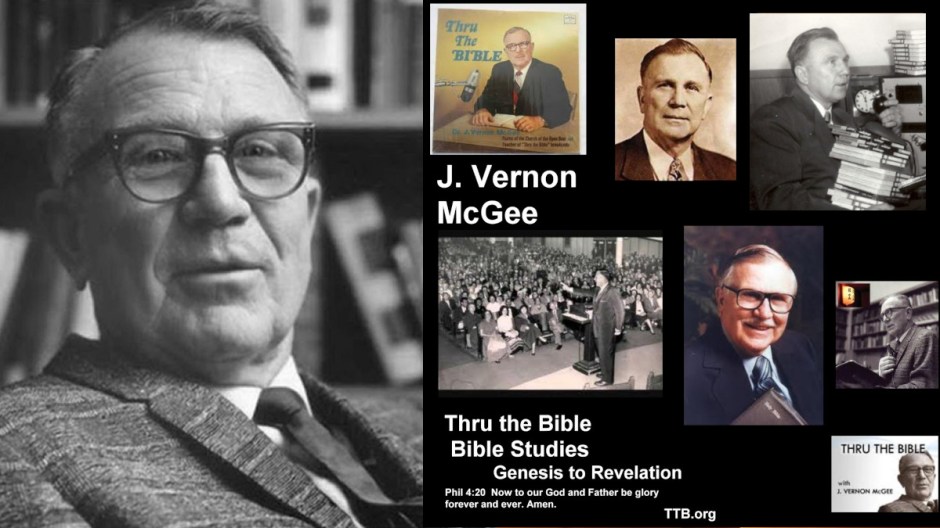
The audio on this video is the property of Thru the Bible. It is offered free of charge. If you wish to make a donation, do not send it to us. Visit http://www.ttb.org for information. The audio is attributed to Dr. J. Vernon McGee and Thru the Bible. Intellectual property rights are those of Thru the Bible.
Please contact us if you feel our understanding of the terms of use are in error.
Copyright information obtained from https://ttb.org/about/copyright-policy

Dr. McGee’s sermon covers Matthew chapters 22 through 24, starting with the verbal clash between Jesus and the religious rulers. Chapter 22 begins with the parable of the king who made a marriage feast for his son. This parable is a continuation of Jesus’ answer to the chief priests and elders and parallels the parables in Matthew 13, focusing on how and why the current age began. The king sends servants to call those who were bidden (the lost sheep of the House of Israel), but they refused to come. He sent other servants, but the invited guests made light of it, going to their farms and merchandise, while others mistreated and killed the servants. In response, the king sent his armies to destroy the murderers and their city, which Dr. McGee believes is a reference to the destruction of Jerusalem in 70 AD. Then, the invitation goes out to everyone found on the highways, both good and bad, and the wedding is furnished with guests. However, a man without a wedding garment (the righteousness of Christ, essential for salvation) is found, bound, and cast into outer darkness, illustrating that while many are called, few are chosen and must come on the king’s terms.

Following this, the religious leaders launch their final attack on Jesus. First, the Herodians question him about paying tribute to Caesar, a political trick to trap him. Jesus, perceiving their wickedness, calls them hypocrites and uses their own coin to state, “Render therefore unto Caesar the things which are Caesar’s, and unto God the things that are God’s,” marvelously answering their question without falling into their trap. Next, the Sadducees, who deny the resurrection, question him about a woman married to seven brothers. Jesus responds that they err by not knowing the Scriptures nor the power of God, stating that in the resurrection, people neither marry nor are given in marriage but are like the angels. He further proves the resurrection by quoting God as saying, “I am the God of Abraham, the God of Isaac, and the God of Jacob,” asserting that God is not the God of the dead but of the living. This silences the Sadducees. Finally, the Pharisees, after hearing that Jesus silenced the Sadducees, gather together and ask him which is the great commandment in the law. Jesus answers, “Thou shalt love the Lord thy God with all thy heart, and with all thy soul, and with all thy mind. This is the first and great commandment. And the second is like unto it, Thou shalt love thy neighbor as thyself. On these two commandments hang all the law and the prophets”. Then, Jesus questions the Pharisees about the Christ, asking whose son he is. They reply, “The Son of David”. Jesus then asks how David, in the Spirit, calls him Lord (Psalm 110:1), highlighting the impossibility of David calling his natural son Lord, implying a supernatural birth. No one is able to answer him, ending the verbal clash.

Chapter 23 marks Jesus’ denouncement of the scribes and Pharisees and his weeping over Jerusalem. He warns the multitude against the scribes and Pharisees who sit in Moses’ seat but do not practice what they preach. He pronounces a series of “woes” upon them, calling them hypocrites for binding heavy burdens on others, doing their works to be seen, loving titles and recognition, and shutting up the Kingdom of Heaven. He criticizes their outward piety and inward corruption, comparing them to whitewashed sepulchers full of dead men’s bones. He also rebukes their meticulous tithing of insignificant items while neglecting the weightier matters of the law: judgment, mercy, and faith. Dr. McGee emphasizes the harshness of Jesus’ language, contrasting it with the liberal conception of a gentle Jesus. Jesus condemns their rejection of the prophets and foretells the persecution of those he will send. He concludes this chapter with a lament over Jerusalem’s rejection of him.

Chapter 24 begins the Olivet Discourse, where Jesus’ disciples ask him privately three questions: when will the temple be destroyed, what will be the sign of his coming, and what will be the sign of the end of the age. Dr. McGee states that the destruction of the temple (fulfilled in 70 AD) is primarily addressed in Luke’s Gospel. Matthew focuses on the signs of his coming and the end of the age, which relate to his coming to establish his kingdom, not the church. Jesus warns them to “take heed that no man deceive you,” as many will come in his name saying, “I am Christ,” and will deceive many. He speaks of wars and rumors of wars, but these are not the sign of the end. Nation will rise against nation, and there will be famines, pestilences, and earthquakes, which are the beginning of sorrows. Dr. McGee believes they are currently in the age leading up to the Great Tribulation. He then discusses the Great Tribulation period, during which the nation Israel will be afflicted and hated by all nations. False prophets will arise, and iniquity will abound. He clarifies that the gospel of the Kingdom will be preached in all the world as a witness before the end comes, distinguishing it from the gospel of grace preached today. The sign of the end will be the “abomination of desolation” standing in the Holy Place. Those in Judea are instructed to flee to the mountains. This period will be a time of great tribulation, unprecedented in history. False Christs and false prophets will perform great signs and wonders, but believers should not be deceived. The coming of the Son of Man will be like lightning, visible to all. Following the tribulation, the sun will be darkened, the moon will not give its light, and the stars will fall from heaven. The sign of the Son of Man will appear in heaven, and all the tribes of the earth will mourn when they see him coming in the clouds with power and great glory. He will send his angels to gather his elect (the nation Israel).

Jesus then gives the parable of the fig tree, which Dr. McGee interprets as the nation Israel. When the fig tree’s branch becomes tender and puts forth leaves, it indicates that summer is near. Similarly, when they see all these signs, they will know that his coming is near. Jesus states, “Verily I say unto you, this generation shall not pass, till all these things be fulfilled,” which Dr. McGee believes could refer to the Jewish race or the generation living at that time. He emphasizes that heaven and earth will pass away, but Jesus’ words will not. However, the specific day and hour are unknown, not even to the angels, but only to the Father. Jesus compares his coming to the days of Noah, where people were eating, drinking, marrying, and giving in marriage until the flood came and took them all away. The phrase “two in the field; the one shall be taken, and the other left” refers to judgment, not the Rapture of the church; the wicked will be taken away in judgment, and the others will be left to enter the millennial kingdom. Therefore, they are to “watch,” a watching characterized by fear and anxiety in that day, unlike the comforting hope of believers watching for the Lord’s return today. The sermon concludes with a call to be ready, as the Son of Man will come at an unexpected hour, and to live in light of the fact that everyone will stand in the presence of Christ to give an account.

Thru the Bible: Matthew 14-17

The audio on this video is the property of Thru the Bible. It is offered free of charge. If you wish to make a donation, do not send it to us. Visit http://www.ttb.org for information. The audio is attributed to Dr. J. Vernon McGee and Thru the Bible. Intellectual property rights are those of Thru the Bible.
Please contact us if you feel our understanding of the terms of use are in error.
Copyright information obtained from https://ttb.org/about/copyright-policy

In Matthew chapter 14, Dr. McGee begins by discussing Herod’s reaction to the fame of Jesus, believing him to be John the Baptist risen from the dead. Herod’s superstitious nature and guilt over the beheading of John are highlighted. The circumstances surrounding John’s death, influenced by Herodias and her daughter, are recounted as a “sadistic sad sorted sorry account”. Following this, the narrative shifts to Jesus withdrawing and then performing the miracle of feeding the 5,000. This miracle is emphasized as being recorded in all four gospels, highlighting its importance. The disciples’ initial suggestion to send the multitude away contrasts with Jesus’ command to feed them.

Dr. McGee then details the event of Jesus walking on the water, which occurs after he sends the multitude away to pray. The disciples’ fear at seeing him, believing him to be a spirit, is mentioned. Peter’s attempt to walk on water and his subsequent sinking when he loses focus on Jesus are described, emphasizing the importance of keeping one’s eyes on the Lord. The disciples’ eventual worship of Jesus as the Son of God after the wind ceases is noted. The speaker then transitions to Jesus healing multitudes in the land of Gennesaret.

A significant portion of the discussion revolves around Jesus’ confrontation with the scribes and Pharisees who questioned his disciples about not washing their hands before eating. Jesus rebukes them for prioritizing their traditions over the commandments of God, using the example of honoring parents. He accuses them of hypocrisy, quoting Isaiah to highlight the disparity between their outward actions and inward hearts. Jesus clarifies that it is not what goes into the mouth that defiles a man, but what comes out of the mouth, proceeding from the heart, listing evils such as evil thoughts, murders, adulteries, etc.. This confrontation is described as the real break between Jesus and the religious leaders.

Dr. McGee then delves into the Transfiguration of Jesus in Matthew 17. This event is presented as a vision shown to Peter, James, and John, where Jesus’ face shone like the sun, and Moses and Elijah appeared talking with him. The speaker emphasizes that the Transfiguration sets forth the perfect humanity of Christ and the hope of humanity for future glorification. God the Father’s voice from the cloud declaring, “This is my beloved Son, in whom I am well pleased; hear ye him,” is highlighted as God’s ultimate testimony and the final authority. The disciples’ fearful reaction and Jesus’ reassuring touch are mentioned, culminating in them seeing “no man save Jesus only”.

Finally, Dr. McGee covers the healing of a demon-possessed boy that the disciples were unable to cure due to their unbelief. Jesus’ powerful rebuke of the demon and the subsequent healing are described as the “worst case” he dealt with. Jesus reiterates his impending betrayal, death, and resurrection to his disciples, who react with sorrow. The chapter concludes with the incident of the tribute money, where Jesus instructs Peter to catch a fish containing the necessary coin, demonstrating his power and provision. The speaker concludes by noting that the disciples were slow to believe and understand, and that Jesus is patient with believers today.

Thru the Bible: Matthew 11-13

The audio on this video is the property of Thru the Bible. It is offered free of charge. If you wish to make a donation, do not send it to us. Visit http://www.ttb.org for information. The audio is attributed to Dr. J. Vernon McGee and Thru the Bible. Intellectual property rights are those of Thru the Bible.
Please contact us if you feel our understanding of the terms of use are in error.
Copyright information obtained from https://ttb.org/about/copyright-policy

In chapter 11, Dr. McGee begins by noting that after Jesus enunciated his ethic, performed miracles, and sent out his disciples, the reception of his message was rejection. This chapter marks a turning point in Jesus’ ministry. Even John the Baptist, in prison, sent two disciples to ask Jesus, “Art thou he that should come, or do we look for another?”. Dr. McGee finds this a logical question, as John might have expected Jesus to have assumed power by this time. Jesus did not rebuke John but told his disciples to report what they had seen and heard – the blind receiving sight, the lame walking, lepers cleansed, the deaf hearing, the dead raised, and the poor having the gospel preached to them. These were the credentials of the Messiah prophesied in Isaiah. Jesus then defended John to the multitudes, emphasizing that John was not a “reed shaken with the wind” but a strong voice. He was rugged and more than a prophet, being the forerunner prophesied in Malachi 3:1. Jesus stated that there had not arisen anyone greater than John the Baptist among those born of women, yet the least in the Kingdom of Heaven is greater than he because of being in Christ. Dr. McGee interprets the difficult verse about the Kingdom of Heaven suffering violence as referring to both external forces seeking to destroy it and the wholehearted commitment needed to enter it. He notes that John is the Elijah who was to come if they had received Christ. Jesus then likens that generation to spoiled children who were never pleased. They criticized John for his austerity and Jesus for eating and drinking. A significant change occurs as Jesus begins to upbraid the cities where most of his mighty works were done because they did not repent, pronouncing judgment on Chorazin, Bethsaida, and Capernaum, stating it would be more tolerable for Tyre and Sidon, and even Sodom, in the day of judgment than for them due to the greater light they rejected. Jesus then thanks the Father for hiding these things from the wise and prudent and revealing them to babes. He declares that all things are delivered to him by the Father and invites all who labor and are heavy laden to come to him for rest, offering his easy yoke and light burden, which Dr. McGee identifies as the burden of sin.

Chapter 12 marks open conflict with the religious rulers. The conflict begins when Jesus’ disciples pluck and eat corn on the Sabbath, and the Pharisees accuse them of harvesting. Jesus defends his disciples by referring to David eating the showbread and the priests working in the temple on the Sabbath, claiming that “in this place is one greater than the temple” and that “the Son of Man is Lord even of the Sabbath day”. This claim of superiority leads to greater bitterness from the Pharisees. In the synagogue, Jesus heals a man with a withered hand on the Sabbath, further provoking the Pharisees who then take counsel to destroy him. Despite this, great multitudes followed Jesus, and he healed them all, charging them not to make him known, fulfilling Isaiah’s prophecy about his servant. A man possessed by a demon, blind and dumb, is brought to Jesus, and he heals him, causing the people to wonder if he is the Son of David. However, the Pharisees accuse him of casting out demons by Beelzebub, the prince of demons. Jesus refutes this, warning that a kingdom divided against itself cannot stand and that if he casts out demons by the Spirit of God, then the kingdom of God has come. He speaks of the unpardonable sin as blasphemy against the Holy Spirit, which occurred when they attributed his works to Satan despite the Holy Spirit’s power. Dr. McGee clarifies that this specific sin cannot be committed today, but resisting the Holy Spirit’s work in offering forgiveness still leads to a lack of remedy. Jesus then rebukes that generation as vipers, stating that out of the abundance of the heart, the mouth speaks. When the scribes and Pharisees ask for a sign, Jesus says the only sign will be the sign of Jonah – three days and three nights in the heart of the earth, a resurrection sign. He contrasts their rejection with the repentance of the men of Nineveh and the wisdom-seeking of the Queen of Sheba, both of whom will condemn that generation. He gives the parable of the unclean spirit returning with seven more wicked spirits to an empty house, illustrating that reformation without true conversion is insufficient and leaves one in a worse state. Jesus then emphasizes that the strongest relationship is the spiritual one with Christ and fellow believers, not blood ties.

Chapter 13 is described as one of the high points of Matthew’s Gospel and key to understanding the Kingdom of Heaven. Dr. McGee asserts that the Kingdom of Heaven is not synonymous with the church but is Christendom, encompassing the church. He interprets the seven (or eight) parables in this chapter as revealing the mysteries or the condition of the Kingdom of Heaven during Jesus’ rejection. The first is the Parable of the Sower, which Dr. McGee considers the key to the other parables because Jesus himself interprets it. The sower is the Son of Man, sowing the seed, which is the Word of God, in the world. The wayside hearers are those from whom the devil snatches the word. The stony ground hearers receive the word with joy but lack root and fall away during tribulation. The thorny ground hearers are choked by the cares of the world and the deceitfulness of riches. The good ground hearers understand the word and bear fruit. The next parable is the Parable of the Tares and Wheat, where an enemy (Satan) sows tares (false doctrine, children of the wicked one) among the wheat (children of the Kingdom). The householder (Jesus) instructs the servants not to pull up the tares prematurely, but to let both grow until the harvest (end of the age), when the angels will separate them. This illustrates the current state of Christendom. The Parable of the Mustard Seed describes the Kingdom of Heaven as a small seed that grows into a large tree where birds (evil, Satan) lodge, representing the outward growth of the organized church (Christendom) becoming influenced by evil. The Parable of the Leaven likens the Kingdom of Heaven to leaven (always a symbol of evil and corruption) hidden by a woman (a principle of evil in doctrine) in three measures of meal (the Word of God), signifying the corruption of the Word. Dr. McGee considers this a key verse in the Bible, illustrating how various isms and cults use and distort the Bible. Jesus interprets the Parable of the Tares and Wheat again for his disciples. The Parable of the Hidden Treasure in a field (the world) represents the nation Israel, hidden and scattered but to be bought (redeemed) by the man (Christ) who sells all he has. The Parable of the Pearl of Great Price depicts the merchant man as Christ, seeking a goodly pearl (the church), who sells all he has (his riches, becoming poor, shedding his blood) to buy it, with the pearl formed by sin (foreign matter) being covered by Christ’s righteousness. The Parable of the Dragnet cast into the sea gathering all kinds of fish represents the end of the age when angels will separate the wicked from the just. Finally, the parable of the householder (every scribe instructed in the Kingdom of Heaven) brings forth things both new and old from his treasure (the Word of God). Dr. McGee concludes by noting the rejection Jesus faced in his own country, Nazareth, where their unbelief limited his mighty works. This unbelief can limit God’s power today as well. The sermon ends by introducing chapter 14, highlighting the growing antagonism towards Jesus, leading to the slaying of John the Baptist, and foreshadowing the ultimate crisis.

Thru the Bible: Matthew 8-10

POSTED BY TEXAS GOSPEL VOLUNTEER

The audio on this video is the property of Thru the Bible. It is offered free of charge. If you wish to make a donation, do not send it to us. Visit http://www.ttb.org for information. The audio is attributed to Dr. J. Vernon McGee and Thru the Bible. Intellectual property rights are those of Thru the bible. Copyright information obtained from https://ttb.org/about/copyright-policy

In Matthew chapter 8, following the high ethical standards presented in the Sermon on the Mount, Matthew introduces a series of miracles performed by Jesus. These miracles are not presented in chronological order but rather in a logical sequence to demonstrate that the King who gave the ethic also possesses the power to enable its accomplishment. Dr. McGee emphasizes that just as believers today can do nothing without Christ, these miracles reveal Jesus’ divine power. The chapter begins with Jesus descending from the mountain, followed by great multitudes, and proceeds to narrate six miracles showcasing his power over various realms.

The miracles in Matthew 8 illustrate Jesus’ comprehensive authority. He heals a leper through touch, signifying his power over human disease. He heals the Centurion’s servant from a distance, demonstrating his authority without physical contact and marveling at the Centurion’s faith. Jesus then heals Peter’s mother-in-law by touching her and casts out demons, moving into the supernatural realm. He further demonstrates his power over nature by stilling a storm. Finally, he casts out demons from two men, highlighting his authority over the spiritual realm and a particularly difficult case. These miracles are presented to show the multifaceted power of the King.

Moving into Matthew chapter 9, the theme of Jesus’ power continues with six more recorded miracles. Upon returning to Capernaum, Jesus heals a paralytic, notably connecting the healing with the forgiveness of his sins, a power exclusive to God. Matthew himself is called to be a disciple, and Jesus associates with publicans and sinners, emphasizing his mission to call the sick rather than the righteous. The chapter also includes the healing of a woman with a twelve-year issue of blood after she touched his garment, and the raising of a ruler’s daughter from the dead, marking the first instance of Jesus raising someone from death in the Gospels. Additionally, he heals two blind men and a dumb man possessed by a demon, further displaying his widespread healing power.

In Matthew chapter 10, having demonstrated his power through these twelve miracles, Jesus commissions his twelve disciples, now referred to as apostles, to go to the nation of Israel and preach the gospel of the Kingdom. He gives them authority over unclean spirits to cast them out and to heal all kinds of sickness and disease, providing them with the same credentials he possessed. Their specific mission is directed towards “the lost sheep of the house of Israel,” and they are instructed to heal the sick, cleanse the lepers, raise the dead, and cast out demons freely. Dr. McGee emphasizes that these instructions were specific to that time and mission to Israel, not necessarily a direct mandate for all Christians today.

While the specific instructions given to the apostles in Matthew 10 were for a particular context, Dr. McGee points out that the chapter also contains general principles applicable to all believers. Jesus warns them of coming persecution, instructing them to be wise as serpents and harmless as doves. He tells them not to fear those who can kill the body but rather fear God. He assures them of God’s care and the importance of confessing him before men. The chapter concludes with a call for total commitment and the promise of reward for those who receive his messengers. Dr. McGee encourages listeners to interpret these instructions within their historical context while still recognizing the enduring spiritual truths they contain.

Dr. J. Vernon McGee – Matthew 2-4

Dr. McGee’s message in these excerpts from his study of Matthew emphasizes that the Gospel of Matthew was specifically written to the nation of Israel and aims to demonstrate how the life and ministry of Jesus Christ fulfilled numerous Old Testament prophecies. He highlights the visit of the wise men, correcting the common misconception of there being only three and pointing out that their journey, prompted by a star (which he believes was a supernatural event, not merely astronomical), was in response to prophecies like Balaam’s prophecy of a star coming out of Jacob. The gifts they brought had symbolic significance, with gold representing his kingship, frankincense his life, and myrrh his death.

Dr. McGee explains the subsequent flight into Egypt and the return to Nazareth as literal fulfillments of Hosea 11:1 and Isaiah 11:1 (as it relates to being called a Nazarene) respectively, showing how God orchestrated events to align with prophecy. He underscores that these seemingly disparate prophecies were fulfilled literally and naturally.

The introduction of John the Baptist is presented as the fulfillment of Malachi’s prophecy of a messenger preparing the way for the Lord. John’s message was one of repentancebecause the Kingdom of Heaven was at hand, which Dr. McGee clarifies as the rule of heaven over the earth, present in the person of the King.

The baptism of Jesus by John was not for Jesus’ own repentance, as he was sinless, but rather for him to identify with sinful mankind and to fulfill all righteousness. Dr. McGee also notes that it set him aside for his office as priest, with the Holy Spirit descending upon him.

The temptation of Jesus in the wilderness was a genuine test, but Dr. McGee insists that Jesus could not have fallen. This test was to prove and demonstrate his perfect character, contrasting it with the temptation of Eve. Jesus consistently used scripture to overcome Satan’s temptations, highlighting the importance of knowing and using the Word of God. Dr. McGee also raises the point that the devil seemed to have the authority to offer Jesus the kingdoms of the world.

Dr. McGee then discusses Jesus moving his headquarters from Nazareth to Capernaum, explaining this as another fulfillment of prophecy from Isaiah, bringing light to the region of Galilee of the Gentiles. Jesus continued the message of repentance and the nearness of the Kingdom of Heaven, echoing John the Baptist. He called his first disciples, promising to make them “fishers of men”. Jesus’ ministry in Galilee involved teaching, preaching the gospel of the Kingdom, and performing numerous healings, demonstrating his power and authority. Dr. McGee concludes by mentioning the Sermon on the Mount as the manifesto of the King.

The audio on this video is the property of Thru the Bible. It is offered free of charge. If you wish to make a donation, do not send it to us. Visit http://www.ttb.org for information. The audio is attributed to Dr. J. Vernon McGee and Thru the Bible. Intellectual property rights are those of Thru the Bible.
Please contact us if you feel our understanding of the terms of use are in error.
Copyright information obtained from https://ttb.org/about/copyright-policy