
From the Old Testament to Matthew

TEXAS GOSPEL VOLUNTEER

The transition from the Old Testament to the New Testament is marked by a period of approximately 400 years of seeming divine silence. After the prophet Malachi, there were no prophetic voices or explicit divine messages recorded in scripture. However, this era was far from uneventful; it was a time of significant transformation and change for the Jewish people and the world stage. Understanding this period is crucial for properly interpreting the New Testament.

During these 400 years, often referred to as the Intertestamental Period, the world underwent considerable shifts. The dominant powers of the Old Testament, the Medo-Persian Empire and Egypt, gradually faded in prominence. World power shifted westward, from Asia to Europe, and from the Medo-Persian Empire to Greece. By the time the New Testament begins, Rome had risen to become the dominant world power.

In 480 BC, Xerxes of Persia was victorious against the Greeks at Thermopylae. However, his defeat at the Battle of Salamis marked the end of the East’s bid for world dominion. In 333 BC, Alexander the Great emerged from the West, leading the united Greek forces to victory over the Persians at Issus. In 332 BC, Alexander visited Jerusalem and, after being shown the prophecies of Daniel that spoke of him, he spared the city. Following Alexander’s death in 323 BC, his empire was divided among his four generals. Judea, located next to Egypt, came under the rule of the Ptolemaic dynasty. In 320 BC, Seleucus, the founder of the Seleucid kingdom in Syria, attempted to take over Judea, turning the small country into a buffer state between Syria and Egypt.

In 203 BC, Antiochus the Great took Jerusalem, bringing Judea under Syrian influence. In 170 BC, Antiochus Epiphanes desecrated the temple in Jerusalem. In 166 BC, Mattathias, a priest of Judea, led a revolt against Syria, marking the beginning of the Maccabean period. This era was marked by immense suffering and heroism for the Jewish people. Judas Maccabeus, known as “the hammer,” organized the revolt. In 63 BC, Pompey of Rome took Jerusalem, placing the Jewish people under Roman rule, where they remained at the time of Jesus’ birth and throughout the New Testament period. In 40 BC, the Roman Senate appointed Herod as King of Judea, initiating the rule of a notoriously wicked family. In 37 BC, Herod took Jerusalem and killed Antigonus, the last of the Maccabean king-priests. In 31 BC, Caesar Augustus became emperor of Rome, and in 19 BC, the rebuilding of the Herodian Temple began. Jesus was born in Bethlehem in 4 BC.

During this period, several distinct parties emerged within Jewish society, none of which are mentioned in the Old Testament. The Pharisees were the dominant party, arising to defend Jewish traditions and practices against foreign influences. They were strict legalists, believed in the Old Testament, and were nationalistic in their politics, seeking to restore the kingdom to the line of David.

The Sadducees were composed of wealthy, socially minded individuals who sought to reject tradition. They were liberal in their theology, rejected the supernatural, and were closely akin to the Greek Epicureans, who believed in pursuing pleasure.

The scribes were professional expounders of the law, stemming from the days of Ezra. However, they became overly concerned with the letter of the law rather than its spirit. They possessed knowledge of the law but often failed to translate it into practical action.

The Herodians were political opportunists who sought to maintain the Herods in power.

This period also saw significant literary activity. The Old Testament was translated into Greek in Alexandria, Egypt, between 285 and 247 BC. This translation, known as the Septuagint, was used by Paul and quoted by Jesus. The Apocrypha of the Old Testament was also written during this era.

This period was marked by God’s silence, yet it was a time when He was preparing the world for the coming of Christ.

The four Gospels are directed to different groups of people. The Gospel of Matthew was written primarily for the nation of Israel, a religious people. The Gospel of Mark was directed to the Romans, who were men of action and believed in law and order. The Gospel of Luke was written to the Greeks, the thinking people. The Gospel of John, while written for believers, was indirectly aimed at the Orient, where people were seeking deliverance.

The Gospel of Matthew, written by a publican named Matthew, was originally written in Hebrew for the nation of Israel. God prepared the nation for the coming of Christ.

The Gospel of Matthew is a key book because it connects the Old Testament prophecies and moves into the New Testament. Matthew mentions the church by name, unlike the other Gospel writers.

The Gospel presents the program of God, the kingdom of heaven. The term “kingdom of heaven” is specific to this Gospel, appearing 32 times, and the word “kingdom” appears 50 times. Understanding the phrase “kingdom of heaven” is essential for interpreting this Gospel and the Bible. The kingdom and the church are not the same, but the church is in the kingdom. The kingdom of heaven is the reign of the heavens over the earth.

The theme of this Gospel is the Lord Jesus, who will establish the kingdom on earth. The three major discourses in Matthew concern the kingdom. The Sermon on the Mount presents the law of the kingdom, the mystery parables in Matthew 13 concern the kingdom, and the discourse in Matthew 24-25 looks forward to the establishment of the kingdom on earth.

The movement in the Gospel of Matthew includes the person of the king, the preparation of the king, the propaganda of the king, the program of the king, the passion of the king, and the power of the king.
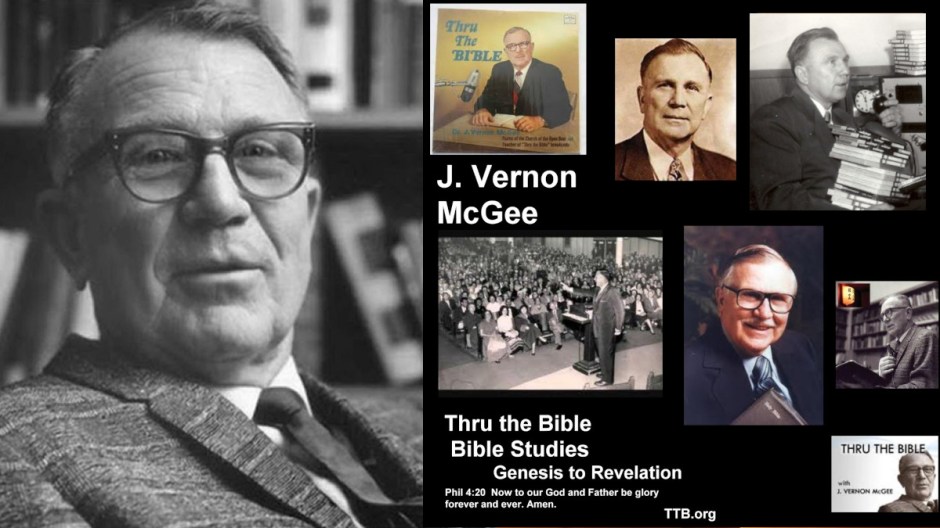
Dr. J. Vernon McGee – Matthew 2-4

Dr. McGee’s message in these excerpts from his study of Matthew emphasizes that the Gospel of Matthew was specifically written to the nation of Israel and aims to demonstrate how the life and ministry of Jesus Christ fulfilled numerous Old Testament prophecies. He highlights the visit of the wise men, correcting the common misconception of there being only three and pointing out that their journey, prompted by a star (which he believes was a supernatural event, not merely astronomical), was in response to prophecies like Balaam’s prophecy of a star coming out of Jacob. The gifts they brought had symbolic significance, with gold representing his kingship, frankincense his life, and myrrh his death.

Dr. McGee explains the subsequent flight into Egypt and the return to Nazareth as literal fulfillments of Hosea 11:1 and Isaiah 11:1 (as it relates to being called a Nazarene) respectively, showing how God orchestrated events to align with prophecy. He underscores that these seemingly disparate prophecies were fulfilled literally and naturally.

The introduction of John the Baptist is presented as the fulfillment of Malachi’s prophecy of a messenger preparing the way for the Lord. John’s message was one of repentancebecause the Kingdom of Heaven was at hand, which Dr. McGee clarifies as the rule of heaven over the earth, present in the person of the King.

The baptism of Jesus by John was not for Jesus’ own repentance, as he was sinless, but rather for him to identify with sinful mankind and to fulfill all righteousness. Dr. McGee also notes that it set him aside for his office as priest, with the Holy Spirit descending upon him.

The temptation of Jesus in the wilderness was a genuine test, but Dr. McGee insists that Jesus could not have fallen. This test was to prove and demonstrate his perfect character, contrasting it with the temptation of Eve. Jesus consistently used scripture to overcome Satan’s temptations, highlighting the importance of knowing and using the Word of God. Dr. McGee also raises the point that the devil seemed to have the authority to offer Jesus the kingdoms of the world.

Dr. McGee then discusses Jesus moving his headquarters from Nazareth to Capernaum, explaining this as another fulfillment of prophecy from Isaiah, bringing light to the region of Galilee of the Gentiles. Jesus continued the message of repentance and the nearness of the Kingdom of Heaven, echoing John the Baptist. He called his first disciples, promising to make them “fishers of men”. Jesus’ ministry in Galilee involved teaching, preaching the gospel of the Kingdom, and performing numerous healings, demonstrating his power and authority. Dr. McGee concludes by mentioning the Sermon on the Mount as the manifesto of the King.

The audio on this video is the property of Thru the Bible. It is offered free of charge. If you wish to make a donation, do not send it to us. Visit http://www.ttb.org for information. The audio is attributed to Dr. J. Vernon McGee and Thru the Bible. Intellectual property rights are those of Thru the Bible.
Please contact us if you feel our understanding of the terms of use are in error.
Copyright information obtained from https://ttb.org/about/copyright-policy

Dr. J. Vernon McGee – Matthew 1

The audio on this video is the property of Thru the Bible. It is offered free of charge. If you wish to make a donation, do not send it to us. Visit http://www.ttb.org for information. The audio is attributed to Dr. J. Vernon McGee and Thru the Bible. Intellectual property rights are those of Thru the Bible.
Please contact us if you feel our understanding of the terms of use are in error.
Copyright information obtained from https://ttb.org/about/copyright-policy

Dr. McGee’s message in this excerpt from his discourse on the Gospel of Matthew begins by underscoring the vital importance of understanding the approximately 400-year intertestamental period between the Old and New Testaments. During this time of divine silence, significant global shifts occurred, witnessing the decline of the Medo-Persian and Egyptian empires and the rise of Greece under Alexander the Great, who even visited Jerusalem. Subsequently, the Roman Empire emerged as the dominant world power by the time the New Testament opens. Internally, Judea underwent a radical transformation, with new cultural norms, institutions, and organizations developing, giving rise to the Jewish parties mentioned in the New Testament, such as the Pharisees (defenders of Jewish tradition and nationalists), the Sadducees (wealthy, liberal in theology, and opposed to tradition), the scribes (legal experts focused on the letter of the law), and the Herodians (political opportunists). Dr. McGee emphasizes that understanding this historical context is crucial for appreciating the New Testament.

He then turns his attention to the Gospel of Matthew, stating that it was written primarily for the nation of Israel, a religious people, and possibly was first penned in Hebrew. He considers Matthew a key book that bridges the Old Testament and the New, gathering numerous Old Testament prophecies and showing their fulfillment in Jesus Christ. A central theme in Matthew is the Kingdom of Heaven, an expression unique to this Gospel, which Dr. McGee defines as the reign of the heavens over the Earth, clearly distinguishing it from the church. The genealogy that opens Matthew’s Gospel is deemed a profoundly important document, establishing Jesus’ lineage from Abraham, which places him within the chosen nation, and from David, which gives him the legal claim to the throne. This genealogy was a matter of public record and its accuracy was not challenged in early times.

Dr. McGee draws a significant parallel between the “book of the generation of Adam” in Genesis and “the book of the generation of Jesus Christ” in Matthew, highlighting that while entrance into Adam’s family is by natural birth, entry into Christ’s family occurs through the New Birth by faith in Christ. He also points out the remarkable inclusion of four women—Tamar, Rahab, Ruth, and Bathsheba—and Gentiles in Jesus’ genealogy, which was unconventional for the time, suggesting themes of sin, faith, grace, and God’s redemptive purposes. He explains the seemingly broken pattern in verse 16, where it states “Jacob begat Joseph the husband of Mary, of whom was born Jesus,” clarifying that while Joseph provides the legal title to David’s throne (being in the line of David through Solomon), he was not Jesus’ biological father due to the curse on Jeconiah’s line; Mary, also of the lineage of David (through Nathan), was the one who bore Jesus.

A cornerstone of Dr. McGee’s message is the Virgin Birth of Jesus Christ. He emphasizes that Matthew explicitly teaches that Joseph was not Jesus’ father and sees this as the fulfillment of the prophecy in Isaiah 7:14: “Behold, a virgin shall be with child and shall bring forth a son, and they shall call his name Emmanuel“. He strongly criticizes liberal interpretations that attempt to translate the Hebrew word alma and the Greek word parthenos as “young woman” instead of “virgin,” arguing that the Septuagint translation by Hebrew scholars clearly understood it to mean virgin. Dr. McGee underscores the profound significance of the name Emmanuel, meaning “God with us,” asserting that Jesus can only be the Savior (Jesus) because he is Emmanuel through the Virgin Birth. He firmly believes that while one might initially come to Christ without fully understanding the Virgin Birth, a true child of God will not ultimately deny this foundational doctrine.

The audio on this video is the property of Thru the Bible. It is offered free of charge. If you wish to make a donation, do not send it to us. Visit http://www.ttb.org for information. The audio is attributed to Dr. J. Vernon McGee and Thru the Bible. Intellectual property rights are those of Thru the Bible.
Please contact us if you feel our understanding of the terms of use are in error.
Copyright information obtained from https://ttb.org/about/copyright-policy

How do you respond when your faith is questioned?

Floyd Rogers – Texas Gospel Volunteer, Christian writer

Matthew 11:1-6 NASB: When Jesus had finished giving instructions to His twelve disciples, He went on from there to teach and preach in their cities. 2 Now while in prison, John heard about the works of Christ, and he sent word by his disciples, 3 and said to Him, “Are You the Coming One, or are we to look for someone else?” 4 Jesus answered and said to them, “Go and report to John what you hear and see: 5 those who are blind receive sight and those who limp walk, those with leprosy are cleansed and those who are deaf hear, the dead are raised, and the poor have the gospel preached to them. 6 And blessed is any person who does not take offense at Me.”  

Matthew 11:1-6 comes immediately after Jesus gave his apostles instructions as they headed out to preach to the lost sheep of the tribe of Israel.  In these verses, John is in prison and sends messengers to Jesus to ask if Jesus is the one, or if it is someone else. John is the one who baptized Jesus, but now that he is in prison for preaching the Gospel he asks if Jesus is the one!

We shouldn’t be surprised that John is in prison for preaching the Gospel. These verses follow Jesus telling his apostles they will be persecuted for delivering his message. An important lesson here is that hard times can make one question if his or her understanding of God’s word is correct. And even an Apostle of Jesus can lose faith.

Matthew told us in earlier verses  that Jesus’ disciples were in a boat with Jesus as a storm hit. Even though Jesus was in the boat with them, they lost faith until Jesus calmed the sea. Now we hear of John asking questions while he is in prison. Some say John lost faith and one could infer this from what Matthew wrote, and it would not be the first time an Apostle lost faith. But I think it’s more likely he’s questioning whether Jesus will be a military-political leader or if someone else is coming to rule on earth.  Could he be questioning his understanding of Messiah? I ask this because Matthew’s theme seems to be to convince Jewish people that Messiah will rule the Kingdom of Heaven.  He uses this phrase 32 times when other Gospel writers exclusively use the phrase Kingdom of God. I think he uses Kingdom of Heaven to drive home his point. 

My point in all this is it’s OK to ask God for faith when we have questions. It’s OK to ask God if we have it wrong. There’s no sense in being dishonest with God because he knows your thoughts whether you express them or not. The apostles in a boat, and John in prison began to have doubts.  But in both cases, they reached out to Jesus for answers rather than let any doubts they have fester. They were short sighted.  Jesus saw the whole picture which ended with his resurrection and salvation for anyone who accepts his call.

Shouldn’t our first response when doubt starts to creep in be to ask Jesus to strengthen our faith and to open our eyes to his will?

What are your thoughts?

Also on the web:

Did Jesus promise a reward for helping those who preach the Gospel?

Floyd Rogers – Texas Gospel Volunteer, Christian writer

Matthew 10:40-42 NASB: “The one who receives you receives Me, and the one who receives Me receives Him who sent Me. 41 The one who receives a prophet in the name of a prophet shall receive a prophet’s reward; and the one who receives a righteous person in the name of a righteous person shall receive a righteous person’s reward. 42 And whoever gives one of these little ones just a cup of cold water to drink in the name of a disciple, truly I say to you, he shall by no means lose his reward.”  (New American Standard Bible®, Copyright © 1960, 1971, 1977, 1995, 2020 by The Lockman Foundation.)

When Jesus gave his disciples instructions as they got ready to preach to the lost sheep of the House of Israel, he spoke of rewards.  I believe this includes rewards for the apostles and for those who helped them. Let’s examine Matthew 10:40-42 and consider what Jesus had to say, the disagreement some people have about verse 42, and the implications for us today.

Jesus has just finished telling his apostles that many will reject the Gospel, and some will get violent. But he also said, “The one who receives a prophet in the name of a prophet shall receive a prophet’s reward…” He added the one who receives a righteous person in the name of a righteous person shall receive a righteous person’s reward. I think it’s clear in this context he is saying the reward of those who help the apostles spread the gospel is the same as that of the apostles who are preaching the gospel and the act of welcoming Jesus’ apostle is the same as the act of welcoming Jesus.  I think a fair analogy from our modern world is the welcoming of an ambassador.  The host country isn’t just welcoming the ambassador, it welcomes the ambassador’s country; the one who sent him or her.

I found there is some disagreement about whom Verse 42 speaks. Jesus tells of the reward given to the person who gives a drink of water to any of these little ones.  Jesus often used the word “children” as a metaphor to describe adults in a spiritual sense. Here, there are at least two groups this metaphor may describe.  I believe Jesus’ metaphor of giving cold water to “little ones” refers to the apostles giving the lost sheep the Gospel, and says the apostles will be rewarded. But I found at least one author who says this refers to the apostles as “little ones” and those who give them a literal drink of cold water will be rewarded. I could argue either way, but at the end of the day, Jesus is talking about rewards given to those who help in carrying out his work.

I think it’s important to note, these are Jesus’ instructions to his apostles as they head out on a specific mission.  Some of the instructions given in the chapter (such as not preaching to the Gentiles or Samaritans) are clearly for this mission only because later they are told to preach to everybody.  But I think since Jesus said, “a prophet,” and not my apostle; and since he spoke of “a righteous person” rather than a specific righteous person, that this applies to all who do this rather than only the people to whom the apostles encountered on this specific mission.  When we help a person spread the gospel, I understand these verses to tell us we share in his or her reward. Could we infer from this a warning about helping those who spread a false doctrine?

What are your thoughts?

Also on the web: