The book of Acts gives a remarkable account of the day of Pentecost in chapter 2. This event marked a pivotal moment in history when God sent His Spirit in an extraordinary way. The apostles boldly proclaimed God’s message, and the world around them paid attention. Some people today suggest that every church gathering should aim to recreate such experiences. But is that expectation realistic given the unique context of Pentecost? And how should this passage influence the church now?
Pentecost was an exceptional, one-time event. It was not intended to set a recurring pattern for Christian worship. The Holy Spirit visibly descended like tongues of fire, and the apostles spoke in real, identifiable languages—not meaningless sounds but known languages that people understood in their native tongues. Acts 2 makes it clear that this miraculous sign served a distinct purpose: to demonstrate the Spirit’s arrival and signal the beginning of the church.
Similar events occurred later in Acts, such as among the Gentiles in chapter 8 and followers of John the Baptist. These moments introduced different groups into the church but were not meant to define the regular Christian experience. These miraculous signs were God’s way of confirming His work during that unique time in history.
While Christians today may not witness such dramatic signs, the message of Pentecost remains vital. It reminds us that God’s Spirit empowers His church to proclaim the gospel to all nations. As Paul wrote, “For in one Spirit we were all baptised into one body” (1 Corinthians 12:13). The church’s focus should be on living out this unity and sharing God’s word, not on seeking miraculous signs as a norm.
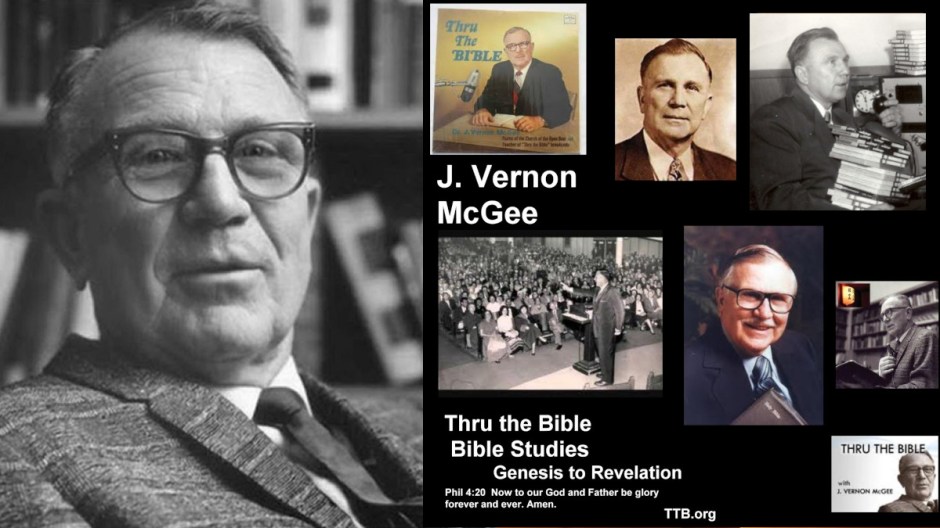
The audio on this video is the property of Thru the Bible. It is offered free of charge. If you wish to make a donation, do not send it to us. Visit http://www.ttb.org for information. The audio is attributed to Dr. J. Vernon McGee and Thru the Bible. Intellectual property rights are those of Thru the Bible. Please contact us if you feel our understanding of the terms of use are in error. Copyright information obtained from https://ttb.org/about/copyright-policy
In chapter 11, Dr. McGee begins by noting that after Jesus enunciated his ethic, performed miracles, and sent out his disciples, the reception of his message was rejection. This chapter marks a turning point in Jesus’ ministry. Even John the Baptist, in prison, sent two disciples to ask Jesus, “Art thou he that should come, or do we look for another?”. Dr. McGee finds this a logical question, as John might have expected Jesus to have assumed power by this time. Jesus did not rebuke John but told his disciples to report what they had seen and heard – the blind receiving sight, the lame walking, lepers cleansed, the deaf hearing, the dead raised, and the poor having the gospel preached to them. These were the credentials of the Messiah prophesied in Isaiah. Jesus then defended John to the multitudes, emphasizing that John was not a “reed shaken with the wind” but a strong voice. He was rugged and more than a prophet, being the forerunner prophesied in Malachi 3:1. Jesus stated that there had not arisen anyone greater than John the Baptist among those born of women, yet the least in the Kingdom of Heaven is greater than he because of being in Christ. Dr. McGee interprets the difficult verse about the Kingdom of Heaven suffering violence as referring to both external forces seeking to destroy it and the wholehearted commitment needed to enter it. He notes that John is the Elijah who was to come if they had received Christ. Jesus then likens that generation to spoiled children who were never pleased. They criticized John for his austerity and Jesus for eating and drinking. A significant change occurs as Jesus begins to upbraid the cities where most of his mighty works were done because they did not repent, pronouncing judgment on Chorazin, Bethsaida, and Capernaum, stating it would be more tolerable for Tyre and Sidon, and even Sodom, in the day of judgment than for them due to the greater light they rejected. Jesus then thanks the Father for hiding these things from the wise and prudent and revealing them to babes. He declares that all things are delivered to him by the Father and invites all who labor and are heavy laden to come to him for rest, offering his easy yoke and light burden, which Dr. McGee identifies as the burden of sin.
Chapter 12 marks open conflict with the religious rulers. The conflict begins when Jesus’ disciples pluck and eat corn on the Sabbath, and the Pharisees accuse them of harvesting. Jesus defends his disciples by referring to David eating the showbread and the priests working in the temple on the Sabbath, claiming that “in this place is one greater than the temple” and that “the Son of Man is Lord even of the Sabbath day”. This claim of superiority leads to greater bitterness from the Pharisees. In the synagogue, Jesus heals a man with a withered hand on the Sabbath, further provoking the Pharisees who then take counsel to destroy him. Despite this, great multitudes followed Jesus, and he healed them all, charging them not to make him known, fulfilling Isaiah’s prophecy about his servant. A man possessed by a demon, blind and dumb, is brought to Jesus, and he heals him, causing the people to wonder if he is the Son of David. However, the Pharisees accuse him of casting out demons by Beelzebub, the prince of demons. Jesus refutes this, warning that a kingdom divided against itself cannot stand and that if he casts out demons by the Spirit of God, then the kingdom of God has come. He speaks of the unpardonable sin as blasphemy against the Holy Spirit, which occurred when they attributed his works to Satan despite the Holy Spirit’s power. Dr. McGee clarifies that this specific sin cannot be committed today, but resisting the Holy Spirit’s work in offering forgiveness still leads to a lack of remedy. Jesus then rebukes that generation as vipers, stating that out of the abundance of the heart, the mouth speaks. When the scribes and Pharisees ask for a sign, Jesus says the only sign will be the sign of Jonah – three days and three nights in the heart of the earth, a resurrection sign. He contrasts their rejection with the repentance of the men of Nineveh and the wisdom-seeking of the Queen of Sheba, both of whom will condemn that generation. He gives the parable of the unclean spirit returning with seven more wicked spirits to an empty house, illustrating that reformation without true conversion is insufficient and leaves one in a worse state. Jesus then emphasizes that the strongest relationship is the spiritual one with Christ and fellow believers, not blood ties.
Chapter 13 is described as one of the high points of Matthew’s Gospel and key to understanding the Kingdom of Heaven. Dr. McGee asserts that the Kingdom of Heaven is not synonymous with the church but is Christendom, encompassing the church. He interprets the seven (or eight) parables in this chapter as revealing the mysteries or the condition of the Kingdom of Heaven during Jesus’ rejection. The first is the Parable of the Sower, which Dr. McGee considers the key to the other parables because Jesus himself interprets it. The sower is the Son of Man, sowing the seed, which is the Word of God, in the world. The wayside hearers are those from whom the devil snatches the word. The stony ground hearers receive the word with joy but lack root and fall away during tribulation. The thorny ground hearers are choked by the cares of the world and the deceitfulness of riches. The good ground hearers understand the word and bear fruit. The next parable is the Parable of the Tares and Wheat, where an enemy (Satan) sows tares (false doctrine, children of the wicked one) among the wheat (children of the Kingdom). The householder (Jesus) instructs the servants not to pull up the tares prematurely, but to let both grow until the harvest (end of the age), when the angels will separate them. This illustrates the current state of Christendom. The Parable of the Mustard Seed describes the Kingdom of Heaven as a small seed that grows into a large tree where birds (evil, Satan) lodge, representing the outward growth of the organized church (Christendom) becoming influenced by evil. The Parable of the Leaven likens the Kingdom of Heaven to leaven (always a symbol of evil and corruption) hidden by a woman (a principle of evil in doctrine) in three measures of meal (the Word of God), signifying the corruption of the Word. Dr. McGee considers this a key verse in the Bible, illustrating how various isms and cults use and distort the Bible. Jesus interprets the Parable of the Tares and Wheat again for his disciples. The Parable of the Hidden Treasure in a field (the world) represents the nation Israel, hidden and scattered but to be bought (redeemed) by the man (Christ) who sells all he has. The Parable of the Pearl of Great Price depicts the merchant man as Christ, seeking a goodly pearl (the church), who sells all he has (his riches, becoming poor, shedding his blood) to buy it, with the pearl formed by sin (foreign matter) being covered by Christ’s righteousness. The Parable of the Dragnet cast into the sea gathering all kinds of fish represents the end of the age when angels will separate the wicked from the just. Finally, the parable of the householder (every scribe instructed in the Kingdom of Heaven) brings forth things both new and old from his treasure (the Word of God). Dr. McGee concludes by noting the rejection Jesus faced in his own country, Nazareth, where their unbelief limited his mighty works. This unbelief can limit God’s power today as well. The sermon ends by introducing chapter 14, highlighting the growing antagonism towards Jesus, leading to the slaying of John the Baptist, and foreshadowing the ultimate crisis.
The thought of evangelism often stirs mixed emotions—excitement, nervousness, and even fear. This is not surprising, as the New Testament recognizes these reactions and addresses them directly. The Apostle Paul boldly declared in Romans 1:16, “I am not ashamed of the gospel.” While most Christians would agree they are not ashamed of the gospel, many still admit feeling anxious about sharing it. But is there a distinction between anxiety and shame, and what did Paul mean by his statement?
Anxiety and shame are indeed different. Anxiety often arises when we approach someone with the gospel because of the nature of the message. It involves telling people hard truths: that humanity is sinful and deserving of eternal punishment. This can feel daunting because it’s not the easiest conversation to begin. However, acknowledging the problem of sin is essential since the question of salvation hinges on being saved from something—and that something is eternal separation from God.
Paul’s encouragement not to be ashamed reminds believers to move beyond their fears. Sharing the gospel requires confronting these feelings and focusing on the incredible hope offered through salvation. The good news of Jesus Christ is the most transformative message anyone can hear. A practical way to start is by framing it positively: “I have the best news you’ll ever hear.” This approach can help ease anxiety and create an opening for deeper conversation.
Evangelism calls for courage, but it also reminds us of our mission to share God’s love and redemption. As Paul demonstrated, confidence in the gospel’s power can overcome any hesitation.
In recent years, society has experienced a significant spiritual shift. This change mirrors the pattern described in the Bible, particularly in the book of Romans. As evolution becomes the prevailing worldview and people live as if God doesn’t exist, society has embraced behaviours that the Bible considers sinful.
The apostle Paul’s words in Romans 1 seem eerily relevant to our current situation. He describes a society where God “gave them over” to their sinful desires. This phrase, originally a legal term, signifies divine judgment on nations that reject God’s truth.
The progression of this judgment follows a clear pattern:
Sexual immorality becomes widespread
Immorality is embraced and celebrated
A “reprobate mind” takes hold, where people can no longer discern right from wrong
Sadly, these stages are evident in society today. From the normalization of sexual promiscuity to the widespread acceptance of immorality, and the celebration of increasingly depraved behaviours, the parallels are striking.
Romans 1:28 states, “And since they did not see fit to acknowledge God, God gave them up to a debased mind to do what ought not to be done.” This verse encapsulates the current state of affairs, where moral relativism reigns and biblical values are scorned.
In light of this sobering reality, Christians are called to pray fervently for a spiritual revival. Only through a return to the gospel can the nation hope to reverse this downward spiral and experience God’s grace once more.
The audio on this video is the property of Thru the Bible. It is offered free of charge. If you wish to make a donation, do not send it to us. Visit http://www.ttb.org for information. The audio is attributed to Dr. J. Vernon McGee and Thru the Bible. Intellectual property rights are those of Thru the Bible. Please contact us if you feel our understanding of the terms of use are in error. Copyright information obtained from https://ttb.org/about/copyright-policy
Dr. J. Vernon McGee in his exposition of Matthew 5-7, known as the Sermon on the Mount, emphasizes its significance while clarifying its proper interpretation. He notes that while excerpts appear in other gospels, Matthew provides the most extensive account. McGee believes Jesus likely repeated these teachings on multiple occasions. He highlights two contrasting and erroneous viewpoints on the Sermon: the “far left” liberal theologians who consider it the entirety of the gospel and the only crucial part of Scripture, sometimes even reducing it to the Golden Rule, and the “far right” hyper-dispensationalists who dismiss it as irrelevant to believers today.
McGee firmly states that the Sermon on the Mount is not the Christian Gospel. He contrasts it with Paul’s declaration of the gospel in Corinthians, which centers on Christ’s death for our sins, His burial, and His resurrection according to the Scriptures. These foundational elements of the Christian faith are absent from the Sermon on the Mount. Treating the Sermon as the gospel leads to hypocrisy because its ethical standards are impossibly high for unregenerate individuals to achieve. McGee argues that proclaiming to live by the Sermon while failing to do so creates hypocrites within the church.
He explains that the ermon on the Mount presents law lifted to its highest degree, even exceeding the demands of the Old Testament law. For instance, Jesus redefines murder as including anger towards a brother and adultery as including lustful looking. According to McGee, if one honestly examines the Sermon, they will realize their inability to measure up to its standards and recognize their need for a savior.
Furthermore, McGee clarifies that the modus operandi for Christian living in the present age is not found within the Sermon on the Mount. While it provides high ethical standards that are not contrary to Christian living and indeed express the mind of Christ, it lacks the dynamic power of the indwelling Holy Spirit, which is essential for believers to live righteously. The Sermon offers the ethic, but the Holy Spirit provides the power to live it out.
McGee posits that the primary purpose of the Sermon on the Mount is to set forth the law of the Kingdom of Heaven. He identifies Matthew’s Gospel as presenting Jesus as the King, and the Sermon as the King’s manifesto or the platform of the Prince of Peace. He believes this law will find its full fruition during the Millennium when Christ returns to Earth to rule, enforcing every word of it. While it is for us to learn and understand today, it is not fully in effect in the current age.
Despite this, McGee emphasizes that Christians who acknowledge Jesus as Lord should not despise the Sermon but seek to understand and apply its principles in light of other Scriptures, recognizing they can only obey through the power of the Holy Spirit. He notes that the Sermon on the Mount can bring conviction to the hearts of men, revealing their sinfulness and their falling short of God’s glory. It reveals Christ’s deeper definitions of sin, like murder and adultery of the heart.
McGee then delves into specific aspects of the Sermon. The Beatitudes describe the characteristics of the citizens of the Kingdom, such as being poor in spirit, mourning, and meek. He stresses that these are states of being, not achieved through human effort but produced by the Spirit of God. He points out that some of these promises, like the meek inheriting the earth, are not currently being fulfilled, indicating their future application in the Kingdom.
In chapters 6, McGee discusses the externalities of religion – giving of alms, prayer, and fasting – emphasizing that these should be done sincerely and privately as acts of devotion to God, not for public recognition or praise. He criticizes ostentatious displays of piety, noting that those who seek human glory have already received their reward. He considers the Lord’s Prayer a model prayer, offering guidance on how to pray with sincerity and simplicity, but cautions against its rote recitation, especially when its specific petitions don’t align with one’s present circumstances. He also addresses the topic of money, urging believers to invest in eternal treasures by supporting the Lord’s work. He touches on anxiety about material needs, encouraging trust in God’s provision while still exercising wisdom.
Chapter 7 addresses judging others, cautioning against harsh and condemning judgment of inward motives. However, McGee clarifies that this doesn’t forbid discerning fruits and judging wrong actions. He uses the analogy of a speck in a brother’s eye versus a log in one’s own to illustrate the hypocrisy of focusing on others’ minor faults while ignoring one’s own significant shortcomings. He also discusses the principle of not casting pearls before swine, implying a need for discernment in sharing spiritual truths. McGee highlights the importance of prayer in understanding how to interact with others and emphasizes the Golden Rule as a principle to operate by, within the broader context of seeking God’s will. He contrasts the straight and narrow way to life with the wide path to destruction and warns against false prophets, who are to be known by their fruits. He concludes by reiterating that not everyone who claims to follow Jesus will enter the Kingdom, but only those who do the will of the Father. True discipleship involves building one’s life on the rock foundation of Christ.
In a concluding summary, McGee explains that God governs mankind through three great systems: the Mosaic Law, which revealed sin; the present age of Grace, where salvation is by faith in Christ and believers live by the power of the Holy Spirit; and the future Kingdom, where the law of the Sermon on the Mount will be enforced by Christ. He stresses that salvation today is solely through faith in Christ’s death and resurrection not by adherence to any law, including the Sermon on the Mount. The human heart is the fundamental problem, requiring regeneration by God. The Christian life in this age is characterized by the fruit of the Spirit, not by striving to keep a code of conduct through human effort. The Sermon on the Mount, therefore, serves to highlight our spiritual inadequacy and drive us to seek salvation and the enabling power of the Holy Spirit in Jesus Christ.