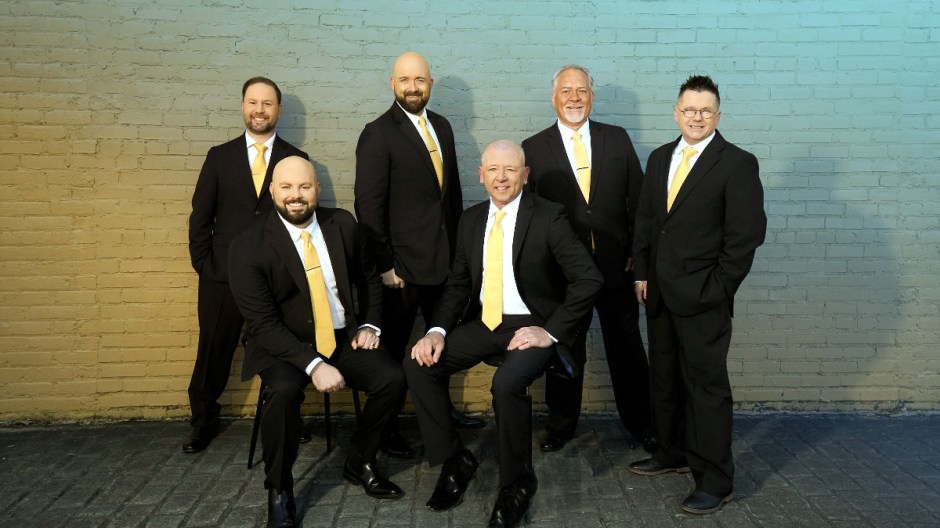
The Rogers Family keeps right on blessing Southern Gospel with their joyful new single

JEFF TURNER

There’s a moment near the top of “He Keeps Right On Blessing Me” when Kim Shields’ piano intro gets gently shouldered aside by a brass section so unapologetically jaunty that you half expect it to tip its hat on the way in. It’s a musical entrance that announces itself without apology, and it sets the tone for everything that follows.

The track is the third single from the Rogers Family for Horizon Records, and if you’ve been paying any attention to the Southern Gospel world lately, you already know this North Carolina family has been building something quietly remarkable in the foothills of the Blue Ridge Mountains.

“We are so excited for the release of ‘He Keeps Right On Blessing Me,’” the group said in a newsletter sent to Texas Gospel Canada. “When we heard it for the first time, we knew immediately that we needed to record it. It’s a toe-tapping, hand-clapping song that will get stuck in your head, in a good way! We pray that as you listen you will be reminded of the many blessings of God in your life.”

That description, “toe-tapping,” isn’t marketing copy. It’s a clinical diagnosis.

Once the brass section hands things over to Samuel Shields, his delivery of the opening verse carries the kind of soulful assurance that sounds lived-in rather than performed:

When I wake up in the morning / And I don’t know what awaits / Cause every new day seems to have a trial / There’s one thing I am sure of / With every step I take / My Jesus will be there for every mile

Producer Roger Talley’s arrangement doesn’t stay in one place for long. It moves through key changes with the ease of a family that has been singing together long enough to communicate without words, and then sisters Rebekah and Hannah Shields step forward to carry the second and third verses, their voices adding texture and personality to a song that already has plenty of both.

At the centre of it all is the Adina Bowman-penned chorus, a melody so hooky it feels like it must have existed somewhere before:

And He keeps right on blessing me / Keeps right on keeping me / Oh, the Lord has been so good to me / He protects me from the enemy / He’s providing all I need / My Jesus keeps right on blessing me

The story behind the Rogers Family is the kind that Southern Gospel was practically invented to tell. The group traces its roots to Northeast Georgia, where Ray and Helen Rogers sang in local churches alongside their daughter Kim, who played the piano from the start. Kim later met Sammy Shields at a church in North Carolina, they married in 1999, and together they put down roots in the Blue Ridge foothills and raised three children: Rebekah, Samuel, and Hannah.

When Ray Rogers passed away in 2010, the next generation stepped forward. Not as a replacement for what had been, but as a continuation of it. Helen and Kim stayed close, remained active, remained passionate, and the family kept singing. That kind of tenacity has a way of showing up in the music, a quality of honouring what came before while making something that feels entirely present tense.

Today, the six-member group, Helen, Kim, Sammy, Rebekah, Samuel, and Hannah, travels and ministers together. Kim is still at the piano, which feels entirely right. Some things shouldn’t change.

“He Keeps Right On Blessing Me” is out now.

Les Butler marks 50 years in Southern Gospel music with a Nashville celebration

AMY TURNER

Perhaps he wasn’t expecting a crowd. But then again, Les Butler has never quite understood the depth of his own reach.

When REAL Southern Gospel Radio threw open the doors of its Nashville-area studios to honour the man who has spent half a century shaping the sound, the stories, and the soul of Southern Gospel music, people came from everywhere. Florida. Michigan. Places in between that don’t always make it onto the itinerary unless something genuinely matters. And for the community that calls this genre home, Les Butler genuinely matters.

The Open House was billed as a celebration, and it delivered on that promise. There was food, laughter, and a commemorative cake decorated with a caricature of Butler himself, the kind of small, affectionate detail that tells you everything about how people feel about someone. Industry leaders, recording artists, radio staff, and loyal listeners filed through the studio, each one carrying a version of the same story: that Les Butler changed something for them, opened a door, championed a career, or simply kept the music playing when it needed someone to keep the music playing.

Among those who showed up were Tom and Rebecca Peck, Eddie Crook, Nick Bruno, and Lem Kinslow, names that carry weight in Southern Gospel circles. Their presence underscored what the occasion already made plain: this wasn’t a courtesy appearance kind of crowd. These were people who meant it.

“Fifty years of service is an extraordinary accomplishment,” said attendees throughout the day, a phrase that sounds simple until you start thinking about what fifty years actually looks like. It looks like thousands of broadcasts. It looks like artists who needed someone in their corner finding one. It looks like an audience that might never have discovered this music being handed a reason to love it.

Butler’s career spans broadcasting, publishing, artist development, and ministry, a range that speaks less to ambition than to a particular kind of restlessness that comes from caring deeply about something. Southern Gospel has always occupied a specific, sometimes underestimated corner of American music, rooted in faith and community and a vocal tradition that goes back generations. Butler understood that corner, respected it, and spent five decades refusing to let the world overlook it.

In the week leading up to the celebration, he received a wave of messages and videos from across the industry, congratulating him on the milestone. The volume of it said something that no single tribute could.

Some people become indispensable to a world not by dominating it but by serving it consistently, quietly, and with genuine conviction. Southern Gospel has that in Les Butler. And on a warm afternoon in Nashville, with the cake cut and the stories still going, fifty years felt like both a long time and, somehow, just the beginning.

Ministry, entertainment, or something the Booth Brothers settled long ago

AMY TURNER

The question has been asked in sanctuaries and greenrooms, on fan forums and theology blogs, with the kind of fervour reserved for things of extreme importance. Is Christian music ministry or entertainment? It is the sort of question that sounds profound right up until someone like Michael Booth gets hold of it.

“I don’t think that’s a good question at all,” says Booth, one third of the Booth Brothers, the Southern Gospel trio that has spent decades doing something that defies easy categorisation. “I think it’s divisive and I think it’s distracting.”

He is not being dismissive. He is being precise, which is a different thing entirely.

The Booth Brothers, consisting of Michael, Ronnie, and Buddy, have collected GRAMMY nominations, Dove Awards, and Singing News Fan Awards the way other people collect regrets. Chart-topping songs, industry recognition, a reputation among listeners and peers alike as one of the finest acts Gospel Music has produced in a generation. And still, inevitably, someone in the crowd or the comment section wants to know: what exactly are you doing up there?

Booth’s answer reframes the whole conversation. He reaches for 1 Corinthians the way a craftsman reaches for a well-worn tool. “Whether we eat or we drink, whatever we do, we do unto the glory of God,” he says, quoting the passage with the ease of someone who has lived inside it. “And I believe that goes for… whatever we do, that’s everything. So that means if you’re a gospel singer, a preacher, a teacher, an evangelist, a comedian, a plumber, whatever it is, we’re to do it for the glory of God.”

The logic is elegant and it cuts straight through the debate. Ministry or entertainment? The Booth Brothers do both, without apology, and they do them simultaneously. Audiences leave their events with something harder to quantify than a setlist, hearts and minds refreshed, having moved through inspiring songs and genuine laughter in the same breath. It is a combination that sounds unlikely on paper and feels inevitable in the room.

For Booth, the binary question misses the point so completely it almost becomes a different question. “The question is not whether it’s ministry or is it entertainment,” he says. “The question is motive. Is my motive to glorify God?”

That single word, motive, does a lot of heavy lifting. It shifts the responsibility away from genre labels and industry taxonomy and places it squarely with the artist, in the quiet space between intention and performance, before a single note is sung.

The Booth Brothers have built their career in that space. Every note carries what their biography describes as “the utmost desire for each song and lyric to minister to audiences, touch souls, and ultimately point others to Jesus Christ.” That is not the language of people trying to win an argument about categories. That is the language of people who settled the question a long time ago and got on with the work.

“I’m not going to be able to solve this for everybody,” Booth admits, with the candour of a man who has no interest in pretending otherwise. “I’m not even going to try. I’m just going to share with you my thoughts.”

It turns out, that is more than enough.

The Hyssongs’ new single “It’s Not Over Yet” carries a message of faith, healing, and hope that hits harder than most

AMY TURNER

There’s a moment in gospel music when a song stops being just a song. It becomes testimony. It becomes the thing a family reaches for when the doctors have delivered news that lands like a stone in still water, and the ripples just keep going. For Richard Hyssong and his family from Maine, that moment arrived twice, seventeen years apart, and the second time, they already had the song waiting.

The Hyssongs have been a fixture in Southern gospel circles long enough to know the difference between a number that fills a setlist and one that fills a room with something harder to name. “It’s Not Over Yet,” their new Horizon Records single, belongs firmly in the second category. Written by Jason Cox, Kenna Turner West, and Brian White, the track rides a stately, unhurried arrangement produced by award-winning Jeff Collins, with Dell Hyssong stepping forward to carry the lead. The production is deliberate in its restraint; there’s nothing here designed to distract from the lyric, which doesn’t pretend to offer easy comfort so much as it insists, plainly and without apology, that the story isn’t finished yet.

Richard reaches back to 2008 to explain why the song landed so personally. Their daughter Makayla was born into a situation no parent should have to navigate: 22 tumours in and on her heart, and a massive number of brain tumours alongside them. The prognosis was bleak. Doctors told the family she would likely not survive, and if she did, she would face severe limitations. “We were devastated,” Richard says simply, the understatement carrying the full weight of what those days must have been. But the tumours on Makayla’s heart disappeared. She grew up. She talks and walks and sings, and she now travels with the family, lending her voice to the very ministry that her survival helped to shape.

That backstory would be enough on its own to give “It’s Not Over Yet” its emotional ballast. But then December 2025 arrived, and the Hyssongs found themselves standing at a second crossroads. After years of good health, doctors discovered two tumours on one of Makayla’s kidneys, and one on the other. The song they had been singing to audiences about holding on and trusting God had become the message they needed to receive themselves all over again.

“We are not going to give up,” Richard says. “We know that ‘It’s Not Over Yet.’ The same God that healed her before can do it again.”

The lyric itself doesn’t shy away from the scale of what it’s asking people to believe. It invokes the parting of the Red Sea and the fall of Jericho, reaching for the kind of precedent that makes current impossibilities feel smaller. “Are you staring down a giant that just won’t seem to fall,” it asks. “Are you facing the impossible, your back’s against a wall.” The chorus doesn’t offer a formula or a timeline. It offers a posture: keep trusting, keep believing, don’t let your heart forget. The simplicity is the point. Theology dressed in plain clothes, for people who don’t have the bandwidth for anything more complicated.

Richard frames the song’s reach in terms that go well beyond Makayla’s story. “Maybe you have had a bad report from the doctor or family member,” he says. “Maybe you are struggling with finances and think it is the end.” The catalogue of ordinary crises is the point: the song isn’t reserved for extraordinary suffering. It’s for whoever is sitting with something that feels final, looking for a reason to believe that the last word hasn’t been spoken yet.

That’s a hard thing to pull off in any genre, and Southern gospel has its share of songs that attempt it and land somewhere closer to platitude. “It’s Not Over Yet” avoids that fate partly because of the restraint in the production, and partly because the Hyssongs aren’t delivering it from a position of resolution. They’re singing it from the middle of the story, still waiting, still trusting, still travelling Sunday to Sunday and believing it themselves. There’s a credibility in that which no studio polish can manufacture.

Whether the song crosses over beyond the Southern gospel faithful likely depends on how many people in any given congregation are quietly carrying something the doctors or the bank statement or the calendar has told them is over. If the Hyssongs’ experience is any guide, that number is higher than it might look from the outside. And for those people, “It’s Not Over Yet” arrives at exactly the right moment, with exactly the right message: hold on. He has the final say.

11th Hour’s “Just keep the faith” is the Southern Gospel reminder weary believers didn’t know they needed

AMY TURNER

Amber Eppinette Saunders does not write songs for the highlight reel. She writes them for the Tuesday afternoon, the 3 a.m. ceiling stare, the moment when the prayer feels like it is bouncing off the roof and going nowhere. The soprano voice of Southern Gospel trio 11th Hour has built a career on meeting people in those moments, and with “Just Keep the Faith,” the group’s latest single for Sonlite Records, she has landed squarely in that territory once again.

“This song was written with every believer in mind,” says Eppinette Saunders, who co-wrote the track alongside longtime collaborators Kenna Turner West and Jason Cox. It shows. The song does not open with triumph or arrival; it opens with admission: Sometimes we grow weary from all of the trials we go through. From the stage to the pew, the lyric says. No exceptions made, no one excused from the struggle.

Producer Roger Talley frames that honesty in an arrangement built around Tim Parton’s piano and organ, kept front and centre throughout, grounding the track in the African-American-influenced gospel tradition that 11th Hour has long drawn from with both reverence and fluency. The result is music that breathes, that gives Eppinette Saunders room to move through the song’s emotional range without forcing anything.

And she uses that room. When the chorus lands, Just keep the faith as you watch and pray, remember God’s promises and trust in His name, it does not arrive as a slogan. It arrives as something closer to a hand on the shoulder from someone who has been in the same dark hallway and found the way through.

“We all get weary from fighting battles no one else can see,” she says. “Even though it only takes a little faith to keep going, sometimes we need a reminder to hold on to a little bit more.”

That kind of plain-spoken pastoral honesty is part of what has kept 11th Hour, rounded out by Garrett Saunders and Victoria Bowlin, consistently relevant in a genre that rewards authenticity over novelty. The trio has accumulated multiple Top 10 Singing News chart hits and earned nominations for Trio of the Year, AGM Album of the Year, and, individually for Eppinette Saunders, Soprano of the Year. The accolades reflect a group that has never mistaken polish for purpose.

The ministry remains the point. “There is nothing more fulfilling than ministering to the body of Christ and sharing the gospel,” Eppinette Saunders says. “Every dream we have ever had, God has already fulfilled. He never ceases to amaze us.”

“Just Keep the Faith” carries that conviction without wearing it heavily. The message is distilled down to its simplest, most durable form: perseverance matters, God comes through, hold on. In a landscape full of songs that complicate faith or celebrate it from a comfortable distance, this one sits down beside the listener in the middle of the hard part and says the thing that needs saying.

With Amber, Garrett, and Victoria continuing to follow wherever the next open door leads, 11th Hour shows no sign of softening their mission or their sound. If anything, this single makes clear they are just getting started.