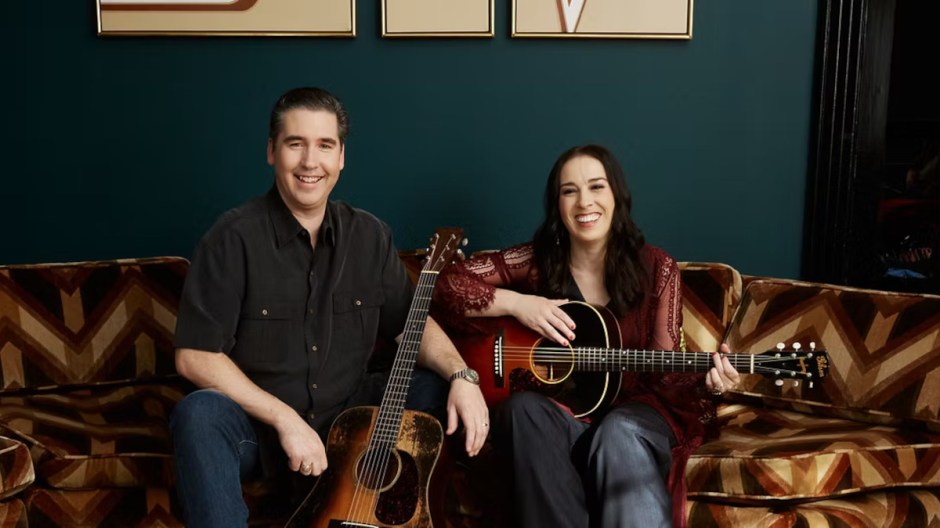
The Triumphant Quartet plans to release new music in 2027, according to a social media post from the group.
The band said it has been working in the studio and is partnering with Gordon Mote on the upcoming project. Details about the songs and their release date have not been announced.
Triumphant thanked the musicians, writers and others involved in creating the new music.
“We’re incredibly grateful for the songs, the musicians, the writers, and every person who has helped bring this new music to life,” the group said in the post.
The band did not say when in 2027 the music would be released.
Southern gospel trio 11th Hour is leaning into gratitude with their new single “Today Is The Day,” a song built on a simple but stubborn idea, that mercy resets every morning, whether you feel like accepting it or not.
Amber Eppinette Saunders points to scripture as the spark. “His mercies are new every morning,” she says, citing the familiar verse that anchors the song’s message. She and her bandmates, Garrett Saunders and Victoria Bowlin, wrote the track from a place of plain gratitude, the kind that comes from simply waking up and getting another day.
Eppinette Saunders penned the song alongside Kenna Turner West and Jason Cox, the same team behind the group’s previous release, “Just Keep the Faith.” Musically, “Today Is The Day” borrows a page from mid-60s Beatles records, favoring off-kilter phrasing over anything predictable. Producer Roger Talley builds the arrangement around staccato piano, a rhythmic backbone that pushes the song through its shifting tonal centers without ever losing the thread of its central message.
For Eppinette Saunders, the daily decision behind the song matters more than the music itself. “It’s about starting fresh,” she says, “trusting God a little more, and making the choice every day to be more like Him.”
11th Hour has built a decade-plus career on that same instinct toward renewal, adapting their sound while staying rooted in worship music. The group has landed multiple Top 10 hits on the Singing News charts and picked up award nominations across Southern Gospel music, including a Singing News Trio of the Year nod and an AGM Album of the Year nomination, with Eppinette Saunders herself nominated for Soprano of the Year.
“There is nothing more fulfilling than ministering to the body of Christ and sharing the gospel,” Eppinette Saunders says. “Every dream we have ever had, God has already fulfilled. He never ceases to amaze us.”
The trio shows no signs of slowing. Eppinette Saunders, Garrett Saunders and Bowlin say they intend to keep singing wherever the opportunity leads, treating each new stage as another chance to spread their message.
Anthem Edition didn’t set out to make a survival record, but that’s kind of what “Something’s Goin’ On” turned into. The Southern Gospel quartet’s new EP, out now on Sonlite Records, catches four singers at different points in their own lives and lets that tension become the whole point of the project.
“When we started searching for songs to record, each member of the group had songs that truly spoke to where they are in life right now,” says Tim Rackley, who co-founded the group back in 2003. “We knew, if the songs moved us in a powerful way, they would move the listeners as well.”
Artists may say this kind of thing without a lot of thought, but Rackley backs it up with a simple production philosophy: match the singer to the song’s emotional center, not the other way around. “You cannot deliver a song fully if you don’t feel it yourself,” he says, and it shows in how the EP moves. The record opens and closes with its two most energetic cuts, “He Is Who He Is” and the title track, but the real character lives in between, in the hushed intimacy of “He Still Washed His Feet,” the front-porch warmth of “Land Of Joy Untold,” and the full-throated testimony of “I’m Another Lazarus.”
The focus track, “I Am Saved,” is where producer Roger Talley leans hardest into a more contemporary sound, building a quartet chorus around a message of grace and redemption that Rackley calls the emotional anchor of the whole project.
“Filled with strong songs, great harmonies, and messages that point people to Christ, this project blends the best of Southern Gospel tradition with a fresh sound for today’s listeners,” Rackley says. “From start to finish, these songs encourage, inspire, and remind us of God’s faithfulness. Something’s Goin’ On shows just how far this lineup has come.”
What started in 2003 as a trio called The Old Paths, founded by Doug Roark and Tim Rackley, grew into a quartet and eventually landed a deal with Crossroad Music’s Sonlite Records in 2012. Their breakout album, ‘Right Now,’ produced two number one hits and a Singing News Fan Award for Favorite New Quartet, a strong start that was followed, in 2015, by a hiatus. The group came back to touring in 2017, rebranded as Anthem Edition in late 2022 with bass vocalist Andrew Utech joining the lineup, and added tenor Cameron Edens in the fall of 2023.
Listen for songs from Something’s Goin’ On throughout the day on Texas Gospel Canada!
Two years after losing their mother, Karen Peck Gooch and Susan Peck Jackson have turned grief into melody. The sisters and the rest of Karen Peck & New River just released “Mama Knows,” a song built from a single, ordinary moment that became something larger.
The story starts with an azalea tree. Their mother, Myrtle Sue Tench, planted it years ago in her front yard, and it grew into something towering, something people noticed. Every spring it bloomed bright pink, and every spring Mrs. Tench photographed it, often posing beside it herself. The tree became a kind of ritual, a marker of the season, a reason to step outside and pay attention.
This year, the ritual continued without her. Their sister Sandra sent a text to Karen and Susan: mama’s tree is blooming. That was it, nothing more, but it landed differently than any ordinary garden update. “I thought, oh, I bet mama, if she could say anything to me right now, she would say, oh, these flowers are so beautiful, and they smell so, so beautiful,” Karen recalls.
That imagined sentence, equal parts loss and comfort, became the emotional core of “Mama Knows.” The song doesn’t try to explain grief so much as sit inside it, the way a blooming tree can hold a person’s memory without saying a word.
For Karen and Susan, music has become the language for what’s hard to say out loud. Their mother is gone, but the tree still blooms, the pictures still get taken, and now there’s a song to go along with them.
Provided to YouTube by The Orchard Enterprises Mama Knows · Karen Peck & New River · Karen Peck · Kenna West · Don Poythress Good Answers ℗ 2025 Daywind Records
Darin & Brooke Aldridge have spent their career singing about faith, family and home, but on their new album “Soul Condition,” out now on Billy Blue Records, they went looking for something a little more specific: the sound of where they actually come from.
The eleven-track record marks the duo’s 11th studio album and brings in some serious bluegrass and gospel firepower, with Grand Ole Opry members Sonya Isaacs and Becky Isaacs of The Isaacs joining alongside GRAMMY winner Jason Crabb. But for Darin Aldridge, the album’s emotional center didn’t come from a Nashville studio. It came from a small church in Avery County, North Carolina.
“Speaking of our heritage back in western North Carolina, we got to go up to my uncle’s church that he’s pastored at now in Linville Falls, North Carolina,” Aldridge says. He and Brooke called in family for the occasion, pulling together as many aunts, uncles and cousins as could make it on short notice. “We called a bunch of our aunts and uncles and cousins that we could get together in one afternoon,” he recalls. “And we all come to that little community church and sang several hymns that day.”
The session had the feel of a family reunion as much as a recording date. Aldridge played guitar, his cousin Tommy and his mother took turns on piano, and Brooke’s parents rounded out the room. “I played a little guitar. My cousin Tommy played piano and my mom played piano. Brooke’s mom and dad were there,” he says, before turning to his wife to confirm the memory. “Wasn’t it, Brooke?”
The goal was simple: capture one of the songs from Soul Condition sung by an actual family choir, voices that had known each other, and those hymns, for generations.
For Brooke Aldridge, the afternoon delivered more than they expected. “It turned out so very special in that little church there,” she says, “and I think it’ll give people a good taste of where we come from and how we were raised.” That, she adds, is exactly what she and Darin set out to do with the record. “That’s exactly what we were trying to capture in Soul Condition.”