Almost 500 years ago, Martin Luther emphasized the core message of the gospel: justification is by grace alone, through faith alone, in Christ alone. If this is true, how should we understand a passage like James 2:24, which says, “You see that a person is justified by works and not by faith alone”? It might seem like this verse is saying that works do play a role in our salvation.
However, works do not provide our salvation. Instead, they have a very important role in showing that our salvation is real. Isn’t James saying that to other people who observe our lives, we are seen as justified by our actions, not just by our faith, which is invisible. We know that before God, we are justified by grace through faith. But to the world, both believers and non-believers, they cannot see our faith. Therefore, our good deeds demonstrate that we have been justified.
This is similar to what Paul said in Ephesians: “For by grace you have been saved through faith, and that not of yourselves; it is the gift of God, not as a result of works, so that no one may boast. For we are his workmanship, created in Christ Jesus for good works, which God prepared beforehand that we should walk in them” [Ephesians 2:8-10. Salvation is decided by faith alone, but it is shown by our obedience to God’s will.
1 Peter 3:21 says, “Baptism now saves you, not the removal of dirt from the flesh, but an appeal to God for a good conscience, through the resurrection of Jesus Christ.” Some people might read the part that says, “Baptism now saves you,” and think that water baptism is necessary for salvation. However, the very next phrase clarifies this by saying, “not the removal of dirt from the flesh.” Clearly, Peter is saying that water itself cannot save anyone.
Peter goes on to explain in the same verse that salvation comes through faith in the work of Christ, which was made possible by his resurrection. Salvation is not achieved by any action or ritual, including baptism. Instead, it is about an “appeal to God for a good conscience,” which means asking God to cleanse and purify your heart and conscience. This cleansing happens not through a ritual like baptism, but through faith in Jesus Christ, who is the only way to safety and salvation through his death and resurrection. The only way to appeal to God for a good conscience is to ask for the salvation provided in Jesus Christ.
In Matthew 12, Jesus gave a strong warning against the Pharisees, saying that any blasphemy can be forgiven except blasphemy against the Holy Spirit. Jesus even stated that the person who commits this sin cannot be forgiven in this life or in the life to come. This is a very serious statement, so what exactly does it mean to blaspheme the Holy Spirit?
This is related to a specific time in history, during the ministry of Jesus Christ. When Jesus came to earth, he submitted to the will of God the Father and worked through the power of the Holy Spirit. Everything he did was by this power. When the leaders of Israel said about Jesus that he did his miracles by the power of Satan, or Beelzebub, Jesus said, “You have blasphemed the Holy Spirit by attributing my works to Satan. That’s unforgivable”. It was unforgivable because they had seen all that Jesus did and heard all that he said, and yet they chose to believe the exact opposite of the truth, concluding that he was from Satan rather than God. This complete rejection of Christ, knowing the truth and still denying it, cannot be forgiven. Any rejection of Christ in this manner is also unforgivable.
Throughout church history, some significant errors have come from those who deny that Jesus is God. They do not believe he is the second part of the Trinity, the eternal God who always existed. Since the Bible clearly teaches that Christ is eternal, What does Romans 8:29, mean when it calls Jesus the “firstborn among many brethren.” If Jesus has always been, why would Paul call him the firstborn?
This is a very important question. The Greek word translated as “firstborn” is πρωτότοκος (prōtotokos). In reality, this word does not describe the order of birth, and it doesn’t even necessarily mean a birth happened in the typical sense. Instead, it is a word that means preeminent, meaning the most important or highest-ranking. So, what Romans 8:29 is saying is that among all people, Jesus is the preeminent one. Using language that usually refers to the most important son in a family is similar to other ways the Bible uses human-like words to describe God. For example, God is described as a fire or as a protective bird in the Old Testament. These are metaphors.
Doesn’t the idea of the “firstborn,” borrow from human language, emphasizing the exalted position of Christ? He is the most important one.
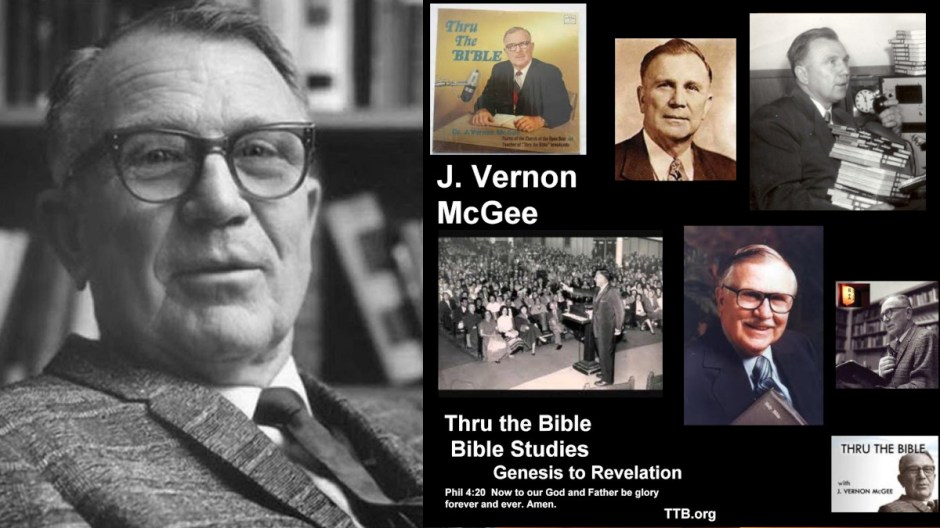
The audio on this video is the property of Thru the Bible. It is offered free of charge. If you wish to make a donation, do not send it to us. Visit http://www.ttb.org for information. The audio is attributed to Dr. J. Vernon McGee and Thru the Bible. Intellectual property rights are those of Thru the Bible. Please contact us if you feel our understanding of the terms of use are in error. Copyright information obtained from https://ttb.org/about/copyright-policy
Dr. J. Vernon McGee begins his sermon by highlighting the importance of the Gospel of Mark, which he describes as a gospel of action filled with miracles. He notes that Chapter 5 is particularly significant, featuring three outstanding miracles demonstrating the power of omnipotence: the casting out of demons from the man in Gadara, the healing of the woman with an issue of blood, and the raising of Jairus’s daughter. McGee delves into the account of the demon-possessed man, emphasizing his desperate condition of living among the tombs and possessing superhuman strength. He clarifies that the man, not the demons, worshiped Jesus, illustrating a struggle within the man’s being. The demons, upon being commanded by Jesus to leave, requested to be sent into a herd of swine, which then perished in the sea. McGee defends Jesus’s action, pointing out the Gadarines’ disregard for God’s law by engaging in pig farming. He further discusses several facts about demons, emphasizing their reality, their prevalence during Jesus’s ministry, their desire to indwell mankind, and Christ’s ultimate power over them.
Moving on, Dr. McGee discusses the healing of the woman with the issue of blood and the raising of Jairus’s daughter, both found in Mark 5. He points out the woman’s 12 years of suffering and her faith in touching Jesus’s garment to be healed, coinciding with the 12 years of Jairus’s daughter’s life. McGee underscores Jesus’s deliberate action in healing the woman before going to Jairus’s house, where he then raised the daughter from the dead with the Aramaic words “Talitha koum,” which McGee interprets as “Little lamb, wake up”. He emphasizes the practical nature of Jesus’s command to feed the girl after she was raised. McGee sees these miracles as demonstrations of Jesus’s power and his role as God’s servant who came to minister and give his life as a ransom.
Transitioning to Mark 6, McGee discusses Jesus’s return to Nazareth, where he was met with astonishment and offense by his own people who questioned his origins and were familiar with his family. McGee clarifies that this was likely Jesus’s second visit to Nazareth, contrasting it with the account in Luke 4 where no miracles were performed initially. He explains that the unbelief of the people in Nazareth limited Jesus’s ability to perform mighty works there, illustrating that faith is necessary to release God’s power. McGee then describes Jesus sending out the twelve disciples two by two, giving them power over unclean spirits and instructing them to travel lightly, focusing on their urgent mission to preach repentance. He also touches on Herod’s reaction to the spreading fame of Jesus, linking it to his guilt over the beheading of John the Baptist. The disciples later returned and reported their experiences, leading Jesus to take them to a deserted place to rest before the account of the feeding of the 5,000.
Finally, Dr. McGee addresses the confrontation between Jesus and the Pharisees and scribes who questioned his disciples’ traditions of washing hands before eating in Mark 7. Jesus rebukes their hypocrisy, quoting Isaiah and stating that their worship is in vain because they substitute the commandments of God with the traditions of men. He uses the example of the tradition of “Corban” to illustrate how they circumvented the commandment to honor one’s parents. McGee emphasizes that true defilement comes from within the heart of man, listing various evil thoughts and actions. He then discusses the healing of the deaf and dumb man in the Decapolis, noting Jesus’s unique method as aids to faith. McGee briefly touches on the feeding of the 4,000 in Mark 8, distinguishing it from the feeding of the 5,000 by several factors. He concludes with the healing of a blind man at Bethsaida in stages, using this as an analogy for spiritual sight, and Peter’s confession of faith in Jesus as the Christ. McGee underscores the importance of acknowledging and following Christ, urging listeners to examine their own faith and relationship with Him.