
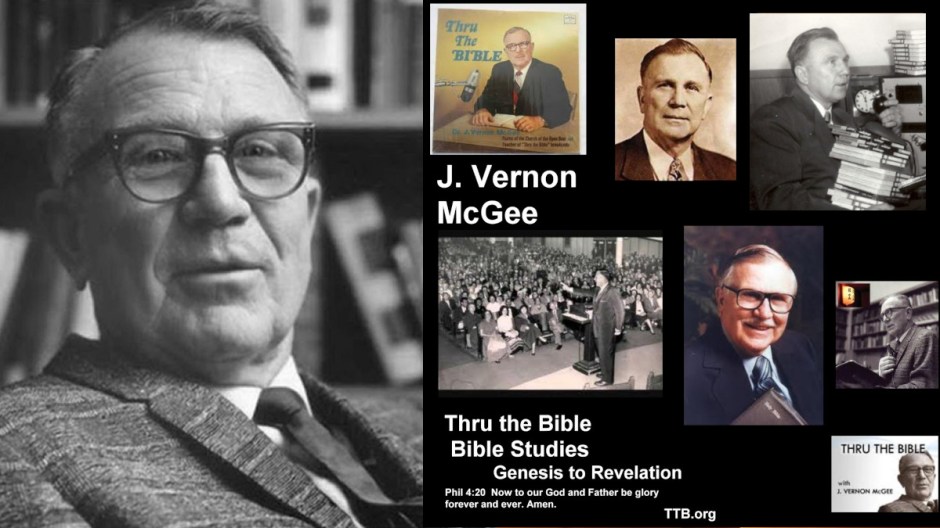
Please contact us if you feel our understanding of the terms of use are in error.
Copyright information obtained from https://ttb.org/about/copyright-policy
Dr. McGee’s sermon covers Matthew chapters 22 through 24, starting with the verbal clash between Jesus and the religious rulers. Chapter 22 begins with the parable of the king who made a marriage feast for his son. This parable is a continuation of Jesus’ answer to the chief priests and elders and parallels the parables in Matthew 13, focusing on how and why the current age began. The king sends servants to call those who were bidden (the lost sheep of the House of Israel), but they refused to come. He sent other servants, but the invited guests made light of it, going to their farms and merchandise, while others mistreated and killed the servants. In response, the king sent his armies to destroy the murderers and their city, which Dr. McGee believes is a reference to the destruction of Jerusalem in 70 AD. Then, the invitation goes out to everyone found on the highways, both good and bad, and the wedding is furnished with guests. However, a man without a wedding garment (the righteousness of Christ, essential for salvation) is found, bound, and cast into outer darkness, illustrating that while many are called, few are chosen and must come on the king’s terms.
Following this, the religious leaders launch their final attack on Jesus. First, the Herodians question him about paying tribute to Caesar, a political trick to trap him. Jesus, perceiving their wickedness, calls them hypocrites and uses their own coin to state, “Render therefore unto Caesar the things which are Caesar’s, and unto God the things that are God’s,” marvelously answering their question without falling into their trap. Next, the Sadducees, who deny the resurrection, question him about a woman married to seven brothers. Jesus responds that they err by not knowing the Scriptures nor the power of God, stating that in the resurrection, people neither marry nor are given in marriage but are like the angels. He further proves the resurrection by quoting God as saying, “I am the God of Abraham, the God of Isaac, and the God of Jacob,” asserting that God is not the God of the dead but of the living. This silences the Sadducees. Finally, the Pharisees, after hearing that Jesus silenced the Sadducees, gather together and ask him which is the great commandment in the law. Jesus answers, “Thou shalt love the Lord thy God with all thy heart, and with all thy soul, and with all thy mind. This is the first and great commandment. And the second is like unto it, Thou shalt love thy neighbor as thyself. On these two commandments hang all the law and the prophets”. Then, Jesus questions the Pharisees about the Christ, asking whose son he is. They reply, “The Son of David”. Jesus then asks how David, in the Spirit, calls him Lord (Psalm 110:1), highlighting the impossibility of David calling his natural son Lord, implying a supernatural birth. No one is able to answer him, ending the verbal clash.
Chapter 23 marks Jesus’ denouncement of the scribes and Pharisees and his weeping over Jerusalem. He warns the multitude against the scribes and Pharisees who sit in Moses’ seat but do not practice what they preach. He pronounces a series of “woes” upon them, calling them hypocrites for binding heavy burdens on others, doing their works to be seen, loving titles and recognition, and shutting up the Kingdom of Heaven. He criticizes their outward piety and inward corruption, comparing them to whitewashed sepulchers full of dead men’s bones. He also rebukes their meticulous tithing of insignificant items while neglecting the weightier matters of the law: judgment, mercy, and faith. Dr. McGee emphasizes the harshness of Jesus’ language, contrasting it with the liberal conception of a gentle Jesus. Jesus condemns their rejection of the prophets and foretells the persecution of those he will send. He concludes this chapter with a lament over Jerusalem’s rejection of him.
Chapter 24 begins the Olivet Discourse, where Jesus’ disciples ask him privately three questions: when will the temple be destroyed, what will be the sign of his coming, and what will be the sign of the end of the age. Dr. McGee states that the destruction of the temple (fulfilled in 70 AD) is primarily addressed in Luke’s Gospel. Matthew focuses on the signs of his coming and the end of the age, which relate to his coming to establish his kingdom, not the church. Jesus warns them to “take heed that no man deceive you,” as many will come in his name saying, “I am Christ,” and will deceive many. He speaks of wars and rumors of wars, but these are not the sign of the end. Nation will rise against nation, and there will be famines, pestilences, and earthquakes, which are the beginning of sorrows. Dr. McGee believes they are currently in the age leading up to the Great Tribulation. He then discusses the Great Tribulation period, during which the nation Israel will be afflicted and hated by all nations. False prophets will arise, and iniquity will abound. He clarifies that the gospel of the Kingdom will be preached in all the world as a witness before the end comes, distinguishing it from the gospel of grace preached today. The sign of the end will be the “abomination of desolation” standing in the Holy Place. Those in Judea are instructed to flee to the mountains. This period will be a time of great tribulation, unprecedented in history. False Christs and false prophets will perform great signs and wonders, but believers should not be deceived. The coming of the Son of Man will be like lightning, visible to all. Following the tribulation, the sun will be darkened, the moon will not give its light, and the stars will fall from heaven. The sign of the Son of Man will appear in heaven, and all the tribes of the earth will mourn when they see him coming in the clouds with power and great glory. He will send his angels to gather his elect (the nation Israel).
Jesus then gives the parable of the fig tree, which Dr. McGee interprets as the nation Israel. When the fig tree’s branch becomes tender and puts forth leaves, it indicates that summer is near. Similarly, when they see all these signs, they will know that his coming is near. Jesus states, “Verily I say unto you, this generation shall not pass, till all these things be fulfilled,” which Dr. McGee believes could refer to the Jewish race or the generation living at that time. He emphasizes that heaven and earth will pass away, but Jesus’ words will not. However, the specific day and hour are unknown, not even to the angels, but only to the Father. Jesus compares his coming to the days of Noah, where people were eating, drinking, marrying, and giving in marriage until the flood came and took them all away. The phrase “two in the field; the one shall be taken, and the other left” refers to judgment, not the Rapture of the church; the wicked will be taken away in judgment, and the others will be left to enter the millennial kingdom. Therefore, they are to “watch,” a watching characterized by fear and anxiety in that day, unlike the comforting hope of believers watching for the Lord’s return today. The sermon concludes with a call to be ready, as the Son of Man will come at an unexpected hour, and to live in light of the fact that everyone will stand in the presence of Christ to give an account.
 Texas Gospel Canada Southern Gospel Radio