

ALIREZA KARIMI
Before I get into this, let me state very clearly: I am a Christian and I do not promote hatred of Muslims. I also do not promote the teachings of the Qur’an. I am presenting this as something important to know when you witness to your Muslim friends who have been taught things that prevent them from listening to the Gospel.

A recurring theme in discussions between Muslims and Christians concerns the Muslim accusation of revelations in the Torah (Tawrāt) and the Gospel (Injīl,) and Islamic claims about the integrity of those scriptures. The Qur’an repeatedly affirms the authority and reliability of the earlier books. Yet in later Islamic thought, it became increasingly common to claim that these scriptures had been textually corrupted.
1. The Qur’anic View of Previous Revelations: Every nation receives a revelation in its own language
The Qur’an teaches that God sent prophets to all peoples and that each group received its revelation in its own language. Arabs, according to this narrative, were simply the last to receive theirs.
Relevant passages include:
- Qur’an 14:4 – “We did not send any messenger except in the language of his people, so that he might make things clear for them.”
- Qur’an 16:36 – “We certainly sent a messenger to every nation…”
On this basis, Jews and Christians already possessed their divinely revealed scriptures, the Torah and the Gospel, while Arabs received the Qur’an as their own scripture.
The Qur’anic expectation that Jews and Christians should judge by their own books
Several passages instruct Jews and Christians to follow the revelation already in their hands:
- Qur’an 5:43 – “Why do they come to you for judgment while they have the Torah, in which is God’s judgment?”
- Qur’an 5:47 – “Let the People of the Gospel judge by what God has revealed in it.”
- Qur’an 5:68 – “You have no ground to stand upon unless you uphold the Torah and the Gospel…”
These verses assume the authority and reliability of the Torah and Gospel available to these communities at the time.
Accusations of distortion refer to speech, not scripture
When the Qur’an accuses certain Jews or Christians of “distorting” revelation (e.g., Qur’an 2:75, 4:46), the distortion is presented as an act of oral misrepresentation, not textual tampering. This was a common accusation in a context where:
- Jews had scriptures in Hebrew.
- Christians had scriptures in Greek, Syriac, Latin, etc.
- Most Arabs could not read these languages.
Thus, when disagreements arose, the charge was that Jews or Christians were misquoting or misinterpreting their scriptures, not altering the written text.
2. The Qur’an’s Argument to Jews and Christians
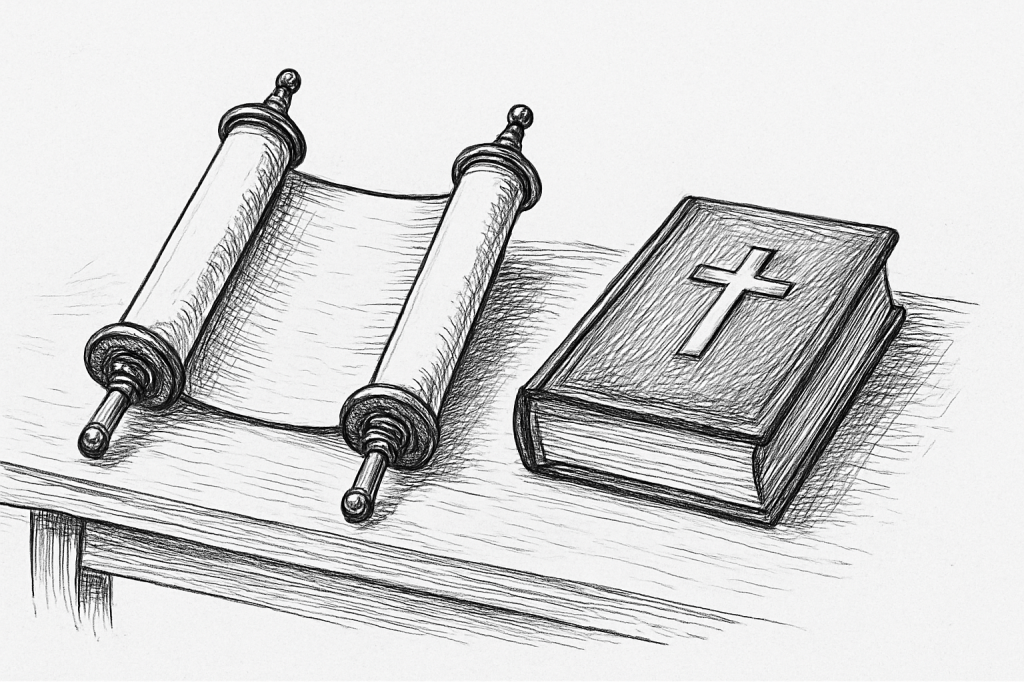
The Qur’an insists repeatedly that Jews and Christians must believe all of their scripture, not selectively, and that failure to do so leads to condemnation.
Examples include:
- Qur’an 2:85 – “Do you believe in part of the Scripture and disbelieve in part? What then is the recompense for those among you who do so except disgrace in this life, and in the Hereafter…?”
- Qur’an 2:89 – The Qur’an describes itself as confirming what the Jews already possessed.
- Qur’an 2:91, 2:97, 2:101, 2:121 – These verses repeat the theme that the Qur’an confirms the earlier books and that the earlier books are to be believed in their entirety.
The Qur’anic reasoning is consistent:
- Jews and Christians possess valid, divine scriptures.
- The Qur’an agrees with these scriptures.
- Therefore Jews and Christians should recognize the Qur’an’s prophet as legitimate because he affirms their books.
This argument depends on the assumption that the Torah and Gospel of the 7th century were intact, trustworthy revelations.
3. Why Later Muslim Thought Shifted: Expecting recognition that never came
The earliest Qur’anic passages present Jews and Christians as people who would recognize the prophet sent to the Arabs, since their books allegedly foretold him. According to this framework, they were expected to recognize him as the prophet mentioned in our scripture.
When Jewish and Christian communities in Medina did not recognize this prophetic claim, the Qur’an concludes that they were deliberately rejecting what they knew to be true, motivated by hostility rather than ignorance. This is important: The issue they claim was not presented as a problem with their scriptures, but with the people reading them.
Escalation of opposition
As Jewish and Christian groups increasingly rejected the new prophet, the Qur’anic perspective shifted:
- In the Meccan period:
Muslims, Jews, and Christians are grouped together as monotheists contrasted with pagans. - After encountering Jewish rejection in Medina:
Qur’an 5:82 – Jews are described as the group most hostile to believers. - When Christians likewise mocked or rejected the new revelation:
The Qur’an’s stance moves toward Muslims standing in opposition to all other groups unless they submit to Islamic governance (e.g., Qur’an 9:29).
The Later Doctrine of Textual Corruption
Because the Qur’an’s argument relies heavily on the authority of earlier scriptures, the persistent refusal of Jews and Christians to accept the “new prophet” became a theological problem. Over centuries, Islamic commentators increasingly adopted a different excuse: The Torah and Gospel must have been textually corrupted in the past. But surviving copies of both from Muhammad’s time do not support this.
to be clear, the Qur’an commands people to judge by the Torah and Gospel then present. There is no claim made during Muhammad’s time that the text had been corrupted. There are Qur’anic statements that earlier scriptures are “guidance and light” (e.g., Qur’an 5:44, 5:46). The Qur’an’s argument is that it “confirms what is with them (Qur’an 2:89, 3:3–4, 10:94).
The Qur’an never states that the Torah or Gospel have been corrupted as texts; it only accuses individuals of distorting with their tongues.
MY CONCLUSION
- The Qur’an affirms the authority and integrity of the Jewish and Christian scriptures available in the 7th century.
- Modern Islamic theology commonly claims that those scriptures had already been altered.
These two claims cannot both be true.
If the scriptures were intact in the 7th century, the Qur’anic affirmation poses a challenge to later Islamic claims of textual corruption. If the scriptures were corrupted before the 7th century, then the Qur’an’s commands to “judge by” them, and its argument that they support the new prophet lose their force.
I stress that I am not saying all this so people can “win” a debate. I’m saying this because God loves all people. This includes Christians, Muslims and Jews. His offer of redemption is made to all people and I hope my Muslim friends will one day accept redemption. Saving faith is a gift from God, not from anything I do or that you do. But hopefully, knowing this will help some remove the blocks they have to hearing His word.
 Texas Gospel Canada Southern Gospel Radio