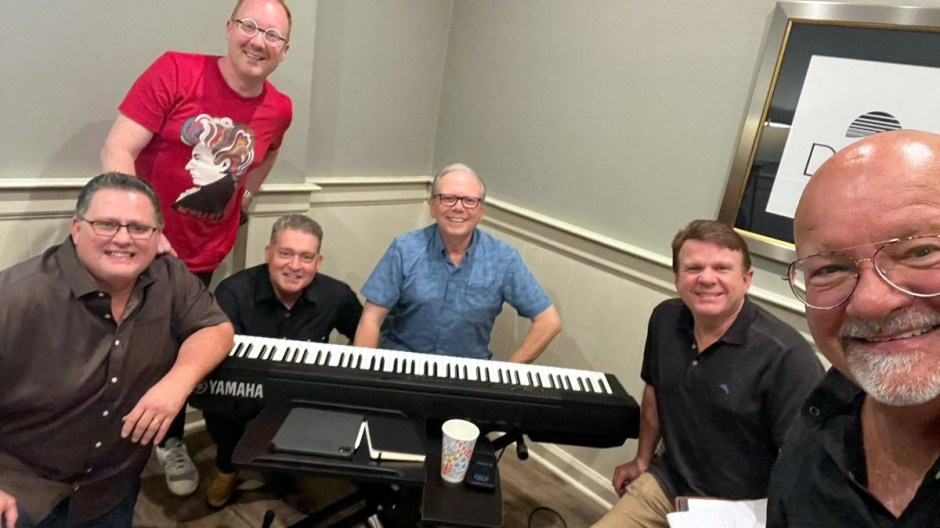
Sonny Clardy signs with Butler Music Group

Butler Music Group (BMG) has announced the signing of Southern Gospel artist Sonny Clardy to its artist roster.

Clardy, a singer, songwriter, music evangelist, and speaker, has served in full-time ministry for more than 25 years. He’s known for his heartfelt songwriting, powerful vocals, and Christ-centered message that has encouraged audiences across the country.

As part of the new partnership, Clardy is currently in the studio recording a new album under the direction of producer Les Butler. The project features several of Nashville’s top musicians and will showcase Clardy’s signature sound alongside a collection of songs he penned himself.

“I couldn’t be more excited to be working with Sonny on this new album,” said Les Butler, owner and producer of Butler Music Group. “He is an exceptionally gifted singer and songwriter whose music genuinely ministers to people. Every song he sings carries authenticity and a message that reaches the hearts of listeners.”

“I truly believe this will be the finest recording of his career,” Butler added.

Clardy shared his own excitement about the partnership. “I feel honored to have Les Butler produce this project,” he said. “We are looking forward to great things together!”

The album is expected to release in late summer 2026, with more details, including the first radio single and release date, to be announced in the coming weeks.

A husband’s recovery from alcoholism gave the Jordan family band a new season

AMY TURNER

There’s a strength that doesn’t announce itself. It shows up in the small, unglamorous moments: showing up to work while your world is quietly falling apart, keeping a family fed and functioning when you feel like you’re the only one holding it together. For Heather Rose Jordan, that strength became so woven into her daily life that she stopped noticing it as strength at all. It just felt like survival.

Heather sings, writes songs, and works as a product manager within The Jordan Family Band, a group built entirely around her family. Her husband Hutch handles production and sound alongside his own songwriting and vocals, and his journey through alcoholism and back out again has become central to how the couple now understands their own story, and how they hope to help others understand theirs.

It wasn’t until a conversation with a client, of all people, that Heather says the weight of what her family had walked through really landed.

“Me and Hutch were talking one morning and I was telling him about a conversation I had with a client of mine about our story,” Heather says. “I told her about the years Hutch spent in alcoholism, about how I felt like I lived as a single mom even though I wasn’t, and then going septic and getting so sick all while trying to open a business. And then came Hutch spending three months away in rehab. And when I finished, she just stopped and said, Heather, I’m so sorry, you’re so strong. I would have never known you went through all that.”

“I told Hutch, even though we’re quickly approaching one year of his sobriety, it truly feels like a lifetime ago,” she continues. “Since he came home, we’ve had so much fun. We’ve laughed, loved each other better, and truly enjoyed our little family so much. God has restored so much in our lives, and it’s hard to believe we were ever that broken. Truly, when we turn to Jesus, I believe he protects our minds from past traumas, shame, and brokenness. Now we get to live fully in his forgiveness and his restoration. And when we look back now, we don’t have to see what Satan tried to destroy. We only see the goodness and the faithfulness of God.”

It’s a lot to carry in one sentence: a business launch, a life-threatening illness, a marriage stretched thin by addiction, three months of separation while her husband got sober two states or two towns away, whatever the distance actually was, it must have felt like the whole world. And yet what stands out isn’t the hardship itself. It’s how quickly, in Heather’s telling, the hardship has receded into something almost unrecognizable, softened by everything that’s come since.

That’s the part worth sitting with. Nearly a year out from Hutch’s sobriety, the Jordans describe a household that sounds almost unremarkable in the best way: laughter, ease, a family simply enjoying being a family. For anyone who has lived alongside addiction, that description is not small. It’s the whole thing.

Alcoholism has a way of convincing the people living with it that recovery is either impossible or reserved for someone else, someone with more willpower, more support, more luck. The Jordans’ story pushes back on that. Hutch’s path out started, as it so often does, with a single admission: that he was an alcoholic, and that he couldn’t fix it alone.

That admission is the hinge point in nearly every recovery story, and it’s the same hinge point the Bible points to for sin more broadly. Scripture doesn’t soften its language on drunkenness, it’s named plainly as sin, but it also doesn’t stop there. The same faith that names the problem offers the way out: confession, surrender, and a willingness to let go of self-reliance.

For the Jordans, that surrender didn’t erase the three months of separation or the years that came before it. What it did was reframe them. Heather doesn’t describe herself as someone who survived a tragedy and is now just getting by. She describes a family restored, laughing again, loving each other better than before.

Jesus said, “I have come that they may have life, and that they may have it more abundantly” (John 10:10). For a family that once measured its days by how badly they were breaking, that promise of abundant life isn’t an abstraction. It’s Tuesday mornings that feel light. It’s a marriage where both people show up. It’s a household where sobriety isn’t just the absence of drinking, it’s the presence of something better.


8th Street’s Jonathan Thompson on the struggle behind Here Comes The Promise

AMY TURNER

On 8th Street in Sapulpa, Oklahoma, there’s a little church called Pentecostal Mission where three boys grew up learning about Jesus, and about harmony. Jonathan Thompson, Ivan and Byron came up singing together in that building before life pulled them in different directions. Careers, families, distance. The kind of things that quietly end a lot of groups before they even start.

But in early 2017, something brought them back. They found themselves standing next to each other again, singing the same songs they’d grown up on, and the group that would become 8th Street was born from that reunion, named for the road that led them to church as kids.

Their latest single, “Here Comes The Promise,” carries that same thread of return, of finding your way back to something solid when life gets heavy. Thompson wrote the song, and he says the meaning isn’t buried too deep.

“The second verse of this song kind of goes more into letting everybody know that we’ve all been there,” Thompson explains. He’s talking about the moments that knock people sideways, the ones that feel unmanageable in the middle of them. “We’ve all had those things in our lives that come up that just feel like something we can’t handle.”

The verse he’s describing speaks to a friend caught in a struggle, unsure what to do, trying to carry it alone. It’s a scenario Thompson knows from the inside. “I’ve been there,” he says. “I’ve done that.” He admits there’s something almost stubborn in how people, himself included, keep reaching for their own solutions. “Sometimes I don’t know why, when we’ve got an almighty God, that we just want to try to do it our way.”

The answer the song offers is simple, and it’s the whole point of the title. Cast your cares on the master, it says.

“That’s exactly what we need to do,” Thompson says, “because I think when we do that, we just feel those arms encircle us, and we know that he is there for us, and those promises are going to come through.”

That sense of promise fulfilled isn’t just a lyric for 8th Street. It’s the arc of the group itself: three friends from a small church on a small street, who walked away and found their way back to the same harmony they started with.

The Dunaways Return With New Single “That Sounds Like God To Me”

Some groups have a confidence that comes from decades of experience. The Dunaways have that kind of confidence. So does Les Butler, the Hall of Fame producer who’s been in their corner since the songs started climbing charts back in the early 2000s. Now the two are reuniting for the family group’s first new single in years, and by the sound of it, nobody involved is treating this as a comeback so much as a continuation.

“That Sounds Like God To Me,” set to hit Southern Gospel radio in late summer 2026, was written by Tammy Dunaway and Marcia Henry after a real-life moment convinced them God’s fingerprints are all over the ordinary stuff of daily living. It’s not a flashy premise. It’s a familiar one, delivered with the kind of warmth that’s made the Dunaways a fixture in the genre since the turn of the millennium.

Butler, who produced the track, doesn’t hide his enthusiasm. “I can’t tell you how excited I am to create new music with one of the most talented families I’ve ever been privileged to work with,” he says. “The Dunaways are special. If you don’t believe me, go check out the catalogue of music we produced together, 2000-2020. It will bless your soul!”

That catalogue is substantial: number one songs, national radio play, and multiple placements on Gaither Music Group’s “Shout” series, the annual showcase of Southern Gospel’s best. It’s the kind of resume that makes a reunion feel less like a gamble and more like a homecoming.

For Randall, Tammy, and Kanah Dunaway, the sentiment runs both ways. “We are honored to once again partner with Les Butler and Family Music Group,” Tammy says. “Les has been a faithful friend and supporter of our ministry for many years. We are grateful for this opportunity and pray, ‘That Sounds Like God To Me’ will encourage hearts, strengthen faith, and remind listeners that God is always at work around us.”

The track features Kanah Dunaway on lead vocals, a choice that signals where the family’s sound is headed even as it stays rooted in the harmonies longtime fans know well. It’s a melody built for radio, and given the group’s track record, it seems likely to find its audience fast once it starts reaching stations this summer.

Through it all, the throughline stays the same as it’s always been for the Dunaways: Christ centered music, close family harmony, and a ministry that’s spanned churches, concerts, and conferences across the country for more than thirty years. New single, same mission.

Why Tribute Quartet’s new mountain song rolls away instead of climbing

AMY TURNER

There’s something every songwriter chases: the instant a familiar story turns sideways and suddenly means something new. For Tribute Quartet’s Josh Singletary, that came while thinking about the stone in front of Jesus’s tomb, and just how little that stone actually mattered.

The group already has a mountain in its catalog of songs. “Halfway Up the Mountain” climbed to number one on the Singing News chart, the kind of song that becomes a signature. So when Tribute Quartet went looking for another mountain image, Singletary knew comparisons were inevitable. He also knew the new song had almost nothing in common with the old one.

“The great thing about this song, compared to Halfway Up the Mountain, is just the concept of it was a stone that rolled away,” Singletary explains. “It was a stone that was in front of the tomb. It could have been a mountain in front of the whole of that tomb, and it wouldn’t have mattered. It still would have moved.”

Provided to YouTube by Daywind Records
It Could Have Been A Mountain Β· Tribute Quartet
Forever
β„— 2026 Daywind Records
Released on: 2026-01-30

That idea became “It Could Have Been a Mountain,” a title that flips the usual mountain metaphor on its head. Where “Halfway Up the Mountain” is about the climb, the new song is about the size of the obstacle not mattering at all. Scale a mile high, seal it shut, do whatever you want to it; the resurrection happens anyway. The lyrics lean hard into that contrast, pairing images of the tomb sealed and guarded with the plain fact that none of it held. The hook repeats like a testimony being worked out in real time: it could have been a mountain, but it still rolled away.

There’s also a second layer built into the song, one that pulls the story out of scripture and into the pews. Verses about facing “a night” where “hope is failing,” about feeling “buried in your fear,” turn the empty tomb into a template for whatever mountain a listener happens to be carrying. It’s a familiar move in southern gospel writing, taking a doctrinal moment and making it personal, but Singletary’s framing gives it a sharper edge than most: the size of your mountain was never really the point.

Singletary himself is something of a study in scale versus substance. He was born in Raiford, Florida, a town small enough that it barely shows up on a map, and there’s nothing small about what he’s built since. As Tribute Quartet’s baritone and pianist, he’s also become one of the genre’s steadier utility players, working as an arranger, producer, and studio musician on projects well outside his own group’s output. He now lives in Lebanon, Tennessee, with his wife, Kahlie, and their dog, Hovie, close enough to Nashville’s session rooms to keep that side of his career humming alongside the road schedule.

That dual life, road quartet member and behind-the-scenes producer, tends to show up in the songs he helps shape. “It Could Have Been a Mountain” has the structural instincts of someone who thinks about arrangement as much as message: a repeated hook built for a room to sing back, a bridge that widens the story from history to personal application, an ending that just keeps rolling the phrase away until it feels less like a chorus and more like a release.

Whether it reaches the chart peak “Halfway Up the Mountain” did remains to be seen. But for Singletary, the comparison was never really the goal. The whole point of the new song is that the mountain, and the number attached to it, was never the thing that mattered.