
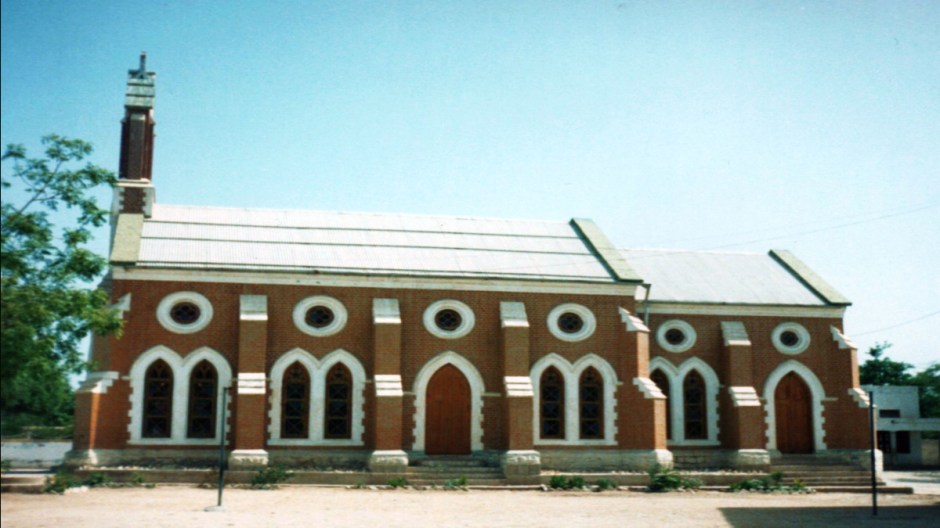
(Photo credit: Francis Hannaway/ St. Mary’s Catholic Church, Sukkur, Pakistan, July 31, 1992. Creative Commons.)
WILLIAM DESJARDINS
Pakistan’s 4.5 million Christians and other religious minorities face an unprecedented crisis of persecution, systemic discrimination, and legal vulnerability that has reached alarming new heights in recent years. Ranked eighth on the Open Doors World Watch List, Pakistan represents one of the most dangerous places in the world to be a Christian, with minorities comprising less than 4% of the population yet bearing a disproportionate burden of violence and injustice.
At the heart of the persecution lies Pakistan’s controversial blasphemy laws, which carry the death penalty and have become weaponized tools of exploitation and intimidation. A groundbreaking confidential police report titled “The Blasphemy Business” has exposed the dark reality behind many blasphemy accusations: criminal networks systematically targeting young people for financial gain.
These sophisticated scams involve fake social media accounts that lure young men into conversations containing blasphemous content, creating elaborate traps that have ensnared over 450 victims since 2021, according to Pakistan’s Human Rights Commission. Once trapped, families face devastating choices—pay substantial bribes to police to drop charges or watch their loved ones face potential death sentences. Lawyers representing affected families have documented not only arrests and disappearances but also evidence of torture in police custody.
The blasphemy laws serve purposes far beyond their stated religious protection mandate. They have become instruments for land grabs, targeting business rivals, and criminal extortion. Though death sentences are rarely carried out, accusations frequently trigger mob violence and extrajudicial killings that claim lives with disturbing regularity.
A rare glimmer of hope emerged when Justice Ishaq Khan of Islamabad’s High Court ordered the government to investigate the abuse of blasphemy laws, prompted by the revealing police report. However, this hope was swiftly crushed by intense backlash from religious extremist groups. Members of the Tehreek-e-Labbaik Pakistan party publicly attacked the court ruling, while lawyers from the Jamiat Ulema-e-Islam party challenged the order in court. By July 24, Justice Khan’s order was suspended amid fears that hostility could turn violent.
This pattern reflects Pakistan’s troubled history with blasphemy law reform. Historically, any attempt to modify or investigate these laws has been quickly shut down by violent protests from radical Islamic groups, creating a climate where even judicial review becomes impossible.
The situation deteriorated dramatically in 2024, with the Centre for Social Justice reporting a record 344 new blasphemy cases—the highest number in Pakistan’s history. At least 10 individuals accused of blasphemy were extrajudicially killed by individuals or violent mobs during the same year, highlighting the deadly consequences of these accusations.
Christians bear a particularly heavy burden under this system. Despite comprising only 1.8% of Pakistan’s population, roughly a quarter of all blasphemy accusations target Christians. This disproportionate targeting reflects deeper systemic discrimination that permeates Pakistani society and institutions.
The human cost of this persecution becomes clear through individual cases. In June 2024, an elderly man was killed by mob violence after being accused of desecrating the Quran, demonstrating how quickly accusations can turn fatal. The case of Anwar Kenneth illustrates the system’s cruel inefficiency: the 72-year-old Christian spent 23 years on death row after being sentenced to death in 2002 for sending allegedly blasphemous letters. Only in June 2025 did Pakistan’s Supreme Court finally acquit him, ruling that “a person of unsound mind could not be held liable for such a crime.”
The Jaranwala incident in August 2023 exemplifies how blasphemy accusations can trigger community-wide violence. When Pervaiz Masih was accused of writing blasphemous content, violent riots erupted that destroyed at least 20 churches and forcibly displaced hundreds of Christians. On April 18, 2025, Masih was sentenced to death, but the damage to the Christian community had already been done.
Perhaps most troubling is the impact on minority children, as documented in a new report by Pakistan’s National Commission on the Rights of the Child (NCRC). The report, titled “Situation Analysis of Children from Minority Religions in Pakistan,” reveals severe challenges including forced conversion, child marriages, and child labor affecting minority children, particularly from Christian and Hindu communities.
Between April 2023 and December 2024, the NCRC received 27 complaints related to the oppression of minority children, including abduction, murder, forced conversion, and underage marriages. Punjab province, Pakistan’s most populous region, reported the highest number of violence cases against minority children (40%) from January 2022 to September 2024, with 547 Christian victims, 32 Hindus, two Ahmadis, two Sikhs, and 99 others.
The discrimination extends into Pakistan’s educational system, where minority children face multiple forms of marginalization. The Single National Curriculum mandates Islamic religious education with no alternatives for minority students to study their own faiths, effectively infringing on religious freedom and hindering academic progress. Minority students report feeling uncomfortable sharing their religious identities, viewing them as inferior markers that lead to mockery from majority-religion classmates and even encouragement to convert.
Economic exploitation compounds these educational challenges. Many minority households remain trapped in cycles of bonded labor, particularly in brick kilns and agriculture, where entire families, including children, work under cruel conditions. This economic vulnerability makes families more susceptible to various forms of exploitation and abuse.
Forced religious conversions and marriages of Christian and Hindu girls to older Muslim men persist as major human rights violations. Despite legal protections on paper, institutional biases, public pressure, and inadequate law enforcement allow these practices to continue unchecked. These forced conversions often serve to legitimize what would otherwise be recognized as kidnapping and sexual assault.
The persecution occurs within a constitutional framework that explicitly limits religious freedom. Pakistan’s constitution restricts the right to free speech to maintain “the glory of Islam,” creating a legal environment where minority rights are subordinated to religious considerations from the outset.
NCRC Chairperson Ayesha Raza Farooq, working in collaboration with UNICEF, emphasizes that millions of children continue to fall through protection gaps due to fragmented efforts, lack of coordination, and limited political will. The NCRC has urged the government to strengthen legal protections, expand social safety nets, create inclusive education policies, and adopt specific measures to counter child and bonded labor, as well as forced religious conversions.
NCRC Minorities Member Pirbhu Lal Satyani states bluntly that children from religious minorities are among the most marginalized in Pakistani society, facing stigma, stereotyping, and structural exclusion that begins in childhood and continues throughout their lives.
The police report exposing “The Blasphemy Business” has opened new territory in Pakistan’s debate over blasphemy laws, revealing uncomfortable truths for the political establishment about the country’s human rights crisis and the extreme vulnerability of its minorities. However, the swift suspension of judicial review attempts demonstrates the powerful forces aligned against reform.
For Pakistan’s minorities, particularly its 4.5 million Christians, each day brings fresh uncertainty. The combination of weaponized blasphemy laws, systematic discrimination, economic exploitation, and social marginalization creates an environment where basic human dignity remains elusive. Without significant political will to confront extremist groups and implement meaningful reforms, Pakistan’s minorities will continue to live under the shadow of persecution, their children growing up in a society that treats their very existence as somehow lesser and their faith as inherently suspect.
The international community watches as Pakistan struggles with this fundamental test of its commitment to human rights and religious freedom. The outcome will determine not only the fate of millions of vulnerable citizens but also Pakistan’s standing as a nation capable of protecting all its people, regardless of their faith.
 Texas Gospel Canada Southern Gospel Radio
