The sixth commandment, found in Exodus 20:13, states, “You shall not murder.” The original Hebrew word, ratsach, refers specifically to acts of homicide, making it clear that this is not a general prohibition against all forms of killing. For instance, this commandment is not meant to advocate vegetarianism or reject capital punishment outright.
Scripture teaches that every human being is made in God’s image (Genesis 1:27). This means human life holds unique value and must be treated with the utmost respect. The sixth commandment goes beyond physical acts of violence—it also speaks to the condition of the heart. It condemns murder, suicide, abortion, and even hatred toward others. Jesus expanded on this in Matthew 5:21-22, emphasizing that harbouring anger against someone can be just as serious as the act of murder.
Believers are called to reflect God’s love by rejecting hatred and embracing compassion. As followers of Christ, we are instructed to cherish life, seek peace, and build each other up in love.
Long ago, amidst the grand courts of Persia, a man of remarkable integrity held a position of immense trust. This man, though an exile, served as the king’s cupbearer—a role requiring not just diligence but unshakable loyalty. Every sip the monarch took, every bite he ate, passed through this man’s hands, for he ensured their safety. Such trust spoke volumes of his character, and it was through this man, Nehemiah, that a city’s broken walls and wounded spirits would find hope.
The story of Nehemiah is not just about ancient times. It echoes across the ages, reminding us of the extraordinary impact of one devoted individual. In moments of great cultural and spiritual crises, there has always been someone—a Wesley, a Wilberforce, a Spurgeon—who aligned themselves with where God was moving and became a catalyst for change. Nehemiah was such a person. Confronted by the plight of his people, his heart broke, and he took their burdens as his own.
“You will never lighten any load until you feel the pressure in your own soul,” the lesson whispers through time. For Nehemiah, this weight drove him to his knees. Eleven times in his account, he cried out, “So I prayed to the God of heaven,” showing us that prayer was not a ritual but the lifeline of his mission. Through prayer, he found clarity and strength, reminding us of the power it holds to bridge human frailty with divine provision.
But prayer alone did not define Nehemiah. He acted with courage and wisdom, stepping close to the ruins of Jerusalem to see the devastation firsthand. He knew that answers to life’s most pressing questions do not come from a distance. One must draw near, feel the dust, hear the cries, and meet the needs of the questioner, not just the question. This proximity transforms a heart of sympathy into one of understanding.
Nehemiah also prepared for the daunting task ahead. He planned, studied, and strategized. He knew that rebuilding the walls would take more than passion; it required diligence and skill. His efforts stand as a rebuke to complacency, urging us to equip ourselves for the challenges we face. We cannot afford to be unprepared, especially in a world increasingly skeptical of absolute truths.
Even as obstacles loomed and opposition mounted, Nehemiah refused to succumb to despair. He avoided the paralysis of pessimism, choosing hope instead. Each stone placed in the wall was a testament to his belief that change was possible, that restoration was within reach. His story calls out to us today: Do not give up. Lives can change, even in the face of overwhelming odds.
Through the ages, one truth endures—sacredness must be protected. When the value of life is lost, everything crumbles like a toppled wall. Nehemiah’s mission was not just about bricks and mortar; it was about safeguarding what was holy and rebuilding a community grounded in the eternal. His legacy reminds us to pause before dismantling fences, to ask why they were placed there, and to recognize their purpose.
The call is clear. In a world clamoring with noise and chaos, we must find our burdens through God’s guidance and carry them with courage. Like Nehemiah, we are invited to feel deeply, pray fervently, act boldly, and hope relentlessly. The walls we build today may stand for generations, telling a story of faithfulness and unwavering trust in the God who calls us to be watchmen for what is sacred.
The Bible tells us in Hebrews 8:8that, “The days are coming,” says the Lord, “when I will establish a new covenant with the house of Israel and the house of Judah.” This new promise would be unlike the first, one that would last forever.
Imagine purchasing a car with a seven-year warranty. During those years, you feel secure, knowing that any issue is covered. As the warranty nears its end, the dealer calls to offer you a free lifetime warranty—an agreement far better than the first. Who would refuse such a generous offer?
Similarly, the old covenant served its purpose, but it was only temporary. Through Jesus, God brought a new covenant that is eternal, unchanging, and available to everyone. This promise, sealed by Christ’s blood, offers complete assurance and peace.
As believers, we are called to trust in this everlasting covenant. Just as the old gave way to the new, God’s promise in Jesus is far greater, providing a lasting relationship with Him.
“For this reason, Christ is the mediator of a new covenant” (Hebrews 9:15)—a promise we can rely on forever.
God calls ordinary people to do extraordinary things. This truth shines through in the story of Shamgar, a little-known judge in ancient Israel. Shamgar’s tale reminds us that God can use anyone, no matter how unremarkable they may seem, to bring about His purposes.
In Shamgar’s time, Israel was facing a dire situation. The Philistines had taken control of the main roads, cutting off supplies and wearing down the Israelites through a war of attrition. The people were forced to use winding back roads and mountain paths just to get around. It seemed like a hopeless situation, but God had a plan.
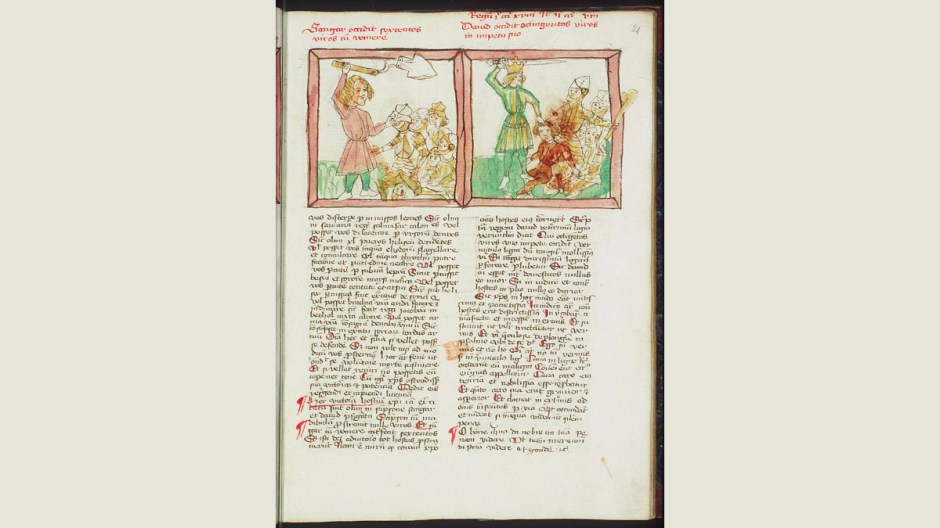
Enter Shamgar, an ordinary man with no special qualifications mentioned in the Bible. There was no dramatic calling like a burning bush or a blinding light. Yet God chose this everyday person to save Israel. Armed only with an ox goad, Shamgar struck down 600 Philistines and brought peace to the land.
Shamgar’s story teaches us that God’s word is always useful and profitable, even in the brief mentions that might seem unimportant at first glance. As it says in 2 Timothy 3:16, “All Scripture is God-breathed and is useful for teaching, rebuking, correcting and training in righteousness.” Every part of the Bible, including the short account of Shamgar, has something valuable to teach us.
This year, as we think about making changes in our lives, we should ask ourselves: “Am I where God wants me to be, and am I doing what God wants me to do?” Like Shamgar, we may feel ordinary or ill-equipped, but God can use us in mighty ways if we’re willing to answer His call. We don’t need special qualifications or dramatic experiences – just a willingness to serve where God places us
The book of Acts gives a remarkable account of the day of Pentecost in chapter 2. This event marked a pivotal moment in history when God sent His Spirit in an extraordinary way. The apostles boldly proclaimed God’s message, and the world around them paid attention. Some people today suggest that every church gathering should aim to recreate such experiences. But is that expectation realistic given the unique context of Pentecost? And how should this passage influence the church now?
Pentecost was an exceptional, one-time event. It was not intended to set a recurring pattern for Christian worship. The Holy Spirit visibly descended like tongues of fire, and the apostles spoke in real, identifiable languages—not meaningless sounds but known languages that people understood in their native tongues. Acts 2 makes it clear that this miraculous sign served a distinct purpose: to demonstrate the Spirit’s arrival and signal the beginning of the church.
Similar events occurred later in Acts, such as among the Gentiles in chapter 8 and followers of John the Baptist. These moments introduced different groups into the church but were not meant to define the regular Christian experience. These miraculous signs were God’s way of confirming His work during that unique time in history.
While Christians today may not witness such dramatic signs, the message of Pentecost remains vital. It reminds us that God’s Spirit empowers His church to proclaim the gospel to all nations. As Paul wrote, “For in one Spirit we were all baptised into one body” (1 Corinthians 12:13). The church’s focus should be on living out this unity and sharing God’s word, not on seeking miraculous signs as a norm.




 Texas Gospel Canada Southern Gospel Radio