

JOHN COPIC
The first chapter of Genesis describes how God began His creative work. On the first day, He said, “Let there be light,” and there was light. While some say God created time in the first verse of the first chapter, where God created the Heaven’s and the Earth, Others say it happened specifically with the creation of light. They see this as more than the creation of physical light. They believe this moment marked the beginning of time itself. The separation of light from darkness established a pattern of day and night, a rhythm that defines how we experience life. This passage, they say, shows that time is not random or accidental; it is part of God’s good design. I won’t pretend to know for sure; the Bible doesn’t speak to the science of all this. But there are some solid thoughts on this.
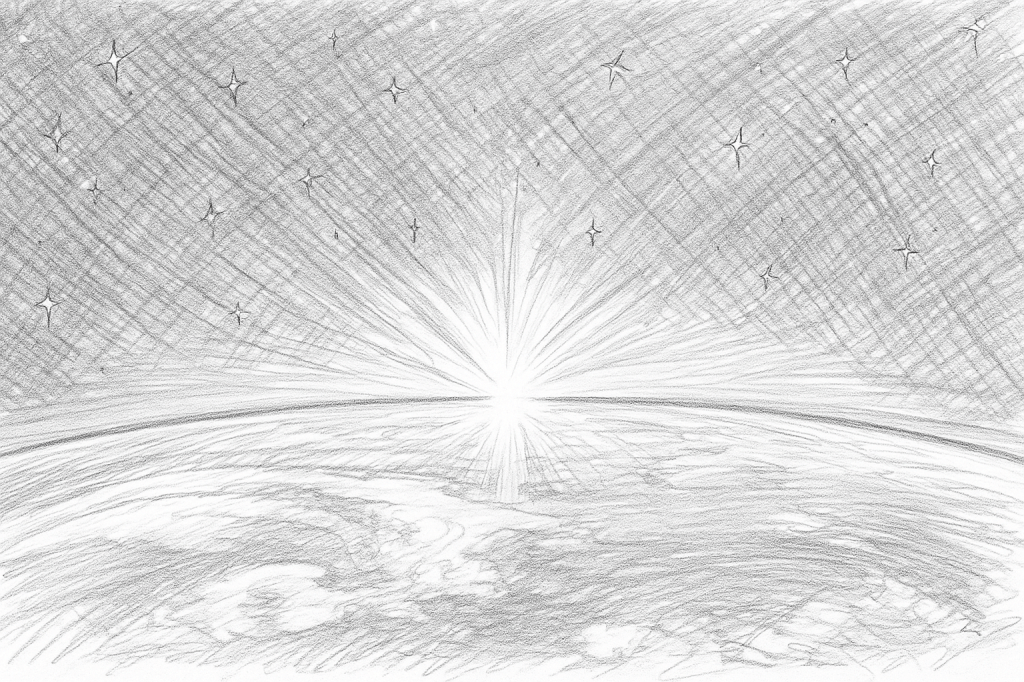
In the account of creation, the Bible is not only describing physical matter but also the establishment of order and purpose. When God called the light “day” and the darkness “night,” He defined what a day is, a measurable period of time. The first day is described using a cardinal number, meaning it sets a standard. The days that follow are described using ordinal numbers, like second and third, showing a sequence built on the definition of that first day. Some say this suggests that God created real, 24-hour days, not long ages or eras, which challenges ideas that combine evolution with divine creation. I respectfully disagree. I read this as God creating with order. If we were to have exact length definitions, I think the Bible would spell this out. But that’s me talking, not the Bible. Shouldn’t we all be careful not to add to the Bible by portraying what we believe about the Word to be the Word itself?
Time, therefore, is one of the first gifts God gave to creation. It is the foundation for everything that follows. Space and matter exist within it. Yet Scripture also reminds us that God Himself is outside of time. He is eternal, not bound by hours or days. I’ve heard pop physicists on TV speak of Time and the physical universe being parts of the same thing. If God created the universe, I would expect him to be independent of it; and that includes being independent of time. Still, He entered into time through Jesus Christ. The eternal Son became human and lived within the limits of our world. Because of this, we can know God personally. Our salvation happens in time because Christ lived, died, and rose again within history. This shows that time is not only a physical reality but also a means through which God reveals His love and redemption.
Our hope for years to come,
Our shelter from the stormy blast,
And our eternal home.
A thousand ages in Thy sight
Are like an evening gone;
Short as the watch that ends the night
Before the rising sun.
The Bible often speaks of God’s relationship to time. In 2 Peter 3:8, it says that with the Lord, a day is like a thousand years and a thousand years like a day. This idea also appears in the Psalms, where it is said that a thousand years to God are like a night that has passed. These passages remind us that while time feels long or short to us, God sees all of it at once. Time belongs to Him. It is His creation and under His control.
Scripture also teaches that everything has its appointed time. In Ecclesiastes 3, we read that there is a time for every purpose under heaven, a time to be born, a time to die, a time to weep, and a time to laugh. Life includes both joy and hardship, and God has made all of it part of His plan. The writer of Ecclesiastes also says that God has “put eternity into the human heart.” Unlike other creatures, people are aware of time passing and sense that there is something beyond it. This awareness calls us to think about eternity and what comes after this life.
The Bible gives several examples where God uses time in miraculous ways. In the book of Joshua, God made the sun stand still so His people could finish their battle. In the days of King Hezekiah, God caused the shadow on a sundial to move backward as a sign that He would deliver Judah. In the New Testament, Jesus walked on water, and when He entered the disciples’ boat, they suddenly reached the shore. Later, the deacon Philip was transported instantly from one place to another after baptizing the Ethiopian official. These moments show that God, who made time, can alter it whenever He chooses.
If time did not exist, change would be impossible. There would be no beginning or end, no growth, no redemption. But in time, God works out His plan. Salvation happens here, in the world we live in, not in some distant spiritual realm. Even the angels, who exist outside our physical world, do not experience salvation as humans do. They look upon it with wonder because it is something unique to us. It is God’s grace shown within time and history.
Time itself reminds us of our need for God. It shows that life on earth is temporary. We all have a past filled with sin and a future that can hold hope through Christ. The passing of time gives us the opportunity to repent, grow, and look forward to eternal life. Even death, which feels like the end, is only the beginning of life in God’s presence.
When we look back at the first day of creation, we see that the creation of time was not a small detail. It was a gift that allows life, history, and salvation to unfold. Time is not our enemy, though it may feel that way when we face pain or loss. It is part of God’s good creation, meant to bring order, meaning, and the opportunity to know Him more fully.
for He says,
2 Corinthians 6:2
“At a favorable time I listened to you,
And on a day of salvation I helped you.”
 Texas Gospel Canada Southern Gospel Radio